What Is an Appositive Phrase? Explained Simply
June 8, 2026 · 15 min read
An appositive phrase is a noun phrase placed next to another noun phrase to rename, identify, or explain it. You'll often notice it through punctuation, because extra information usually takes commas, while essential identification does not.
If you're learning English, you've probably had this moment. You start a sentence, then you want to add one small detail to make your meaning clearer. Maybe you say, “My friend... the one from Brazil... helped me.” You know what you mean, but you're not sure how to build the sentence smoothly.
That's where appositives help. An appositive phrase is a noun or noun phrase that renames another noun right beside it. It lets you add detail in a short, natural way. When you understand this pattern, your English can sound clearer, more organised, and more natural in conversation.
Table of Contents
- What Is an Appositive Phrase and Why It Helps Your Speaking
- The Core Idea Explained with a Simple Analogy
- Essential vs Extra Information and The Comma Rule
- Appositive Phrases in Action with Everyday Examples
- Common Mistakes and How to Correct Them
- Now Practice Speaking with Appositive Phrases
What Is an Appositive Phrase and Why It Helps Your Speaking
You use this grammar point more often than you may think. If you say, “My sister, a doctor, works in London,” the phrase a doctor renames my sister. It gives the listener fast, clear information without starting a whole new sentence.

This matters for speaking because appositives help you add detail without sounding slow or repetitive. Compare these two versions:
- “This is Anna. She is my manager.”
- “This is Anna, my manager.”
The second one feels smoother. It sounds closer to how people often speak in real life.
Why learners find it useful
When you speak, you don't always want long explanations. Sometimes you need a short label that helps the listener understand quickly.
Here are a few common speaking situations where appositives are useful:
- Introducing people: “James, my neighbour, lent me his bike.”
- Explaining places: “Paris, the capital of France, is expensive.”
- Describing your job: “I work as a tutor, a role I really enjoy.”
- Talking about interests: “My favourite hobby, photography, helps me relax.”
Practical rule: If you can add a short noun phrase to rename something, you may be able to use an appositive.
Appositives are not a small or unusual grammar topic. They became a standard topic in school and reference grammar as English punctuation rules were codified in the 19th and 20th centuries, and they are still treated as a core syntax and punctuation skill in widely used educational resources, as noted in this overview of appositives in modern grammar teaching.
Clear speaking also depends on clear sounds. If you want to improve both grammar and pronunciation together, this guide to English vowel pronunciation is a helpful next step.
How this helps you sound more natural
Native speakers often add small details inside one sentence instead of making several short sentences. Appositives help you do that. They make your speech more connected.
They also help you organise information. First, you name the person or thing. Then, right beside it, you add the short explanation. That pattern is easy for listeners to follow.
The Core Idea Explained with a Simple Analogy
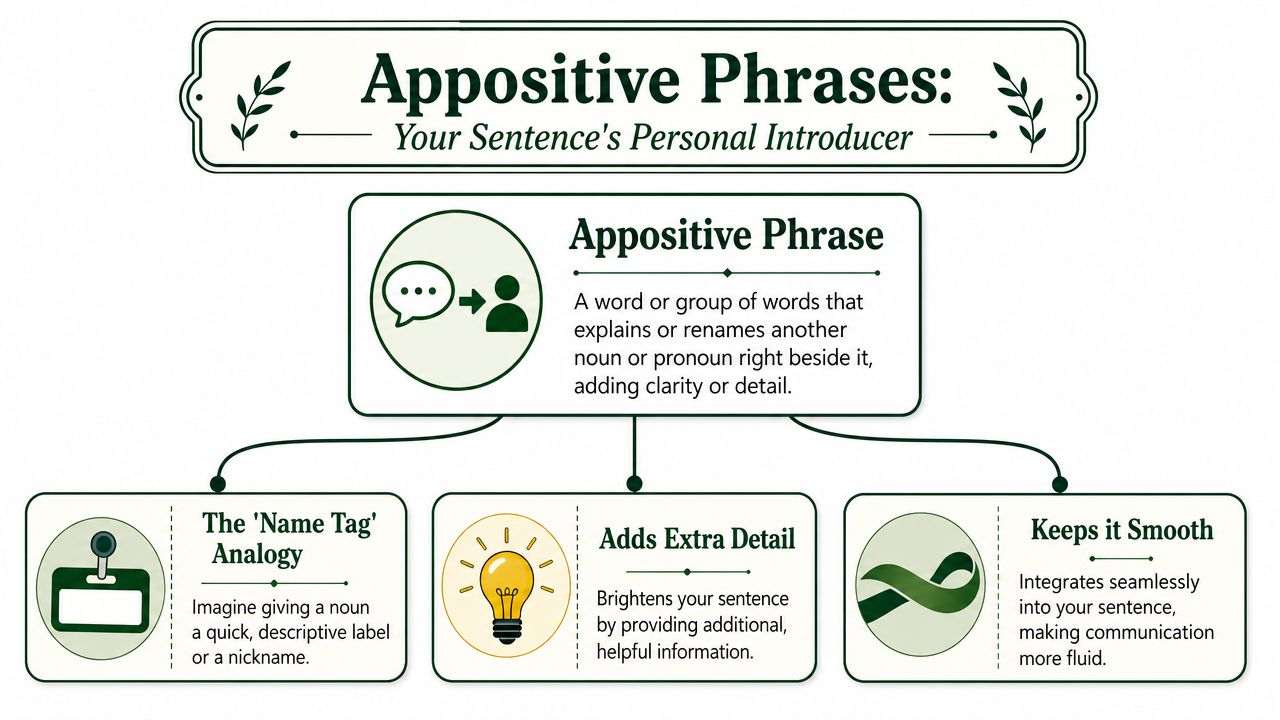
Think of an appositive phrase as a name tag.
You have a noun, like my friend. Then you attach a little name tag to it, like the chef or Sarah. That second part stands beside the first part and tells us who or what it is.
The name tag idea
Look at this sentence:
My friend Sarah called me.
- Main noun phrase: My friend
- Appositive: Sarah
Here, Sarah renames my friend.
Now look at this one:
Sarah, my friend from college, called me.
- Main noun phrase: Sarah
- Appositive: my friend from college
This time, the appositive gives more information about Sarah.
In both cases, the two noun phrases point to the same person. That is the core idea.
What an appositive is doing
An appositive phrase is a noun phrase that follows, and sometimes precedes, another noun phrase to rename or explain it. In grammar terms, it creates a relationship of apposition between the earlier noun and the added noun phrase, as explained in this clear definition of appositive phrases.
You don't need to remember the word apposition to use appositives well. What matters is this simple question:
Do both parts name the same person, place, thing, or idea?
If the answer is yes, you may be looking at an appositive.
Both parts point to the same thing. One names it, and the other renames it.
Quick pattern check
Here's a simple way to spot one:
| Sentence | Main noun | Appositive phrase |
|---|---|---|
| My teacher Mr Khan is very patient. | my teacher | Mr Khan |
| London, a busy city, attracts many visitors. | London | a busy city |
| A talented cook, my aunt makes amazing soup. | my aunt | A talented cook |
Notice something important. An appositive is not a full clause. It doesn't have its own complete verb idea. It works like a compact label.
For example:
- Appositive: “My brother, a nurse, lives nearby.”
- Not an appositive: “My brother, who is a nurse, lives nearby.”
The second example uses a clause, not just a noun phrase.
A speaking tip
Try building sentences in two small parts:
- Say the noun.
- Add a short label beside it.
For example:
- “My city, a quiet place, is perfect for walks.”
- “My cousin Ali just moved to Canada.”
- “Chocolate cake, my favourite dessert, is hard to refuse.”
This pattern is very useful in speaking because it helps you add detail fast, without losing your flow.
Essential vs Extra Information and The Comma Rule
Many learners get confused. The big question is not only what is an appositive phrase, but also when do you use commas?
The easiest way to think about it is this:
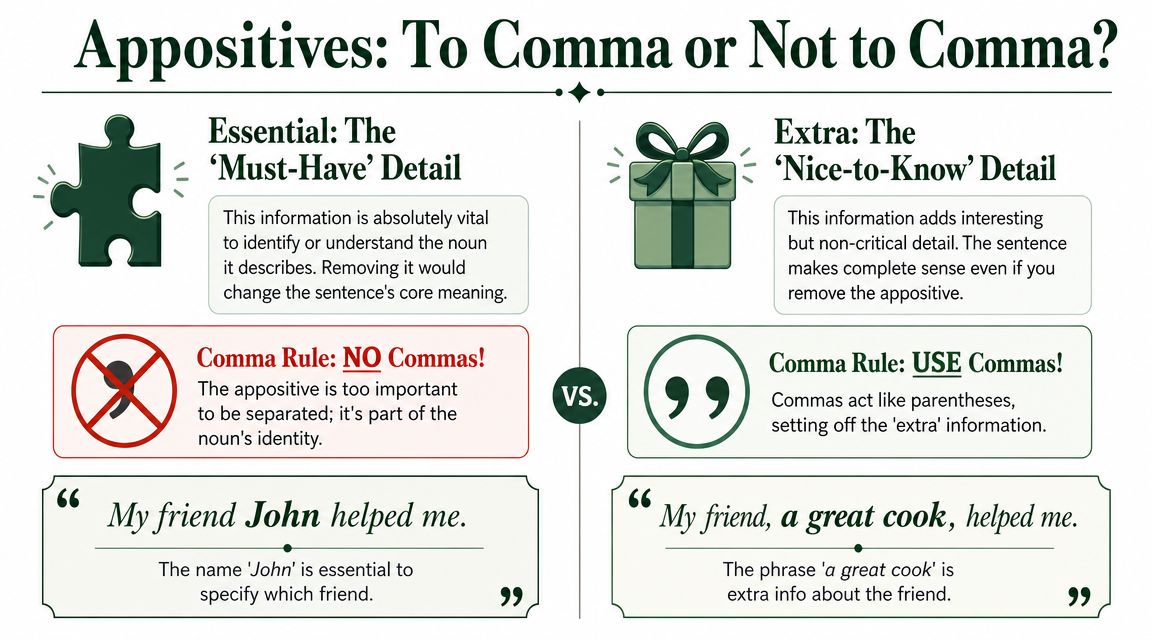
- Essential information means the listener needs it to know exactly who or what you mean.
- Extra information means the listener already knows, and you are only adding more detail.
Essential information
If the appositive is necessary to identify the noun, don't use commas.
Example:
My friend John helped me.
Why no commas? Because John tells us which friend. Without it, my friend is too general.
More examples:
- “The singer Adele has a distinctive voice.”
- “My colleague Emma speaks Spanish.”
- “Author George Orwell wrote political fiction.”
In these sentences, the second noun is important for identification.
Extra information
If the appositive only adds extra detail, use commas around it.
Example:
My brother, David, lives in Manchester.
Why commas? Because the speaker is already clearly referring to my brother. David is extra information.
More examples:
- “Mr Patel, our maths teacher, is absent today.”
- “Rome, the capital of Italy, is full of history.”
- “My laptop, a gift from my uncle, still works well.”
According to this guide to appositives and punctuation, punctuation changes by function: nonrestrictive appositives are usually set off by commas, dashes, or parentheses, while restrictive appositives are not. The important point for learners is that punctuation shows whether the phrase is optional extra information or essential identification.
A simple test you can use
Ask yourself:
Can I remove the appositive and still know exactly what the speaker means?
If yes, it's probably extra information, so commas are likely needed.
If no, it's probably essential information, so commas are likely not needed.
| Type | Meaning | Commas |
|---|---|---|
| Essential | Needed to identify the noun | No |
| Extra | Adds detail, but not needed | Yes |
If the phrase feels like a side note, commas usually help. If it feels like part of the name itself, commas usually don't.
Compare these pairs carefully
These pairs show how commas can change meaning:
- My brother David is tall.
- My brother, David, is tall.
In the first sentence, David helps identify which brother.
In the second sentence, David is just added information.
Another pair:
- The writer Maya spoke at the event.
- Maya, the writer, spoke at the event.
The meaning changes because the relationship changes. In one sentence, the appositive identifies. In the other, it comments.
A speaking reminder
When you speak, people can hear pauses even if they can't see commas. If the information is extra, you often pause a little before and after it.
Say these aloud:
- “My boss, a very calm person, solved the problem.”
- “My boss Linda solved the problem.”
That small pause can help your spoken English sound more natural and easier to follow.
Appositive Phrases in Action with Everyday Examples
Examples make this grammar point easier to feel. Once you see a few patterns, appositives stop looking complicated and start looking useful.
In the middle of a sentence
This is the most common position.
- “My teacher, a patient man, answered every question.”
- “The hotel manager, my cousin, gave us a warm welcome.”
- “Our neighbour, a retired engineer, grows beautiful roses.”
- “This soup, my grandmother's recipe, tastes amazing.”
These work well because the appositive slips into the sentence smoothly.
If you want more everyday English for hospitality situations, this lesson on customer service in a hotel gives useful real-life language.
At the end of a sentence
An appositive can also come after the main idea.
- “I met my best friend, Sara.”
- “They visited their dream city, Tokyo.”
- “He wants to become something exciting, a film director.”
- “We ate my favourite meal, spicy noodles.”
This pattern is helpful when you want to keep the sentence simple, then add a short label at the end.
At the beginning of a sentence
This form is less common for learners, but it's useful and elegant.
- “A skilled designer, Nina creates beautiful websites.”
- “A small seaside town, Brighton feels lively in summer.”
- “My oldest friend, Daniel always gives honest advice.”
This position can sound more formal in writing, but you'll still hear it in careful speech and presentations.
Try reading the sentence once without the appositive, then again with it. You'll hear how the extra label adds colour and precision.
Useful speaking patterns to copy
Memorising full grammar rules can feel heavy. Copying patterns is often easier.
Try these sentence frames:
- “My friend ___, a ___, ___.”
- “___, my favourite ___, ___.”
- “A ___, my town/city/job ___.”
- “I spoke to ___, the person who/ the manager/ my neighbour.”
You can practise with topics from daily life:
- Family: “My aunt, a great cook, makes fresh bread.”
- Work: “My manager Sofia gave clear instructions.”
- Travel: “Kyoto, a beautiful city, impressed me.”
- Hobbies: “Chess, my favourite game, teaches patience.”
When you repeat these patterns aloud, they start to feel natural.
Common Mistakes and How to Correct Them
Most learners don't struggle with the idea of appositives. They struggle with deciding what kind of phrase they are using and how to punctuate it.
Mistake one, using commas when the information is essential
Problem:
“My friend, John, helped me yesterday.”
This might be wrong if you have more than one friend and need John to identify which one.
Better:
“My friend John helped me yesterday.”
Why? Because John is essential identification here.
Mistake two, forgetting commas around extra information
Problem:
“My car a small blue hatchback needs repairs.”
Better:
“My car, a small blue hatchback, needs repairs.”
If the phrase is extra detail, the commas help the reader and listener hear the structure.
Mistake three, using a full clause instead of a noun phrase
An appositive should be a noun or noun phrase, not a full clause with its own main verb.
Problem:
“My sister, she works in finance, lives abroad.”
Better options:
- “My sister, a finance worker, lives abroad.”
- “My sister, who works in finance, lives abroad.”
The first uses an appositive. The second uses a clause. Both are possible, but they are different structures.
Mistake four, making the phrase too long
Very long appositives can make speech hard to follow.
Hard to process:
“My neighbour, a friendly man from the flat upstairs who loves jazz and cooks every evening, invited me for dinner.”
Clearer for speech:
“My neighbour, a friendly man from upstairs, invited me for dinner.”
Or split it into two sentences:
- “My neighbour invited me for dinner. He loves jazz and cooks every evening.”
A quick self-check
Use these questions before you finish your sentence:
- Same person or thing? If not, it's probably not an appositive.
- Essential or extra? That tells you about commas.
- Short enough to say easily? If not, shorten it.
- Noun phrase or full clause? Keep the form clear.
Now Practice Speaking with Appositive Phrases
Reading about grammar helps. Saying it out loud helps more.
If you want appositives to become part of your real English, practise them in short spoken answers. Don't try to make perfect sentences first. Start with one noun and one label.
Speaking prompts you can use today
Say each answer aloud. Try to include at least one appositive phrase.
- Talk about a person: “Describe a friend, a family member, or a teacher.”
- Talk about your job or studies: “Describe your work, a course, or a task you do often.”
- Talk about food: “Describe your favourite dish, a snack, or a meal from your country.”
- Talk about a place: “Describe your hometown, a city, or a place you want to visit.”
- Talk about a hobby: “Describe an activity, a sport, or a creative interest.”
Example answers:
- “My cousin Lea, a very practical person, always gives useful advice.”
- “Accounting, my current field, requires careful attention.”
- “Biryani, a rice dish with spices, is one of my favourite meals.”
- “Lisbon, a coastal city, feels both calm and lively.”
A simple three-step drill
Choose a noun
For example: my friend, my city, my job, tennis.Add a short label
For example: a nurse, a crowded place, a challenge, my favourite sport.Say the full sentence aloud
“My job, a daily challenge, teaches me patience.”
Speak slowly enough to hear the pauses. If the appositive is extra information, your voice will often pause around it naturally.
If you're preparing for a speaking exam, these prompts can also blend well with structured test practice. This guide to an IELTS speaking practice test can give you more ideas for longer spoken answers.
The best way to learn this grammar point is to use it while talking about your own life. That makes the structure more memorable, and it helps you notice when a sentence sounds clear and when it sounds crowded.
If you want a calm place to practise speaking with honest feedback, try Verse. You can speak out loud, build sentences with appositive phrases in real conversations, and get clear notes on grammar, fluency, vocabulary, and pronunciation. There's also a free no-signup demo if you want to see how it feels before committing.