Master English Vowel Pronunciation
You might know this feeling well. You choose the right words. Your grammar is fine. But when you speak, the other person says, “Sorry?” or asks you to repeat one simple word.
Very often, the hidden problem is not grammar. It's the vowel.
English vowels can feel slippery because the same letter can sound different in different words. That doesn't mean you're bad at languages. It means English spelling is a messy guide for speaking. The good news is that vowels are not magic. They are physical sounds you can learn to feel in your mouth, hear more clearly, and practise out loud.
Table of Contents
- Why English Vowels Can Be So Confusing
- The Three Controls for Your Vowel Sound System
- A Practical Tour of Key English Vowels
- Common Pronunciation Mistakes and How to Fix Them
- Your Action Plan for Vowel Practice
- Putting It All Together with a Practice Partner
- Frequently Asked Questions About Vowels
Why English Vowels Can Be So Confusing
A learner can say “I sent the file yesterday” with correct grammar and still get stuck on one word like “sent,” “sheet,” or “work.” That's frustrating because the mistake feels small, but the effect is big. One vowel can change the whole word.
English spelling often looks like a code with missing instructions. In some languages, one letter usually gives you one clear sound. In English, the vowel letter is only part of the story. The sounds around it also matter.
One study on English words found that the vowel in 44% of real words was long, but only 26% in similar-sounding nonsense words, which shows that familiar word patterns and surrounding sounds affect pronunciation, not spelling alone (study on vowel patterns in real words and nonwords).
That helps explain why learners often ask, “Why is this word pronounced like that?” The honest answer is that English listeners do not process speech letter by letter. They also expect patterns from words they already know.
English vowels make more sense when you stop asking only, “What letter is this?” and start asking, “What is my mouth doing in this word?”
Why rules seem to break
Here are a few reasons vowels feel inconsistent:
- Spelling is only a clue. The written vowel doesn't fully tell you how long or relaxed the sound should be.
- Nearby consonants matter. A vowel can change depending on the sounds after it.
- Stress matters too. A stressed syllable is usually clearer and stronger. An unstressed syllable often becomes weaker.
- Your first language helps and causes problems. It helps because you already know how vowels work in general. It causes problems when you use one home-language vowel for several different English vowels.
Many learners think they need to memorise more rules. Usually, they need something simpler. They need to learn to notice a few physical differences and practise them out loud. Once you do that, English vowel pronunciation starts to feel less random and more manageable.
The Three Controls for Your Vowel Sound System
A lot of pronunciation charts look too academic. If they scare you, ignore the chart for a moment and think of your mouth like a small control panel. For most vowel work, you can focus on three main controls.
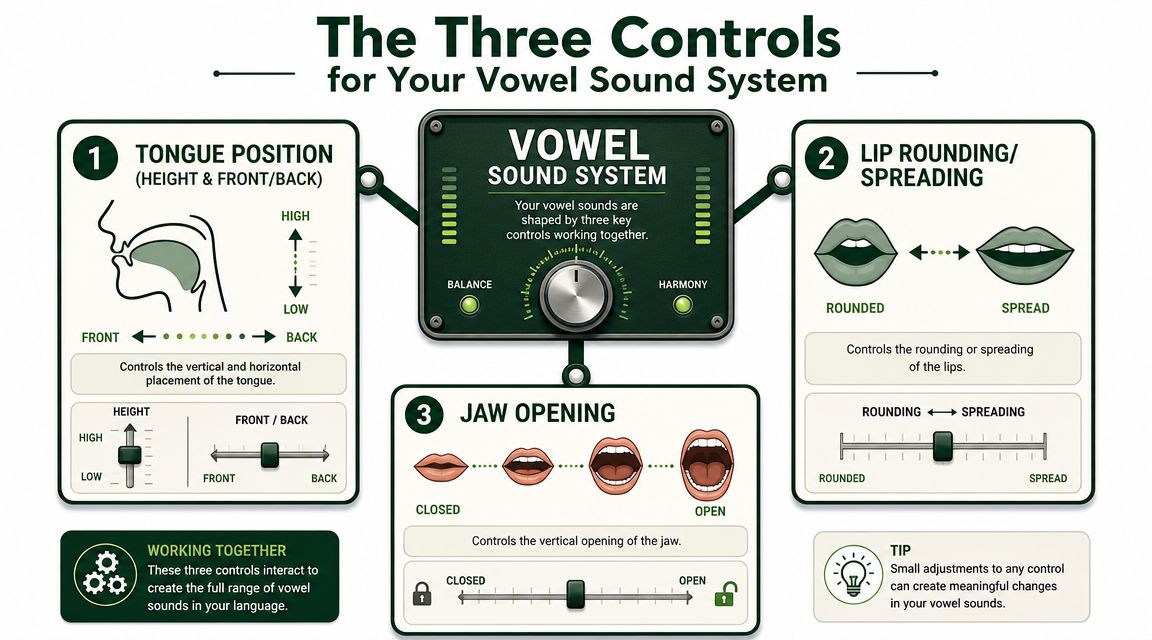
Research on vowel production points to the same core idea. English vowels depend on tongue height, tongue frontness or backness, lip rounding, and vowel length. Learners often struggle when they map several English vowels onto one sound from their first language instead of changing these parts separately (overview of articulatory variables in English vowel production).
Control 1, tongue position
Your tongue is the main shape-maker.
It moves in two useful ways:
- High or low
- Front or back
Say “ee” as in sheep. Your tongue is high and quite forward.
Now say “ah” as in father. Your tongue drops lower and sits more openly in the mouth.
Try this slowly:
- Say “ee”.
- Say “ah”.
- Repeat and notice the tongue movement.
- Put a hand under your chin and feel how the mouth opens more for “ah”.
Two vowels may sound similar to your ear, but a critical difference in tongue position can change the word.
Control 2, lip shape
Your lips also help create the vowel.
Some vowels use more rounded lips, like a small circle. Others use spread lips, almost like a light smile. Compare these:
| Vowel feeling | Lip shape | Example word |
|---|---|---|
| More spread | slight smile | sheep |
| More relaxed | neutral lips | ship |
| More rounded | small circle | food |
| More open and relaxed | wider opening | hot |
If a vowel sounds wrong, don't only listen harder. Check your lips in a mirror. Sometimes the fix is visible.
Practical rule: If two English vowels sound almost the same to you, test your lips and tongue separately. One of them is often the missing difference.
Control 3, jaw opening and tension
This third control is often forgotten, but it helps a lot. Your jaw changes how open the vowel is, and your mouth tension changes how “tight” or “relaxed” the sound feels.
For example, some learners say /ʊ/ and /uː/ as if they were one sound. But the more relaxed vowel and the tenser vowel don't feel the same in the mouth. The same source notes that some learners, including many Spanish speakers, find /ʊ/ difficult because it is more relaxed than their native /u/, while /uː/ is closer but still differs in tenseness.
A useful self-check:
- Too tense? Your mouth may look frozen.
- Too relaxed? The vowel may lose its shape.
- Jaw too closed? The sound may become too narrow.
- Jaw too open? The sound may shift into another vowel.
Don't try to control everything at once. Start with one sound pair. Feel the tongue. Then the lips. Then the jaw. That's enough.
A Practical Tour of Key English Vowels
The fastest way to improve english vowel pronunciation is to compare sounds that are close together. These are often called minimal pairs, which means two words where one sound change creates a new word.
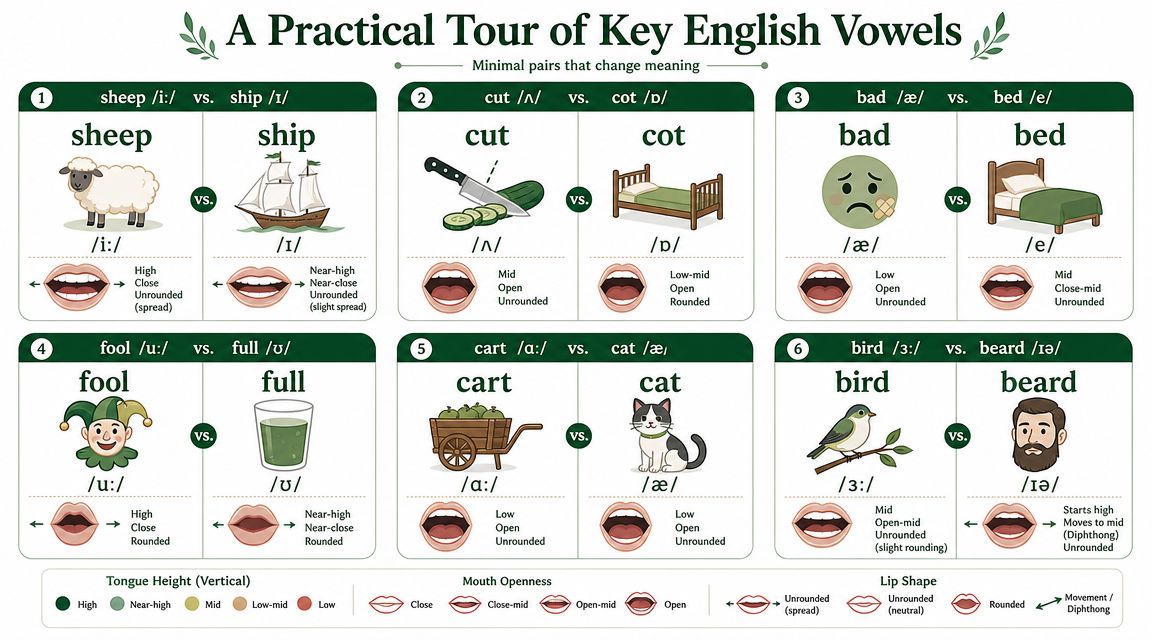
You don't need to memorise every symbol. You only need to notice what changes in your mouth.
Long and short pairs that change meaning
Start with a famous pair:
- sheep
- ship
For sheep, make your lips a little wider, keep the tongue high and forward, and hold the vowel a bit longer.
For ship, relax more. The tongue is still fairly high, but not as tense. The sound is shorter and softer.
Now try these pairs:
- pool and pull
- cart and cut
- bed and bad
- full and fool
A simple way to practise each pair:
- Say the first word slowly.
- Freeze your mouth for a second.
- Say the second word.
- Ask, “What changed, tongue, lips, jaw, or length?”
That question is more useful than “Why can't I hear it?”
A mouth-feel guide
Here is a simple guide you can use while practising:
For /iː/ as in sheep
- lips slightly spread
- tongue high and forward
- more tension
- hold it a little longer
For /ɪ/ as in ship
- lips more neutral
- tongue slightly lower
- more relaxed
- shorter sound
For /uː/ as in food
- lips rounded
- tongue high and back
- firmer shape
For /ʊ/ as in good
- lips rounded, but less tightly
- more relaxed mouth
- shorter, looser sound
For /æ/ as in bad
- jaw opens more
- front of tongue stays low
- bright, open sound
For /ʌ/ as in cut
- jaw less open than /æ/
- central tongue position
- shorter, less wide sound
If a word still feels hard, exaggerate it first. Big mouth movement is a good training step. You can make it smaller later.
The schwa, the quiet vowel in everyday speech
The schwa is the relaxed vowel sound you hear in many unstressed syllables. It often sounds like a quick, soft “uh.” It appears in words like about, sofa, and problem.
Learners often miss schwa because they try to pronounce every written vowel clearly. Native-like speech usually doesn't work that way. Many unstressed vowels become weaker.
That's why a word may look long on the page but sound lighter when spoken. If you stress every syllable equally, your English can sound careful but unnatural.
Try this with about:
- First say it very slowly from spelling, “a-bout.”
- Then say it naturally, with the first vowel weak: “uh-BOUT.”
That weak first sound is doing important work. It makes your rhythm smoother and your word stress clearer.
Common Pronunciation Mistakes and How to Fix Them
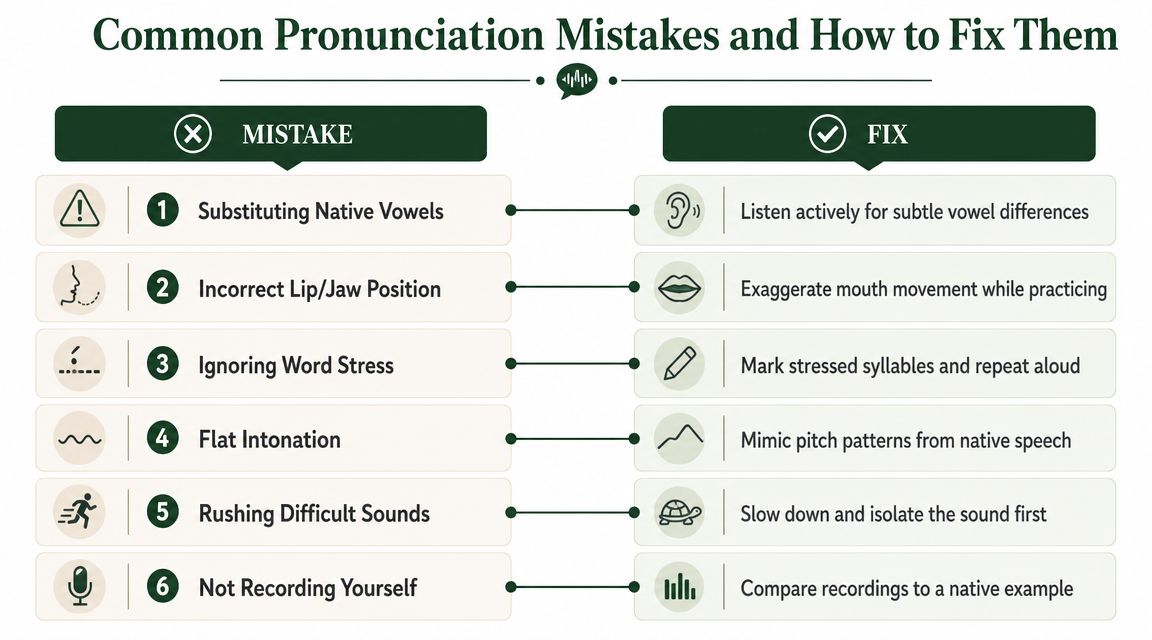
Most vowel mistakes are not random. They follow patterns. Once you know the pattern, the fix becomes easier.
When one home language vowel tries to do too much
A common problem is using one familiar vowel for several English sounds.
For example, a learner may pronounce both ship and sheep with almost the same vowel. Or pull and pool may come out alike. This happens because the speaker hears both English sounds as one category from their first language.
Try a three-part fix:
Hear it
- Listen to one pair only, not ten pairs together.
- Repeat the pair several times and focus on one change.
See it
- Use a mirror.
- Watch whether your lips spread, round, or stay neutral.
Feel it
- Put your fingers lightly on your jaw or cheeks.
- Notice if one sound is tenser or more open.
When vowel length gets ignored
Many learners focus only on vowel quality, meaning the shape of the sound, and forget duration, meaning how long the sound lasts.
That matters. One acoustic study reported a short-to-long vowel ratio of 1:2.2 for higher-level speakers and 1:2.4 for mid-level speakers, showing that timing differences are part of clearer pronunciation (acoustic analysis of English vowel duration).
This doesn't mean you should stretch every long vowel dramatically. It means length is one cue that listeners use.
A quick fix:
| Problem | What it sounds like | What to do |
|---|---|---|
| Long and short vowels sound equal | speech sounds flat or unclear | hold the longer vowel a little more |
| Every vowel is very short | words may blur together | slow down and let stressed vowels breathe |
| Every vowel is very long | speech sounds heavy | shorten unstressed vowels |
Clear vowels are not only about mouth shape. Timing matters too.
Accent differences are normal
You may notice that British and American speakers don't always use exactly the same vowel quality or length. That's normal. Your goal doesn't have to be copying one person perfectly.
If you're learning British pronunciation, stay consistent with a British model as much as you can. If you mix accents sometimes, that's not a failure. Clarity matters more than sounding identical to one region.
For learners who want British-accent practice, it helps to use feedback that points out vowel length, mouth shape, and word stress together, not as separate topics.
Your Action Plan for Vowel Practice
Knowing about vowels is useful. Saying them out loud is what changes your speech.
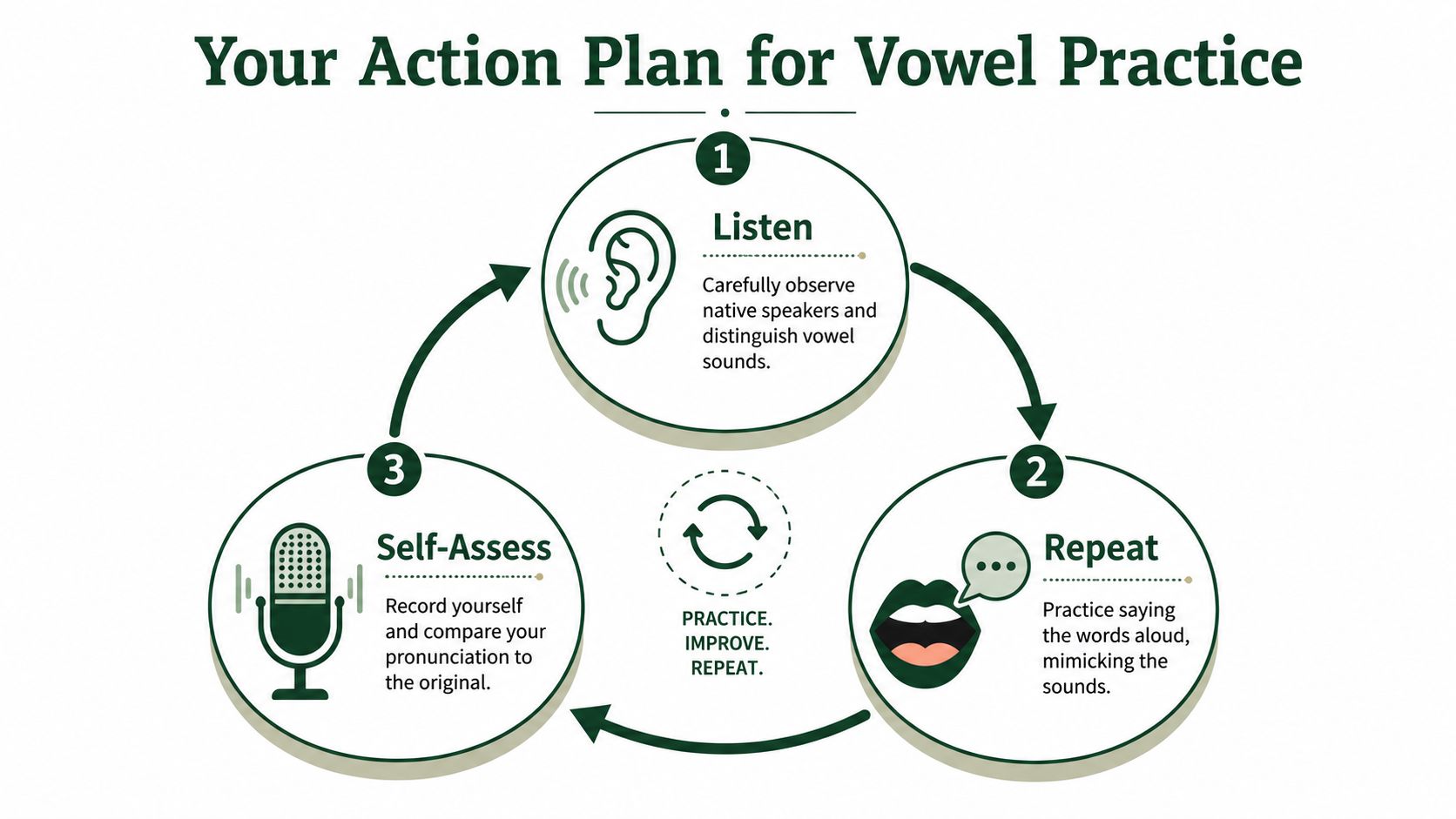
A simple practice loop
Use this loop every day:
Listen
Pick one word pair or one short sentence. Listen carefully to the target vowel. Don't try to copy everything at once.
Speak
Repeat it out loud. Make the mouth movement a little bigger than normal. This helps build muscle memory.
Compare
Record yourself and listen back. Ask one question only: “Does my vowel sound too long, too short, too tense, too relaxed, too open, or too closed?”
This loop works because it keeps your attention narrow. When learners try to fix grammar, speed, vocabulary, and pronunciation all at once, they usually miss the vowel again.
A short daily routine
Here's a simple routine you can keep doing:
First minute
- Choose one pair, like ship and sheep.
- Say each word slowly and clearly.
Next few minutes
- Put the words into short phrases.
- Try “big ship” and “white sheep.”
Last part
- Use the words in your own sentence.
- Record yourself once.
- Listen once, not ten times.
A practical tool can make this easier. If you want a private space for spoken practice, Verse's conversation practice approach lets you speak, get a transcript, and receive feedback on pronunciation, grammar, vocabulary, and fluency after each turn. Use any tool like that in a simple way. Focus on one vowel target per session.
A few good habits help more than long study sessions:
Keep it small
- One vowel pair is enough for a day.
Practise in phrases
- Words alone help, but phrases are closer to real speaking.
Repeat old targets
- Don't drop a sound after one successful day.
Speak before you feel ready
- Mouth training needs real use, not only silent reading.
Putting It All Together with a Practice Partner
Many learners wait until they “understand vowels properly” before they start speaking more. That usually slows progress. Pronunciation is a physical skill, so your mouth has to practise while your brain is still learning.
Small changes beat perfect theory
You do not need a perfect accent map in your head. You need a few dependable habits:
- notice one vowel contrast
- test the mouth shape
- say it in a phrase
- repeat it in conversation
That is enough to build progress.
If you only study vowel charts, you may recognise the sounds but still not produce them well under pressure. Conversation adds pressure in a useful way. It forces your mouth to choose a sound in real time.
Why conversation practice matters
A practice partner helps because you stop performing isolated sounds and start using them for meaning. That is when many learners finally notice which vowels break down during natural speech.
A human teacher can help. A language partner can help too. Some learners also prefer a private option where they can repeat words, pause, and try again without embarrassment. If that suits you, Verse is one place to practise spoken English with judgment-free feedback.
The important part is consistency. Speak often enough that new vowel positions stop feeling strange. At first, a corrected vowel may feel exaggerated or even wrong. Later, it starts to feel normal.
Frequently Asked Questions About Vowels
Do I need to learn IPA to improve my vowels
No. IPA can help, but it isn't required. Many learners improve through listening, mouth awareness, and repetition. If symbols help you, use them. If they confuse you, start with word pairs and mouth movement.
Why is schwa so important
Schwa is common in everyday English because many unstressed syllables become weak and relaxed. If you pronounce every vowel strongly, your speech may sound unnatural and your rhythm may feel heavy.
I can't hear my own mistakes. What should I do
Use short recordings. Compare one word or one sentence only. A mirror also helps because some mistakes are visible in the lips and jaw before they are easy to hear.
Should I focus on British or American vowels
Choose one main model if you can, especially for listening and repetition. But don't panic if your speech is mixed. Consistency helps, but clear communication matters more.
How long should I practise vowels each day
Short daily practice is better than occasional long sessions. A few focused minutes with one vowel target can be enough if you really listen, speak, and compare.
If you want a calm place to practise speaking out loud, Verse can help you work on vowels in real conversation, with honest feedback after each turn. You can try the demo, speak at your own pace, and use it as part of a simple daily practice habit.