Customer Service in a Hotel: A Guide for English Learners
You're at the front desk. A guest walks in after a long trip. They look tired. They want a quick check-in, a clean room, and a calm answer to their first question.
If you work in a hotel, moments like this happen all day. They may look small, but they shape the whole stay. That's what customer service in a hotel really means. It's not only about being polite. It's about helping guests feel safe, understood, and cared for from arrival to departure.
If English is not your first language, hotel service can feel stressful. You might know what you want to do, but not know the right words fast enough. The good news is that hotel English becomes much easier when you learn a few clear service habits and practise useful phrases out loud. You don't need perfect English. You need calm, simple, professional communication.
Table of Contents
- Welcome to the World of Hotel Hospitality
- Who Provides Customer Service in a Hotel
- Core Standards and Goals of Great Hotel Service
- How to Handle Common Guest Scenarios
- Essential English Phrases for Every Situation
- Practice Your Hotel English to Build Confidence
Welcome to the World of Hotel Hospitality
A hotel guest usually arrives with simple hopes. They want things to work. They want the room to be ready, the staff to be helpful, and the process to feel easy. Even when guests don't say much, they notice tone of voice, body language, and how clearly staff explain things.

Customer service in a hotel starts before a problem happens. A warm welcome, clear directions, and a confident answer can lower a guest's stress in seconds. That matters because travel often makes people tired, late, confused, or worried. Good service helps them relax.
For new staff, it helps to think like a guest. Ask yourself, “If I arrived here after a long journey, what would I need first?” Usually the answer is simple. A smile. Clear steps. Fast help. Respect.
Good hotel service feels easy for the guest, even when the staff are working hard in the background.
What guests remember most
Guests often remember feelings before details. They may forget your exact words, but they remember whether you sounded patient or cold. They remember whether you listened or interrupted. They remember whether someone took responsibility.
Here are the basic things guests look for:
- A good first impression, clean lobby, friendly welcome, clear signs.
- Easy communication, simple explanations, polite questions, no confusing language.
- Reliable help, staff who respond and follow through.
- Respect, especially when the guest is upset or tired.
Why this work matters
Hotels don't sell only rooms. They also sell peace of mind. A guest is paying for rest, comfort, and support during their stay. If service is poor, even a nice building can feel disappointing.
That's why many hospitality teams study service carefully and keep improving it. If you want to understand how guest communication skills fit into a bigger learning journey, the Verse English speaking platform is a useful place to explore.
Who Provides Customer Service in a Hotel
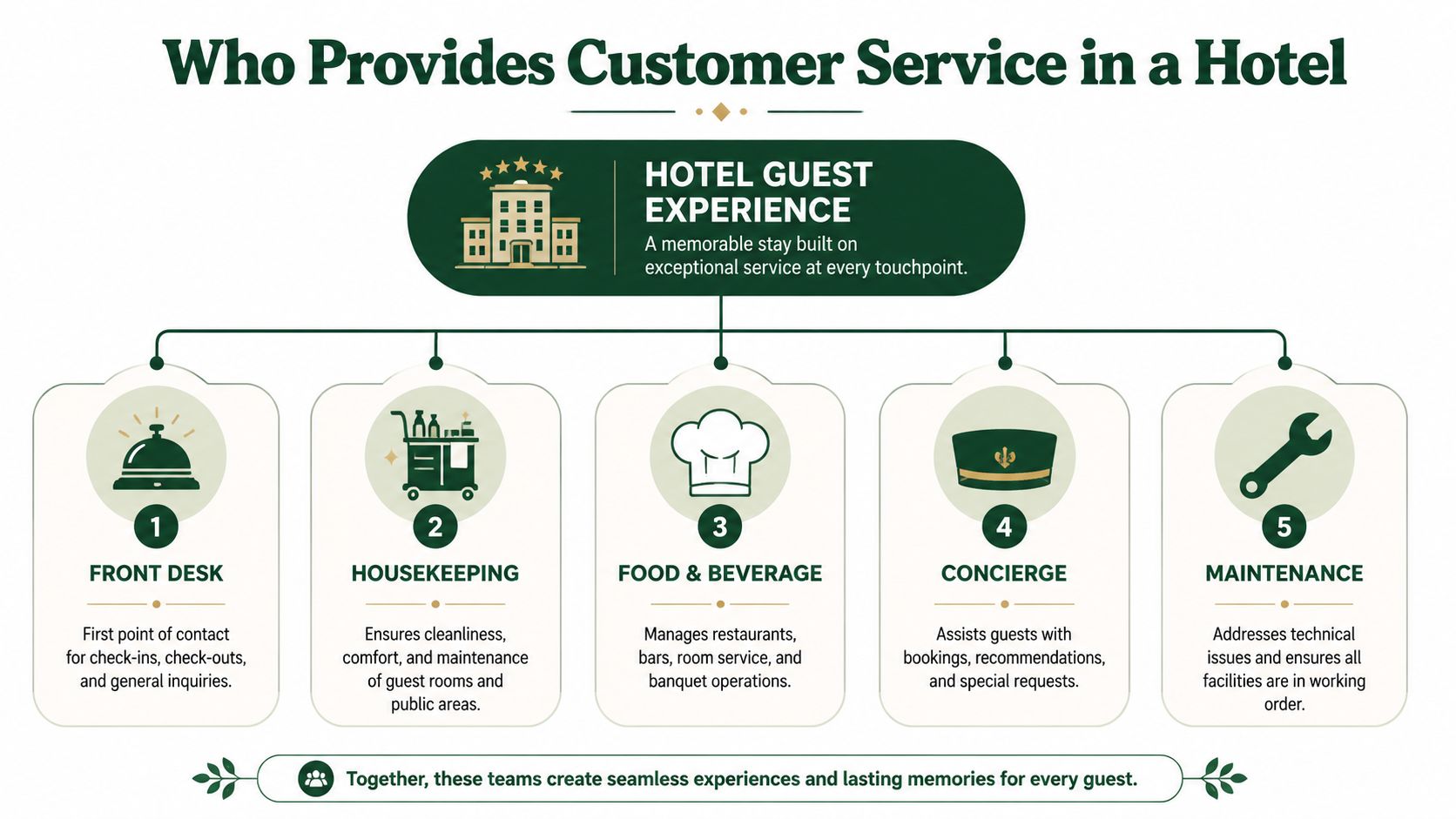
Many new staff think customer service means the front desk only. It doesn't. In a hotel, almost every department affects the guest experience. Some teams speak to guests directly. Others help behind the scenes, but their work still shapes how the stay feels.
Front desk
The front desk is usually the hotel's face. Staff here greet guests, check them in, answer questions, explain hotel rules, and solve many first-line problems. If a guest is confused about breakfast times, Wi-Fi, payment, or transport, the front desk often handles it first.
A strong front desk worker does two things well. They give information clearly, and they stay calm under pressure.
Example:
A guest arrives early and their room isn't ready. A weak answer is, “Check-in is later.” A better answer is, “Your room isn't ready yet, but I can store your luggage and let you know as soon as it's available.”
Housekeeping
Housekeeping is not “just cleaning.” This team protects comfort, hygiene, and trust. A tidy room tells the guest the hotel is organized and careful. In a period when guests became more sensitive to value, room condition, cleanliness, and amenities mattered strongly, especially with the U.S. hotel room average daily rate reaching a record $158.67 in 2024, according to the J.D. Power North America hotel guest satisfaction study.
That matters for your English too. If you work in housekeeping, you may need phrases like, “Would you like fresh towels?” or “I'm sorry, I'll report that maintenance issue right away.”
Food and beverage
Restaurant, breakfast, bar, banquet, and room service staff also provide customer service in a hotel. They manage timing, accuracy, and guest comfort. A polite breakfast server can improve a guest's whole morning. A careless room service delivery can do the opposite.
Digital and phone support
Guests don't always ask for help in person. They may call, message, or send an email first. That means digital service is part of modern hospitality too. Staff need to answer clearly, keep records, and pass information to the right department.
Practical rule: If your team promises something by message or phone, the on-site team must know about it before the guest asks again.
Core Standards and Goals of Great Hotel Service
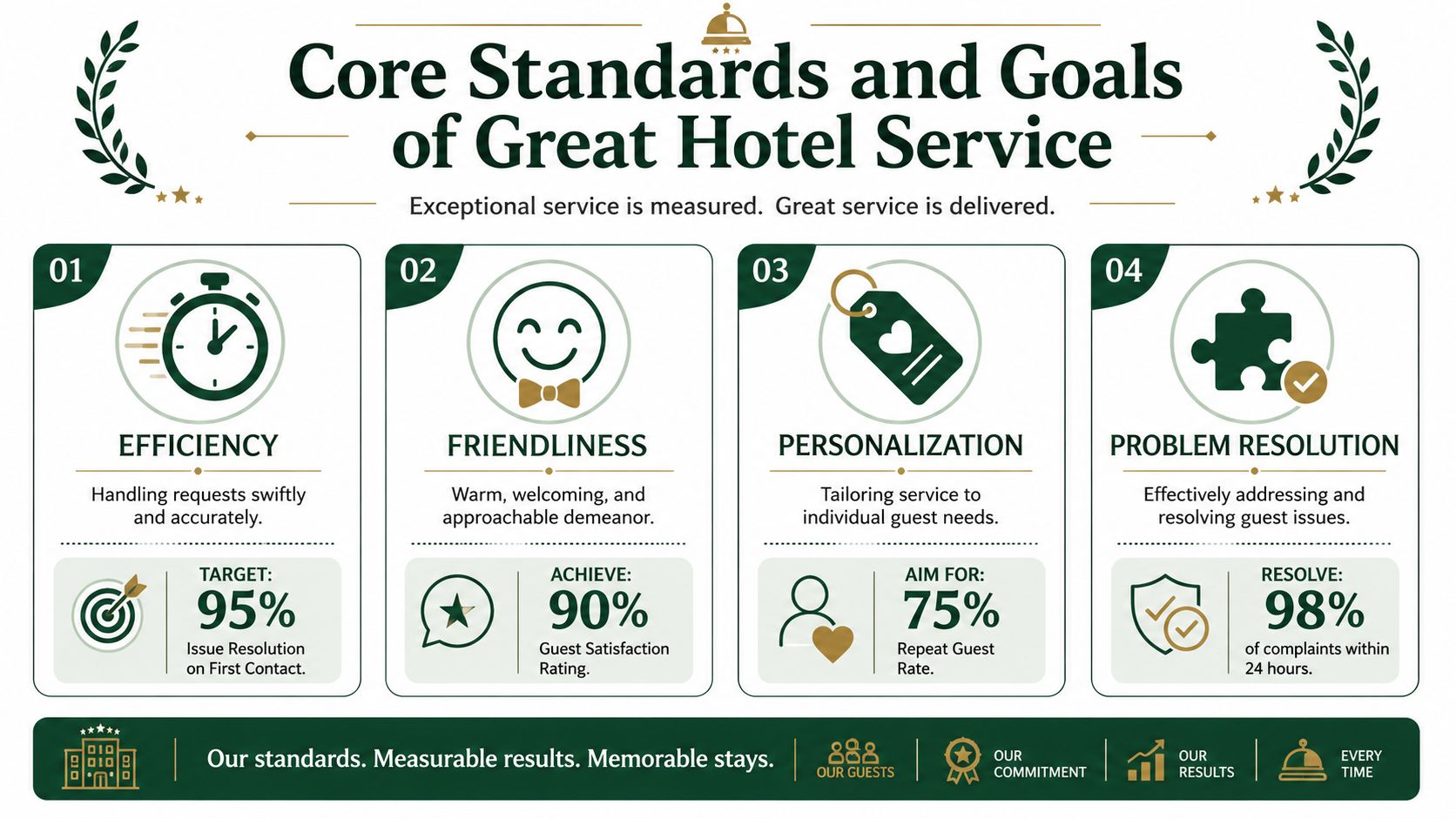
Friendly service is important, but hotels also need clear standards. Otherwise, “good service” becomes too vague. One staff member may think a slow answer is acceptable, while a guest expects immediate action. Standards help teams work the same way.
What great service looks like
Most hotels want the same basic outcomes:
| Standard | What it means in simple words | Guest example |
|---|---|---|
| Efficiency | Help quickly and correctly | Fast, clear check-in |
| Friendliness | Sound warm and respectful | Polite greeting with eye contact |
| Personalization | Notice the guest's needs | Offering a quiet room if requested |
| Problem resolution | Fix issues fully | Following up after a complaint |
These standards matter because service is not only a soft skill. Hotels track it with real measurements. Teams often use CSAT (customer satisfaction), NPS (Net Promoter Score), CLV (customer lifetime value), service volume by channel, and availability versus demand to find weak points and improve decisions, as explained in this hotel service KPI guide.
If these terms are new to you, keep them simple:
- CSAT means how satisfied guests say they are.
- NPS means how likely guests are to recommend the hotel.
- Service volume by channel means where requests come from, such as phone, chat, email, or front desk.
- Availability versus demand helps hotels see if staffing matches guest needs.
Why reviews matter
Guest reviews are one of the clearest signs of service quality. In 2025, the global Guest Review Index reached 86.7%, up 0.5 percentage points year over year, 1.3 points above the pre-pandemic record, while review volume also grew 2.1%, according to this global guest experience benchmark.
For staff, this tells us something important. Small improvements in service are visible. Guests notice them, and they talk about them.
How this helps you on shift
You don't need to manage the hotel's reports to work well. But you should understand what your actions affect.
- A clear explanation can improve satisfaction.
- A faster response can reduce complaints.
- A careful handoff can stop repeated problems.
- A follow-up message or call can turn a bad moment into a better memory.
When you speak with guests, think in this order:
- What does the guest need now?
- What information do they need next?
- Who must know about this request after me?
That simple habit makes your service more professional.
How to Handle Common Guest Scenarios
Real confidence comes from knowing what to do when the situation is not perfect. Below are three common moments in customer service in a hotel. Read the situation, then follow the response steps.
A guest is checking in after a long trip
The guest looks tired. They may not want small talk. They want speed and clarity.
A helpful check-in usually follows this order:
- Greet the guest warmly. Use eye contact and a calm voice.
- Confirm the booking details. Name, stay dates, room type.
- Explain only the important points first. Breakfast time, Wi-Fi, lift location.
- Watch the guest's face. If they look confused, slow down.
- End with one support question. “Is there anything you need before you go up?”
Good service here means balancing friendliness with efficiency. Too many words can feel tiring. Too few words can feel cold.
A guest asks for a special request
Maybe the guest wants extra towels, a later check-out, or a quieter room. Even if you can't say yes immediately, you can still answer well.
Use this protocol:
- Acknowledge the request. Show that you heard it clearly.
- Check what is possible. Don't guess.
- Give a time frame. Tell the guest when they'll get an answer.
- Follow up. If you promised to call back, call back.
Example:
A guest asks for a late check-out. Don't say, “No, not possible,” unless you have already checked. Try, “Let me check availability for you. I'll confirm in a few minutes.”
A guest complains about a problem
Many English learners freeze. The guest may speak fast. They may sound angry. Your job is not to win the argument. Your job is to understand, calm the situation, and move it forward.
Leading hospitality research shows that the strongest service strategy combines personalization with fast recovery after a mistake, using guest preference data and staff with discretion to resolve issues quickly, as described in this hospitality customer experience analysis.
Try this four-step method:
Listen without interrupting
Let the guest finish. Even if you know the answer, wait.Acknowledge the impact
Say, “I'm sorry this happened,” not “That's our policy.”State the next action
Tell the guest exactly what you will do next.Close the loop
Check later that the problem was solved.
When a guest complains, your first job is to reduce stress. The fix matters, but the feeling matters too.
Here is a simple model conversation:
Guest: “The air conditioning in my room isn't working.”
Staff: “I'm sorry about that. Thank you for telling me. I'll contact maintenance now, and I'll update you as soon as I have an answer.”
That response works because it is calm, clear, and responsible.
If the hotel is busy or understaffed
Sometimes the problem is delay. You may want to help fast, but there aren't enough staff. In that case, be honest and specific. Don't give vague promises.
Better:
“We're experiencing a delay, but I've logged your request and marked it as urgent.”
Not as good:
“Someone will come soon.”
Essential English Phrases for Every Situation
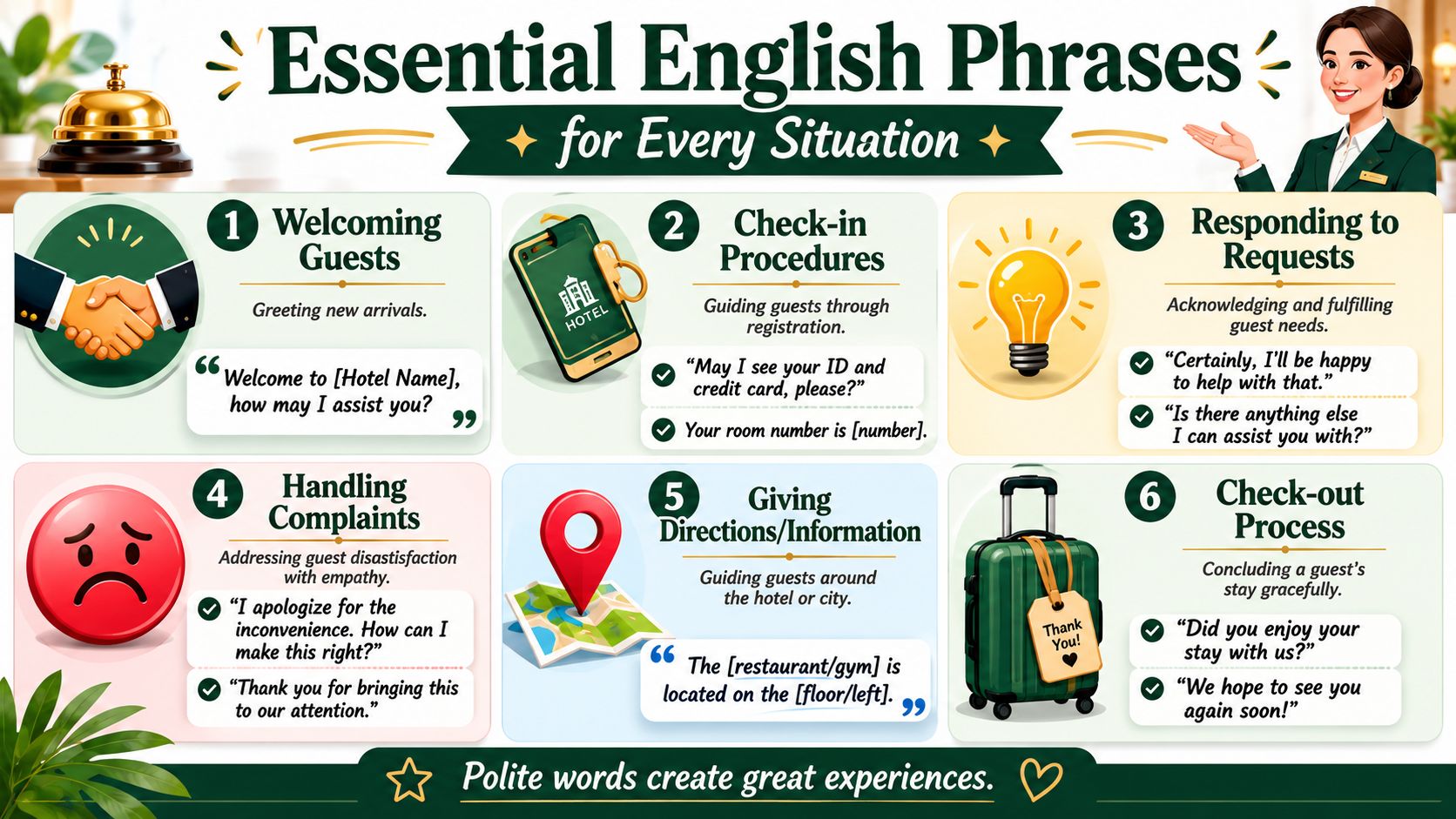
You don't need long sentences to sound professional. Short, polite phrases are usually best. Learn them in groups, then practise them aloud until they feel natural.
If you enjoy learning phrases by situation, you may also like the practical speaking articles on the Verse English blog.
Greeting guests
Use these at arrival or when a guest approaches the desk.
- “Good morning, welcome to the hotel.”
- “How may I help you today?”
- “Do you have a reservation with us?”
- “I hope your journey was comfortable.”
A friendly greeting should sound natural, not memorised. Practise smiling while you speak. Guests can hear warmth in your voice.
Asking questions politely
These phrases help you get information without sounding too direct.
- “May I have your name, please?”
- “Could you please show me your ID?”
- “Would you mind confirming your booking dates?”
- “May I ask which room issue you noticed?”
Short question forms are often easier for guests to understand than long ones.
Offering help
These phrases are useful at the desk, on the phone, or in corridors.
- “Certainly, I can help with that.”
- “Let me check that for you.”
- “I'll contact the right department now.”
- “I can arrange that for you.”
- “Is there anything else you need?”
Language tip: “Let me check” sounds more confident than “I don't know.”
Apologizing and solving problems
A good apology is simple. Don't make it too long. Don't blame another department in front of the guest.
- “I'm sorry for the inconvenience.”
- “Thank you for telling us.”
- “I understand your concern.”
- “Let me fix this for you.”
- “I'll update you as soon as possible.”
Useful pattern:
Apology + action + timing
Example:
“I'm sorry about the noise. I'll contact security now and update you in a few minutes.”
Checking out
The final interaction also matters. A calm, polite check-out can leave a strong last impression.
- “Are you checking out today?”
- “How was your stay?”
- “Here is your receipt.”
- “Thank you for staying with us.”
- “We hope to welcome you again.”
Try practising these phrases in pairs. One person is the guest, one person is the staff member. Then switch roles.
Practice Your Hotel English to Build Confidence
Reading helps, but speaking is what builds confidence. In real hotel work, you don't have much time to translate in your head. You need words that come quickly and calmly.
That's why role-play is one of the best ways to improve. Choose one situation and say it aloud several times. Start with a basic version. Then make it harder. For example, begin with a normal check-in. Next, try the same check-in with a tired guest. After that, try it with a guest who has a question about breakfast or payment.
Here are a few speaking prompts you can use today:
Check-in role-play
The guest arrives early. Their room is not ready yet.Complaint role-play
The guest says the room is too noisy and they cannot sleep.Special request role-play
The guest wants extra pillows and a wake-up call.Phone call role-play
A guest calls to ask where the gym is and what time it opens.
Say your answer out loud, not only in your head. Record yourself if possible. Listen again. Check three things. Were you clear? Were you polite? Did you explain the next step?
If you want extra practice, repeat one phrase in three ways:
formal, friendly, and very simple. This helps you stay flexible during real conversations.
For example:
- Formal: “Certainly, I'll arrange that for you.”
- Friendly: “Of course, I can help with that.”
- Very simple: “Yes, I can do that for you.”
You'll improve faster when practice feels safe and regular. If you want a private way to rehearse hotel conversations and get feedback, you can see how spoken practice works on the Verse how it works page.
If you want to practise hotel English out loud, Verse is a simple place to start. You can speak in realistic situations, get honest feedback on grammar and fluency, and build confidence step by step with less pressure than a real guest interaction.