IELTS Speaking Practice Test: A Self-Study Guide
If you're reading this, there's a good chance you're worried about the speaking test more than the other parts of IELTS. That feeling is normal. Many learners know what they want to say in English, but when they try to speak under pressure, their mind goes blank.
You might also be thinking, "How can I practise speaking if I don't have a teacher with me?" The good news is that you can run a realistic IELTS speaking practice test by yourself. You don't need a perfect accent, special equipment, or a study partner every day.
What you do need is a clear method. Once you know how to copy the test format, record your answers, and review them the right way, your practice becomes much more useful. It stops feeling like random speaking. It starts feeling like training.
This guide walks you through that process step by step. You'll learn how the test works, how to run your own mock test, what prompts to use, how to check your answers, and what to do when you get stuck or nervous.
Table of Contents
- You Can Practice for the IELTS Speaking Test
- Understanding the IELTS Speaking Test Format
- How to Set Up and Run Your Mock Test
- Your Full IELTS Speaking Practice Test Prompts
- How to Review Your Answers Like an Examiner
- What to Do When You Get Stuck or Nervous
- Your Weekly IELTS Speaking Practice Schedule
You Can Practice for the IELTS Speaking Test
A lot of students wait too long to start speaking out loud. They read model answers, underline vocabulary, and watch videos, but they still avoid opening their mouth. Usually, it's because they feel shy, embarrassed, or unsure where to start.
That's why a self-run IELTS speaking practice test is so useful. It gives you a private space to practise in a real way. You can speak, pause, listen back, and try again without anyone judging you.
For many learners, that privacy matters. If you're nervous about speaking with other people, solo practice helps you build confidence before you move to live conversation. A simple routine at home can already teach you a lot about your fluency, grammar, and pronunciation.
Why self-practice works
The speaking test isn't a mystery. It follows a fixed structure, and that makes it easier to practise well. When you know the order of the parts and the kind of answer each part needs, you can train those skills one by one.
Self-practice also helps you notice habits you may miss in the moment, like:
- Stopping too often, even when you know the idea
- Giving very short answers, because you want to be safe
- Repeating the same basic words, instead of using a wider range
- Losing your structure, especially when a question feels unfamiliar
Practical rule: Don't wait until you feel ready to start speaking. Speaking is how you get ready.
If you want a private place to practise spoken English more regularly, you can also explore Verse English speaking practice. For now, though, you can start with nothing more than a phone, a timer, and a quiet room.
What confidence really looks like
Confidence in IELTS speaking doesn't mean never feeling nervous. It means knowing what to do next. You hear a question, you organise a response, and you keep going even if your answer isn't perfect.
That's the skill this article helps you build. Not perfection. Control.
Understanding the IELTS Speaking Test Format
Before you do any mock test, you need to know what you're copying. The IELTS Speaking test is a face-to-face interview, it is recorded, and it lasts 11 to 14 minutes in total, with 3 parts, according to the official IELTS speaking format.
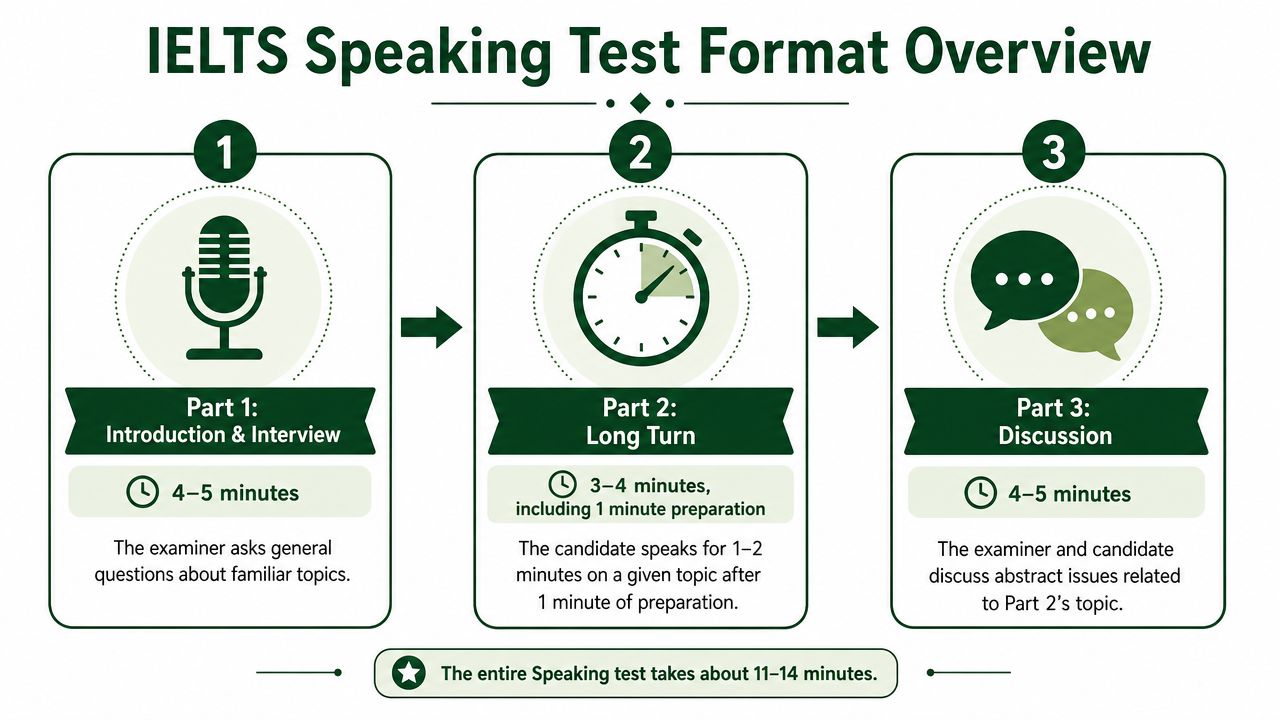
That short length surprises many students. The test is not a long interview. It moves quickly. That's why your practice has to feel timed and structured, not like a casual chat.
Part 1 is your warm-up
Part 1 lasts about 4 to 5 minutes. The examiner asks questions about familiar topics, such as your hometown, work, studies, hobbies, or daily routine.
This part checks whether you can answer simple questions naturally and clearly. You don't need long speeches here. But one-word answers are a mistake. If the examiner asks, "Do you enjoy cooking?" and you only say "Yes," you waste a chance to show your English.
A better answer is short but complete:
"Yes, I do. I enjoy cooking simple meals at home, especially in the evening when I have time to relax."
Part 2 is your long turn
In Part 2, you get 1 minute to prepare and then speak for up to 2 minutes on a topic. This is often called the cue card part.
This section tests a different skill. You need to organise your ideas quickly and keep speaking without too many breaks. Many learners panic here because they think they need amazing ideas. You don't. You need a clear structure and enough language to keep going.
Try thinking of Part 2 like a short talk:
- Beginning, introduce the topic
- Middle, add details and examples
- End, give a final thought or feeling
You are not being tested on having the most interesting life. You are being tested on how well you communicate.
Part 3 is deeper and more abstract
Part 3 lasts about 4 to 5 minutes. The questions connect to Part 2, but they become broader and more abstract.
If Part 2 asks you to describe a person who helped you, Part 3 might ask about the role of mentors in society or whether young people need more guidance today. In this section, you explain opinions, compare ideas, and give reasons.
Think of the whole test like this:
- Part 1, warm-up conversation
- Part 2, short solo talk
- Part 3, discussion of bigger ideas
When your IELTS speaking practice test follows this shape, your training becomes much closer to the actual exam.
How to Set Up and Run Your Mock Test
A good mock test doesn't need to be fancy. It just needs to copy the pressure and rhythm of the actual test closely enough that your speaking habits become visible.

The most useful step is simple. Record yourself. Guidance for IELTS speaking practice recommends deliberate self-recording plus structured review because it helps learners notice fluency problems, filler words, monotone delivery, and pronunciation issues that are hard to catch while speaking, as explained in this IELTS self-recording practice guide.
Your setup checklist
Before you start, get these ready:
- A quiet place, so your recording is clear and you can focus
- A phone or computer, to record your full test
- A timer, so each part feels realistic
- Printed prompts or notes on screen, prepared before you begin
- Water, because a dry mouth can make you sound more nervous
Keep your setup simple. If you spend too much time making it perfect, you may avoid the actual speaking.
How to run the test
Use this sequence:
Start the recording
Speak your name and the date if you want to track progress.Do Part 1
Answer several short questions on one or two familiar topics.Do Part 2 properly
Read the cue card, take your preparation minute seriously, and then speak for your full turn.Move straight to Part 3
Don't take a long break. The test moves on quickly.Stop and save the recording
Give the file a clear name, such as "Mock Test 1" or "Part 2 travel topic".
If you want a model for spoken practice with feedback after each turn, you can read how Verse works for speaking practice.
Common mistakes during self-mock tests
Students often make their practice too easy. Then they feel shocked on test day.
Watch out for these habits:
- Stopping the recording every time you make a mistake, instead of pushing through
- Looking up words in the middle, which removes the pressure
- Writing a full script for Part 2, which doesn't match the exam
- Repeating the same familiar topic, because it feels comfortable
A better mock test feels a little uncomfortable. That's a good sign. It means you're practising under conditions that reveal what still needs work.
Record first, judge later. While you're speaking, your job is to continue. While reviewing, your job is to improve.
Your Full IELTS Speaking Practice Test Prompts
Your official practice run starts now. Read the prompts exactly as they are. Don't improve them, and don't choose an easier version. The point of an IELTS speaking practice test is to respond in real time.
Part 1 Questions
Topic, hometown
- What's your hometown like?
- What do you like most about living there?
- Has your hometown changed in recent years?
- Do you think you will live there in the future?
Topic, daily routine
- What part of your day do you enjoy most?
- Are your mornings usually busy?
- Do you prefer to plan your day or be more flexible?
- Has your daily routine changed recently?
For Part 1, keep your answers natural and complete. Aim for a few connected sentences, not a long speech.
Part 2 Cue Card
You should say:
Describe a person who gave you useful advice.
You should say:
- who this person was
- when they gave you the advice
- what the advice was
and explain why this advice was useful to you.
Now do it like an actual test:
- Take one minute to prepare
- You may make short notes
- Then speak for up to two minutes
If you don't know what to say, don't panic. You can choose a teacher, friend, parent, manager, or even an older sibling. The story does not need to be dramatic. A simple example often works better because it's easier to explain clearly.
Part 3 Discussion Questions
- Why do some people give good advice?
- Do young people and older people usually look for advice in the same way?
- Is advice from family more valuable than advice from friends?
- Why do some people ignore good advice?
- How has the internet changed the way people ask for advice?
- Do you think people rely too much on online opinions today?
Part 3 is where many learners get too short again. Don't answer only the question. Add a reason, then an example.
For example:
Weak answer
"Yes, I think so."
Better answer
"Yes, I think so, because online opinions are easy to find and people often trust quick answers. For example, if someone wants advice about study or work, they may read comments from strangers before speaking to someone they know."
Extra topics for future practice
If you want to repeat this IELTS speaking practice test on another day, switch the topic. Try these common areas:
- Part 1 topic ideas, studies, work, music, books, weather, friends, weekends, shopping
- Part 2 cue card ideas, a useful skill, a memorable journey, a favorite teacher, a place you enjoy visiting, a time you solved a problem
- Part 3 discussion themes, education, technology, transport, social habits, communication, environmental issues
You can also look through more speaking-related study ideas on the Verse blog for English learners.
How to Review Your Answers Like an Examiner
After your mock test, don't just say, "That was bad" or "That was okay." Those reactions don't help. You need to listen with a purpose.
IELTS speaking performance is judged using four criteria, fluency and coherence, lexical resource, grammatical range and accuracy, and pronunciation, and practice guides recommend reviewing recordings against these areas, as explained in this guide to IELTS speaking assessment criteria.
The four things you are judged on
Here is a simple way to understand each one.
Fluency and coherence
Can you keep speaking, and do your ideas connect clearly? Small pauses are normal. Constant stopping is a problem.Lexical resource
This means your vocabulary. Did you use clear and suitable words, or did you repeat the same simple words again and again?Grammatical range and accuracy
Did you use a mix of sentence types? Were your sentences mostly correct and easy to understand?Pronunciation
Could a listener understand you easily? This includes sounds, stress, rhythm, and intonation.
A simple self-review table
Use this table while listening to your recording.
| Criteria | Band 6 (Competent) | Band 7 (Good) | Band 8 (Very Good) |
|---|---|---|---|
| Fluency and coherence | Can speak at length, but pauses or loses flow at times | Speaks more smoothly and usually connects ideas well | Speaks fluently with clear organisation and only occasional hesitation |
| Lexical resource | Uses enough vocabulary for familiar topics, but repeats words | Uses a wider range and chooses words more accurately | Uses varied vocabulary with flexibility and precision in most places |
| Grammatical range and accuracy | Uses some different sentence forms, with noticeable mistakes | Uses a mix of structures with better control | Uses a wide range of structures with strong control, though small mistakes may still happen |
| Pronunciation | Generally understandable, though some sounds or stress may cause trouble | Clear enough for easy understanding most of the time | Easy to understand, with effective stress and intonation most of the time |
Questions to ask yourself
When you replay your answer, pause after each part and ask:
- For fluency, did I stop because I had no ideas, or because I couldn't find words?
- For vocabulary, did I repeat words like "good," "nice," or "important" too often?
- For grammar, did I only use short simple sentences?
- For pronunciation, did I sound flat, rushed, or unclear in key words?
Listen for patterns, not perfection. One mistake isn't the issue. A repeated habit is.
Two sample Part 2 answers
Prompt, describe a person who gave you useful advice.
Sample answer closer to Band 6
"I want to talk about my teacher from secondary school. She gave me advice when I was worried about my future studies. At that time, I didn't know what subject I should choose, and I felt confused. She told me that I shouldn't follow my friends and that I should choose something that really interested me. This advice was useful because I often compared myself with other people. After that conversation, I spent more time thinking about my own goals. In the end, I made a better decision for myself, and I still remember her words now."
Why it sounds Band 6:
- clear meaning
- enough detail
- some repetition
- sentence shapes are a bit similar
Sample answer closer to Band 8
"I'd like to describe my older cousin, who gave me a piece of advice that I still think about today. He spoke to me when I was trying to decide what to study after school, and I was under a lot of pressure because everyone around me seemed to have a clear plan. He said something very simple, which was not to build my future around other people's expectations. Instead, he told me to choose a path that matched my strengths and interests, even if it looked less impressive to others. That advice changed the way I made decisions. It was useful because it helped me become more independent, and it also reduced a lot of stress. Since then, I've tried to make important choices more calmly and more honestly."
Why it sounds stronger:
- ideas flow more naturally
- vocabulary is broader
- sentence forms vary more
- the answer feels more confident and developed
What to Do When You Get Stuck or Nervous
Many students think getting stuck means they are failing. It doesn't. In real communication, people pause, correct themselves, and ask for help. The speaking test is meant to assess communication, not perfection, and official guidance says candidates can use strategies like asking for clarification or taking a brief pause when they lose track, as explained in this advice on handling difficult speaking moments.
That matters because nervous moments are part of the test for many people. The goal is not to remove all nerves. The goal is to recover smoothly.
Recovery phrases you can practise
Use these phrases in your mock tests so they feel natural later.
If you didn't hear or understand the question
"Sorry, could you repeat the question?"
"Could you explain what you mean by that?"If you need a second to think
"That's an interesting question."
"Let me think about that for a moment."
"I haven't thought about that before, but I'd say..."If you lose your train of thought
"I think I lost my point for a second."
"What I mean is..."
"Let me say that in a simpler way."If you make a mistake and want to fix it
"Sorry, what I meant was..."
"That's not quite right. I mean..."
A short pause is usually better than panicked talking.
Another useful trick is to move from a hard idea to a related easier one. If the question feels abstract, start with a simple example from life. This keeps you speaking while your brain catches up.
For example, if you're asked about advice in society and your mind goes blank, you can begin with, "I think advice is important in everyday life, especially for students or young workers..." Then build from there.
Also, don't memorise full answers too closely. If the question changes a little, memorised speech can break down fast. Flexible speaking is safer than perfect scripting.
Your Weekly IELTS Speaking Practice Schedule
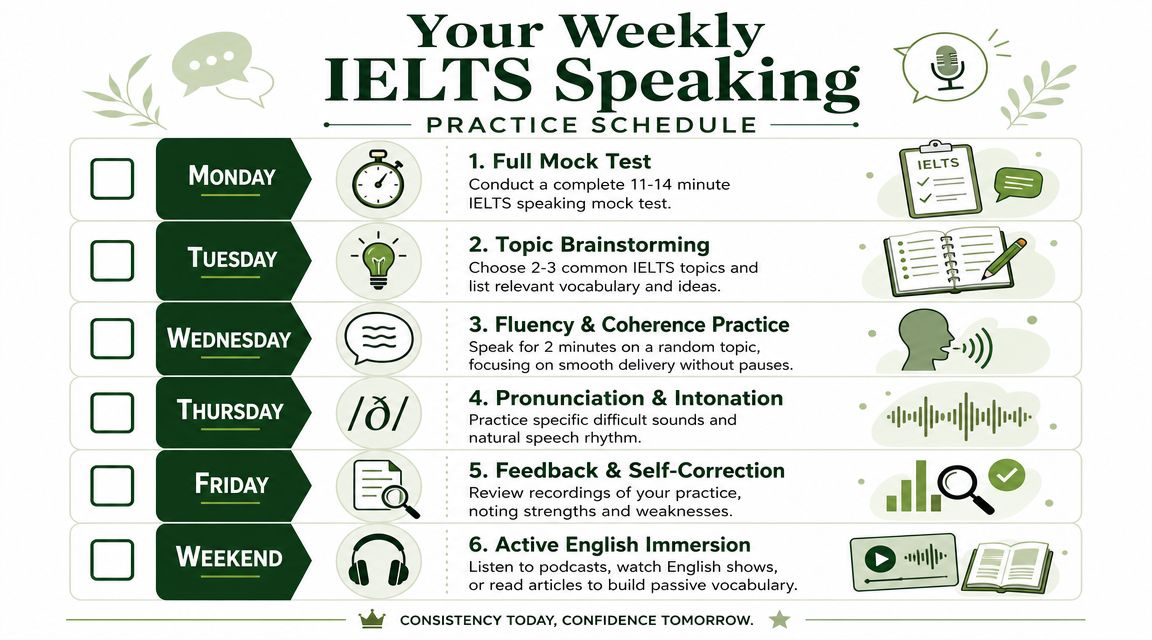
A strong routine is better than occasional heavy study. Short, regular speaking practice helps you build comfort with pressure, ideas, and timing. Keep the focus on speaking in full answers, and in discussion questions, push yourself to add reasons and examples rather than stopping too early.
A simple weekly rhythm
- Monday, do a full mock speaking test. Treat it like an actual test and record it.
- Tuesday, choose a few common topics and brainstorm ideas and useful vocabulary.
- Wednesday, do focused fluency practice. Speak on one random topic without stopping too often.
- Thursday, work on pronunciation. Repeat difficult words, stress patterns, and sentence rhythm out loud.
- Friday, review your recordings and write short notes on your weakest area.
- Weekend, use English more naturally through listening, reading, and extra speaking.
This kind of schedule works because each day has one clear job. You're not trying to improve everything at once.
How to keep the habit going
A few small rules make a big difference:
- Keep sessions manageable, so you don't avoid them
- Speak out loud every study day, even if only for a short time
- Reuse topics, but change your examples and wording
- Track one weakness at a time, such as hesitation, repetition, or unclear pronunciation
If one week feels difficult, simplify it. Don't quit. Even one short recorded answer is more useful than silent study.
Practice becomes easier when you have a steady speaking partner and honest feedback after each answer. That's where a tool can help, but the habit still matters most.
If you'd like a calm place to practise out loud and get feedback on grammar, vocabulary, fluency, and pronunciation, try Verse. It gives you a private way to build speaking confidence, and you can use it to run the kind of IELTS speaking practice test you worked through here.