Best Language Tutor Online: Your 2026 Guide

Many English learners know this feeling. Reading is fine. Listening is getting better. Grammar exercises look familiar. But when it's time to speak, the mind goes blank.
A learner may know the right tense on paper and still freeze in a real conversation. That doesn't mean the learner is bad at English. It usually means the learner has spent more time studying English than using English out loud.
Online help can make that gap smaller. More learners are turning to digital practice for that reason. The global online language tutoring market is projected to reach $12.7 billion by 2032, with a CAGR of 20.2%, which shows how many people are using online tools to improve communication skills (online language tutoring market projection).
The important question isn't only which language tutor online option looks popular. The better question is this: which kind of help gives enough real speaking practice to build confidence?
Table of Contents
- Why Speaking English Feels Harder Than Studying It
- Your Three Main Options for Online Language Help
- How to Choose the Right Language Tutor for You
- How to Test a Tutor in a Trial Lesson
- Using AI for On-Demand Speaking Practice
- Your Next Step Is to Start Speaking
Why Speaking English Feels Harder Than Studying It
A lot of learners build strong passive knowledge first. They read articles. They watch videos. They review grammar rules. But speaking asks the brain to do several things at once. It has to choose words, build a sentence, remember pronunciation, and respond quickly.

That's why a learner can understand English well and still feel nervous while talking. The problem often isn't knowledge. The problem is that silent study doesn't fully prepare someone for live speech.
Speaking is a separate skill
Speaking needs speed. A learner usually can't stop for two minutes to check a grammar rule in the middle of a conversation. Real speech also includes connected sounds, short answers, follow-up questions, and natural rhythm. Learners who want to sound smoother often need focused listening and speaking practice with features like connected speech in English.
Speaking confidence grows when learners stop treating English only as a school subject and start using it as a tool for real communication.
Why stress makes it worse
Stress changes performance. A learner may know the answer, but worry makes word recall slower. Some people start translating from their first language. Others choose very short sentences because they're afraid of mistakes.
A helpful language tutor online option should reduce that pressure, not increase it. The right support gives room to pause, try again, and keep talking.
- Grammar knowledge matters: It gives structure and helps learners notice patterns.
- Speaking practice matters more for fluency: It trains quick recall and clearer expression.
- Regular out-loud practice matters most: It helps the mouth, ears, and brain work together.
Your Three Main Options for Online Language Help
Most learners choose between three formats. Each one can help, but each one supports speaking in a different way. A learner who wants real conversation practice should look at the format before looking at features.
The strong shift toward flexible learning is clear. In 2025, the on-demand tutoring segment held 73.88% of online tutoring revenue, which shows that many learners prefer tools they can use instantly instead of fixed schedules (on-demand tutoring market share).
Comparing Online English Practice Options
| Feature | Live Human Tutor | Structured Course | AI Conversation Partner |
|---|---|---|---|
| Main format | Scheduled conversation or lesson | Lessons with units and exercises | On-demand spoken practice |
| Best for | Personal guidance, detailed explanation | Learners who like clear order | Learners who need frequent speaking practice |
| Schedule | Fixed time | Flexible, but usually self-paced | Very flexible |
| Speaking time | Depends on tutor style | Often limited | Usually easy to repeat daily |
| Feedback style | Human correction and discussion | Written corrections and quizzes | Instant feedback after speaking |
| Pressure level | Can feel high for shy learners | Low, but often passive | Lower for private practice |
| Good at | Personalized support | Building foundations | Building speaking habit |
Live human tutors
A live tutor can be excellent for learners who want personal help. A tutor can explain mistakes, answer specific questions, and adjust the lesson in real time. That's useful for interviews, presentations, exams, or work situations where nuance matters.
Still, not every tutor gives enough speaking time. Some spend too much time teaching grammar rules, typing corrections, or leading the conversation in a way that keeps the learner quiet.
Practical rule: If a learner wants to speak better, the lesson should include a lot of actual speaking, not only explanation.
Structured courses
Courses help learners who need order. They often give clear lessons on vocabulary, grammar, and listening. That can be comforting for someone who feels lost and wants a path to follow.
The weakness is simple. Courses can become passive. A learner may finish many lessons and still avoid speaking. That's why many adults look for ideas beyond standard lessons, such as options discussed in this guide to the best English learning app for adults.
AI conversation partners
This option focuses on practice. The learner speaks out loud, gets a response, and keeps going. That makes it easier to build a daily habit, especially on busy days.
AI tools usually work best as a speaking partner, not as the only form of learning. They can help learners practice everyday topics, repeat difficult phrases, and get quick notes on grammar, vocabulary, and fluency without waiting for a scheduled lesson.
For many learners, the best plan isn't choosing one format forever. It's combining formats with a clear purpose. A human tutor can guide. A course can organize study. An AI partner can make daily speaking possible.
How to Choose the Right Language Tutor for You
Choosing a language tutor online gets easier when the learner stops asking, “Which one is best?” and starts asking, “Which one fits the actual problem?”
Some learners need structure. Some need courage. Some need more speaking time than teaching time. A good choice depends on that difference.
Start with the real goal
A learner preparing for an exam may need corrections, timed answers, and topic practice. A learner moving abroad may need small talk, travel English, and everyday listening. A professional may need meeting language, clear opinions, and smoother pronunciation.
It helps to write one short sentence before choosing anything. For example:
- Conversation goal: Speak for ten minutes without stopping too often.
- Work goal: Explain ideas clearly in meetings.
- Confidence goal: Feel less afraid of making mistakes.
That sentence makes the decision simpler. If the goal is speaking confidence, the tool must create frequent chances to speak.
Match the format to daily life
A perfect method on paper won't help if it doesn't fit the learner's week. Some people can attend regular lessons. Others need short practice sessions between work, study, or family tasks.
A learner can ask three simple questions:
- Can this happen often enough? Speaking improves with repetition.
- Can this happen at low stress moments? Short sessions are easier to repeat.
- Can this happen out loud, not only in the head? Silent review has limits.
A learner who often cancels lessons may need more flexible support. A learner who loses focus alone may need a teacher or clear schedule.
Notice how feedback feels
Feedback should be honest, but it should also help the learner keep talking. If corrections are too heavy, the learner may become careful and quiet. If there are no corrections at all, mistakes may repeat for too long.
A useful tutor usually does these things:
- Listens for patterns: Not every tiny mistake needs to stop the conversation.
- Explains clearly: Short, direct correction is easier to remember.
- Protects confidence: The learner should leave ready to speak again.
Good feedback doesn't punish mistakes. It turns mistakes into the next practice target.
The best language tutor online choice is often the one the learner actively uses every week, with enough speaking time to make progress feel real.
How to Test a Tutor in a Trial Lesson
A trial lesson works best when the learner treats it like a test drive, not a performance. The goal isn't to impress the tutor. The goal is to find out whether the tutor creates a safe, useful speaking space.

Research supports active speaking practice. Learners who speak aloud for at least 15 minutes daily using guided practice improve their CEFR speaking scores by 0.5 to 1.0 levels within 3 months, compared with 0.2 levels for silent study groups (guided speaking practice and CEFR improvement). That's why the trial lesson should include real speaking time, not only introductions.
Prepare one simple speaking task
It helps to bring one topic that matches real life. A learner could talk about work, a recent weekend, a future plan, or a problem that needs advice. The topic should be familiar enough that the learner can focus on speaking, not on inventing ideas.
A simple structure works well:
- First minute: Short self-introduction.
- Next few minutes: Speak about one topic in detail.
- Last part: Ask questions and notice the tutor's feedback style.
Questions that help during the lesson
A short trial can still reveal a lot. The learner can ask questions like these:
- How are mistakes corrected? During the conversation, after it, or both?
- How much speaking time does the learner get?
- Can the tutor focus on fluency, grammar, or pronunciation depending on the goal?
- What happens when the learner gets stuck?
These questions matter because teaching style changes the whole experience. One tutor may guide gently and keep the learner talking. Another may interrupt too often.
A strong trial lesson leaves the learner feeling challenged, but not ashamed.
What to notice after the lesson
After the lesson, the learner can check three things.
First, was there enough talking out loud? Second, were the corrections clear enough to use later? Third, did the learner feel safer speaking by the end than at the start?
If the answer to those questions is mostly yes, the tutor may be a good fit. If the lesson felt like a grammar interview, the learner may need a different style.
Using AI for On-Demand Speaking Practice
Many learners don't struggle because they lack motivation. They struggle because speaking in front of another person feels intense. That pressure can stop practice before it starts.
For shy learners, private speaking practice can make a real difference. One study found that 65% of shy learners avoid online tutoring because they fear judgment during live video sessions, which helps explain why private AI practice can support confidence building (shy learners and fear of judgment in online tutoring).
Why private practice helps shy speakers
A private tool gives the learner room to make mistakes without embarrassment. That matters because fear often reduces speaking length. Learners say less, choose easier words, and stop early. In a private setting, they can try again immediately.
Between lessons, an AI conversation partner can be helpful. It gives on-demand practice when the learner has ten quiet minutes and wants to speak, not just study. Readers looking at different speaking-focused options can also explore this guide to the best language learning apps for speaking.
What good AI speaking practice looks like
Not all digital practice is the same. Tapping answers or reading dialogues silently won't feel like real conversation. Helpful AI speaking practice should include these parts:
- Out-loud speaking: The learner talks, not just types.
- Immediate response: The conversation keeps moving.
- Clear feedback: Notes on grammar, vocabulary, and fluency show what to improve.
- Low-pressure repetition: The learner can retry a sentence or topic without awkwardness.
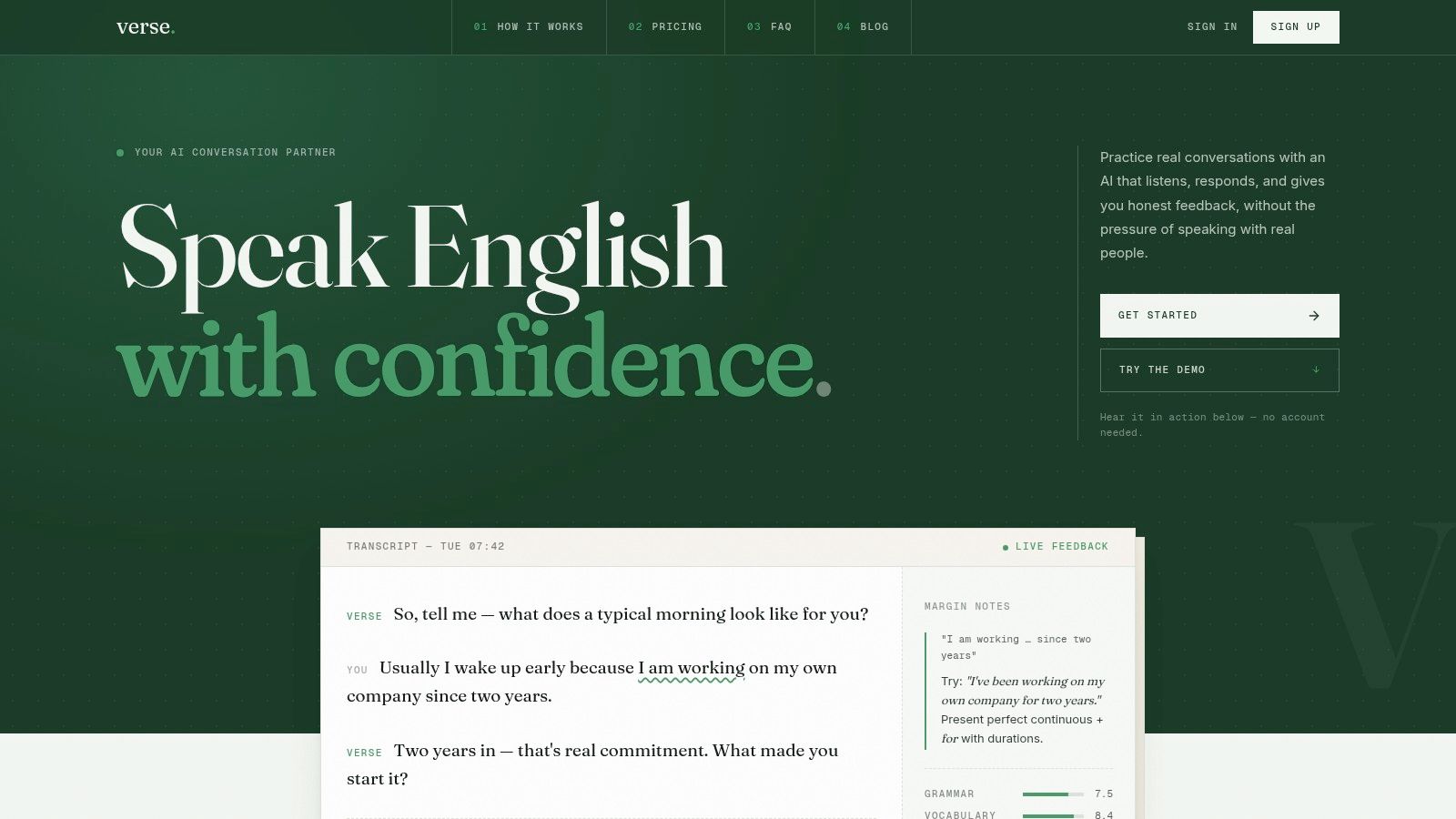
Verse is built for that kind of practice. It's a paid subscription at $12 per month. It focuses on spoken English practice with honest, judgment-free feedback on grammar, vocabulary, and fluency. Learners can choose a British, American, or Australian accent. It also has a free, no-signup demo on the homepage, which helps learners see how private speaking practice feels before committing to regular use.
AI doesn't need to replace human help. It can fill the space between lessons, especially when the main need is confidence through repetition.
Your Next Step Is to Start Speaking
A learner doesn't need perfect grammar before speaking more. A learner needs a way to practice that feels safe enough to repeat.
That's what makes choosing the right language tutor online option so valuable. The best choice is the one that creates regular, honest, out-loud practice. For some learners, that's a human tutor. For others, it's a mix of lessons, self-study, and private conversation practice.
Progress usually starts subtly. One longer answer. One less pause. One small moment of courage.
Speak out loud today, even if the sentence feels simple. That's how confidence begins.