Master Connected Speech in English: Your 2026 Guide

You read an email in English and understand almost everything. Then you join a meeting, watch a video, or listen to a podcast, and suddenly the English feels much harder. You know the words, but they seem to disappear, join together, or change shape.
If that happens to you, you're not behind. You're hearing connected speech in English, which is how spoken English usually works in real life. Words don't stay separate the way they do on a page. They move together.
Once you start noticing these patterns, listening gets less mysterious. Your own speaking can also sound smoother and more confident.
Table of Contents
- Why You Can Read English but Get Lost Listening
- What Exactly Is Connected Speech
- The Four Main Rules of Connected Speech
- Common Connected Speech Examples in Action
- How to Practice Your Connected Speech
- Start Speaking with More Confidence
Why You Can Read English but Get Lost Listening
A learner reads, “What do you want to do?” and thinks, “Easy.” Then they hear it in conversation and catch something like “Whaddaya wanna do?” It feels like a different language.
That gap often isn't about vocabulary. It's about speech flow. As this overview of connected speech explains, English is not spoken as separate word units, but as a continuous stream in which sounds flow across boundaries. That's why spoken English can feel so different from written English.
What your brain expects
When you read, your eyes see clear spaces between words. Your brain processes one word at a time. Listening is different. In fast, natural speech, speakers connect words, reduce small sounds, and keep the voice moving.
So instead of hearing:
- want to
- going to
- did you
- next day
You may hear smoother, shorter versions that sound unfamiliar at first.
Practical rule: If you know the words in writing but miss them in speech, the problem often isn't meaning. It's sound changes.
Why this feels so frustrating
Many learners think, “Maybe my listening is weak,” or “Maybe native speakers talk too fast.” But speed isn't the whole issue. Often, the sounds themselves change when words meet.
This is also why pronunciation study helps listening. If you want to understand weak vowel sounds better, this guide to English vowel pronunciation can help, especially because small vowel changes are common in everyday speech.
A useful mindset is this. Spoken English isn't broken English. It's normal English.
What Exactly Is Connected Speech
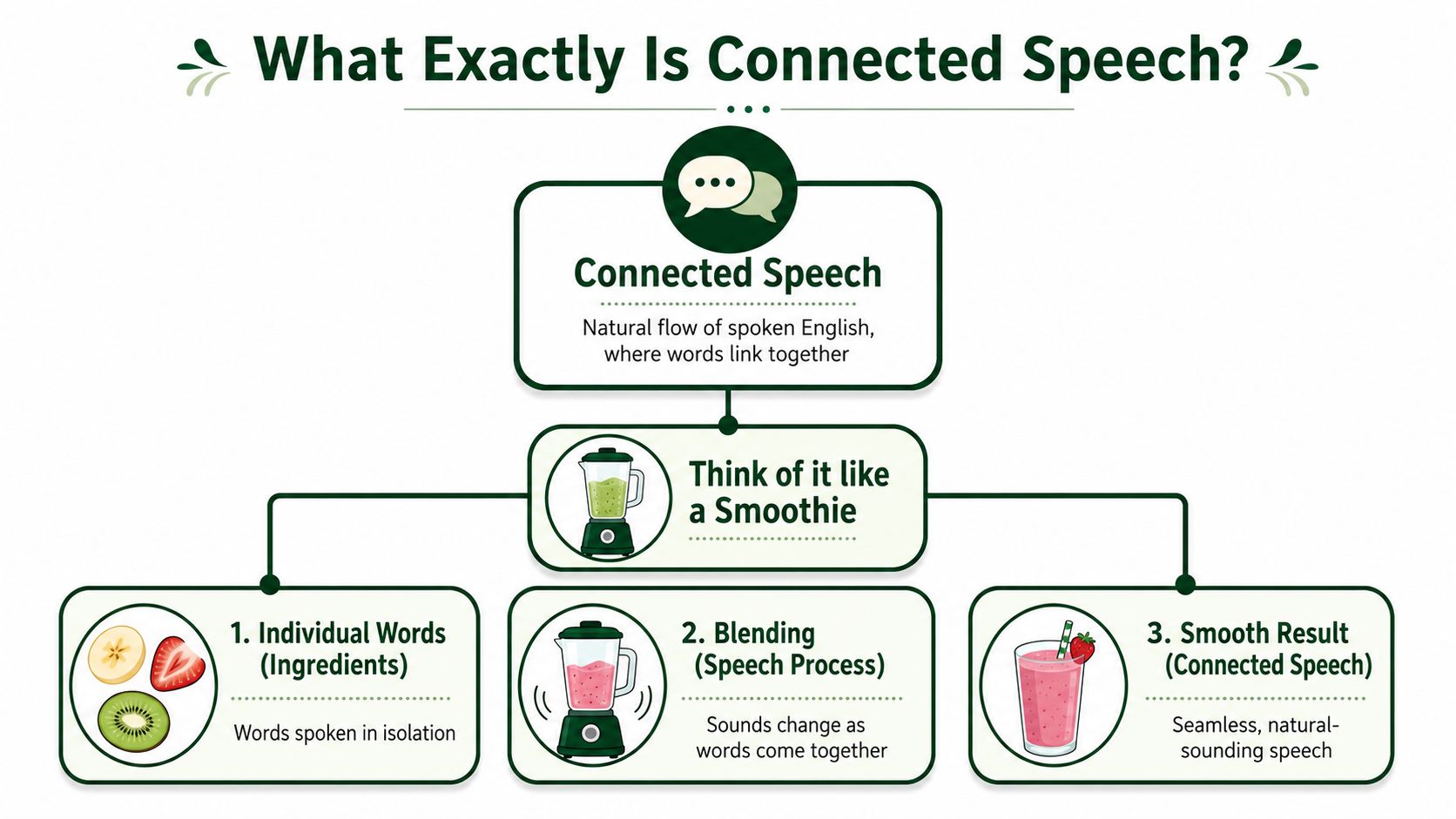
Connected speech means the way words change a little when people speak naturally in full sentences. Instead of saying every word carefully and separately, speakers group words into chunks and keep the voice moving.
Imagine a smoothie. Fruit pieces are separate before blending. After blending, they become one smooth drink. In speech, single words are like the separate pieces. Connected speech is the blended result.
It's about flow, not just speed
A common mistake is thinking, “I need to speak faster.” But connected speech is not primarily a speed effect. It is a phonological pattern where speakers organize words into thought groups and maintain vocal continuity across word boundaries, so word boundaries can become less clear in fluent speech, as explained in this pronunciation lesson on thought groups and flow.
That means a learner can speak quickly and still sound unnatural if they pause in the wrong places. Another learner can speak more slowly but sound smoother because they group words well.
What are thought groups
A thought group is a small chunk of meaning. Instead of saying every word alone, speakers often say a short phrase as one sound unit.
For example:
- I want to go
- Ultimately
- could you help me
- when I arrived
Each phrase tends to flow as one group.
If you pause between every word, listeners hear effort. If you group words by meaning, listeners hear rhythm.
Why learners get confused
The tricky part is that the spelling doesn't show these changes clearly. On paper, every word looks stable. In speech, sounds can link, disappear, or weaken.
That doesn't mean you must copy every casual form you hear. Some patterns are useful to imitate. Others are more important to recognize when listening. A good goal is simple: hear more clearly, then choose a few natural patterns that make your own speech smoother without making it unclear.
The Four Main Rules of Connected Speech
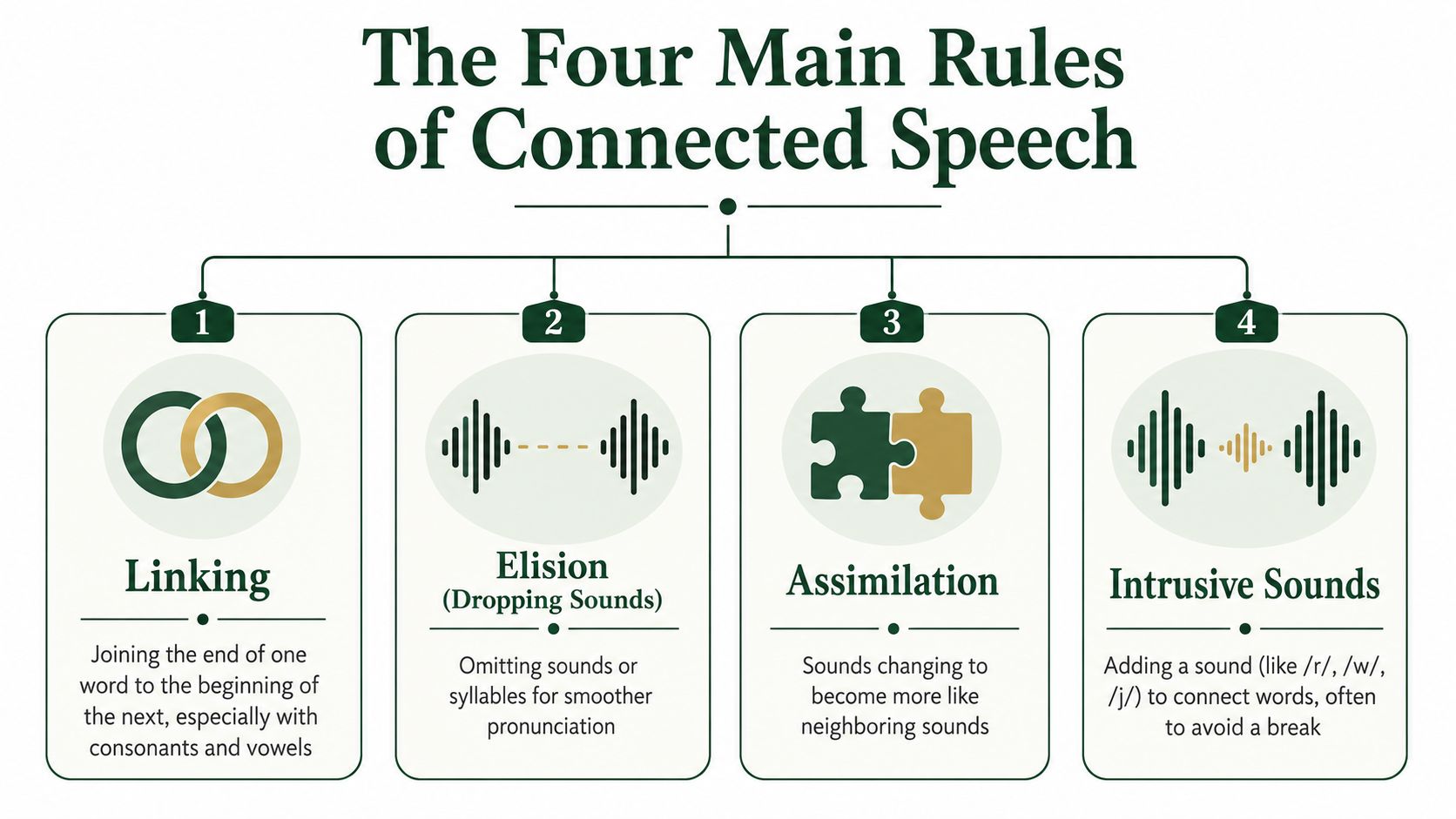
The most useful patterns to notice are linking, elision, assimilation, and reduction. A technical overview of connected speech identifies linking, assimilation, intrusion, elision, and weak forms as core mechanisms, and notes that weak forms reduce function words in fast speech, as described in this connected speech explanation.
For B1 to B2 learners, these four are the best place to start.
Linking
Linking happens when the end of one word connects smoothly to the beginning of the next word.
This is very common when a word ends in a consonant sound and the next word begins with a vowel sound.
Examples:
- pick it up becomes something closer to pi-kit-up
- an apple sounds closer to a-napple
- turn off can sound more joined, not like two separate words
Why does this happen? Because stopping completely between words takes more effort. Linking makes speaking easier and smoother.
A safe speaking habit is to link when it helps clarity. Don't force it. Just avoid hard, unnatural breaks between words.
Elision
Elision means a sound is dropped. Speakers often do this when a full pronunciation feels heavy or awkward inside a phrase.
Examples:
- next day may sound like nex day
- old friend may lose a sound in fast speech
- I don't know often sounds softer in the middle than the spelling suggests
Learners sometimes panic here because they think native speakers are “not saying the word.” In fact, they're saying it in a more efficient way.
Assimilation
Assimilation means one sound changes because of a nearby sound. The mouth gets ready for the next sound and adjusts.
Examples:
- good boy may sound like the final sound in good moves closer to the b sound
- handbag is often pronounced in a way that changes the middle sounds
- did you can sound more like didja
This is one reason phrases become hard to catch. You know both words, but the combined sound feels new.
Listening clue: When two words are hard to hear separately, ask yourself, “Did one sound change because of the next one?”
Reduction
Reduction is one of the biggest keys to natural listening. Small grammar words often become weaker in speech. These are usually function words like to, for, of, and, can.
Instead of full, strong pronunciation, they often use a weaker vowel sound.
Examples:
- want to becomes wanna in many casual contexts
- going to becomes gonna
- for may sound much weaker in a sentence than when spoken alone
- can is often weak in positive sentences, but stronger when stressed
These little words carry grammar, but they usually don't carry the main stress.
Which patterns are safest to imitate
Not every casual form is a good speaking target for every learner. A useful rule is:
- Safe to imitate often, smooth linking, natural weak forms, clear thought groups
- Use carefully, very strong reductions that may sound too casual in formal situations
- Focus mostly on decoding, heavy assimilation or very fast local accent forms
That approach helps you sound more natural without losing clarity.
Common Connected Speech Examples in Action
The easiest way to learn connected speech in English is to look at real phrases you hear all the time. One important fact helps explain these changes. Unstressed syllables are far more likely than stressed syllables to be reduced, deleted, or altered, which makes them the most common place for connected-speech change in English, according to this pronunciation teaching chapter.
So when a phrase sounds “different,” the change is often hiding in a weak, unstressed part.
Common Connected Speech Examples
| Phrase | What it Sounds Like | Pronunciation Guide | Key Process |
|---|---|---|---|
| What do you want to do? | Whaddaya wanna do? | wha-duh-yuh won-uh do | Reduction, assimilation |
| Did you eat? | Didja eat? | did-juh eat | Assimilation |
| Could you help me? | Couldja help me? | could-juh help me | Assimilation |
| Want to go? | Wanna go? | won-uh go | Reduction |
| Going to leave | Gonna leave | gon-uh leave | Reduction |
| Pick it up | Pi-kit-up | pi-ki-tup | Linking |
| Next day | Nex day | neks day | Elision |
| An apple | A-napple | uh nap-uhl | Linking |
| For a minute | Fər a minute | fer uh min-it | Reduction |
| I agree | I y-agree | ai yuh-gree | Linking |
How to use this table
Don't try to memorise every phrase at once. Pick a few that already appear in your life.
For example:
- Work English might include could you, want to, going to
- Daily conversation often includes did you, what do you, for a
- Films and videos are full of weak forms and linked sounds
Start with phrases you already know well in writing. Then train your ear to hear their spoken version.
How to Practice Your Connected Speech
Reading about these patterns helps. Saying them out loud helps more. Many learners keep searching for small, practical explanations of everyday forms like do you and what you, which shows that people want short, usable patterns they can practise in real speech, as noted in this discussion of learner demand for connected speech guidance.
The best practice is simple, short, and repeated.
Listen and echo
Choose one short line from a video, audio lesson, or conversation. Listen once. Then repeat it immediately, trying to copy the rhythm and flow, not just the words.
Focus on:
- The group, where the phrase starts and ends
- The stress, which word sounds strongest
- The joins, where words connect
Do this with one sentence several times, not with ten sentences once.
Mark the weak words
Take a short sentence and underline the important content words. Then circle the small grammar words.
Example:
- I WANT to GO to the SHOP
Now read it aloud. Keep want, go, and shop clearer. Let to and the be lighter.
This builds a more natural rhythm.
Read chunks, not single words
If you practise from text, don't pause at every space. Read in meaning groups.
Try:
- When I got home
- I wanted to call you
- but I was too tired
That kind of chunking improves both listening and speaking. For more ideas on building English into daily life, this article on how to live the language is a helpful next step.
Record and compare
Say one short phrase in two ways.
First, say it word by word.
Then, say it as a smooth thought group.
Example:
- Could / you / help / me
- Couldja help me
When you listen back, ask:
- Is the meaning still clear?
- Does the second version sound smoother?
- Did I keep the important word stress?
Don't try to sound dramatic or extra casual. Aim for smooth, clear, comfortable speech.
Start Speaking with More Confidence
Connected speech in English matters because real English is heard in phrases, not just in separate words. When you understand that, listening becomes less confusing. You stop blaming yourself every time speech sounds fast or messy.
It also helps your speaking. You don't need to copy every accent feature or every casual shortcut. You just need to speak in smoother groups, link naturally where it helps, and let small unstressed words stay light.
That is enough to make your English sound more relaxed and easier to follow.
If speaking still feels tense, that's normal. Confidence grows when practice feels safe and regular. This guide on how to build confidence speaking English can help you keep going without putting too much pressure on yourself.
Keep it simple. Notice one pattern, practise one phrase, and use it in real speech today.
If you want a calm place to practise speaking out loud, Verse can help. You can use it to talk, hear how your English sounds, and get honest feedback in a private, judgment-free way. If you'd like, try the demo and practise a few connected speech phrases until they start to feel natural in your own voice.