Best Language Learning Apps for Speaking: An Honest Guide
You know this feeling. You can read English. You understand podcasts if the speaker is clear. You may even know a lot of words. But then someone asks you a simple question, and your mind goes blank.
Your heart speeds up. You translate in your head. You worry about grammar. You think, “I know this. So why can't I say it?”
As a teacher, I see this all the time. The problem usually isn't that the learner needs more vocabulary. The problem is that they haven't had enough safe, repeated practice saying things out loud. Speaking is a different skill from knowing. It needs use, not just study.
That's why many learners start looking for the best language learning apps for speaking. They don't want another word list. They want a way to open their mouth, try, make mistakes, and keep going without shame.
Table of Contents
- The First Step to Speaking Is Not Learning More Words
- Why Speaking Apps Are Effective for Practice
- A Quick Comparison of Top Speaking Apps
- Detailed App Reviews for Speaking Practice
- Best Speaking Apps for Your Specific Goals
- How to Choose the Right Speaking App for You
- Building a Speaking Habit with Your App
The First Step to Speaking Is Not Learning More Words
A lot of learners think, “I'll start speaking when I know more.” That sounds logical, but it often keeps you stuck for years.
I've taught learners who could explain grammar rules perfectly on paper, but froze when ordering coffee or introducing themselves in a meeting. They didn't fail because they were lazy. They failed because they trained the wrong part of the skill. Reading and speaking are connected, but they are not the same.
Why many learners still feel stuck
Language apps are everywhere now. The category had 231 million downloads in 2023, and one app alone accounted for 60% of all usage, according to Business of Apps' language-learning app market data. That tells us something important. A huge number of learners use general apps, but many of those apps are built around taps, streaks, and short written exercises.
That style can help you start. It often doesn't help enough when your real problem is speaking fear.
You don't build speaking confidence by staying silent and choosing answers on a screen.
What the first real change looks like
The first step is simple. Stop asking, “How can I learn more English?” Start asking, “How can I use the English I already know today?”
That change matters. If you know basic phrases like “I think,” “I need,” “I want to,” and “In my opinion,” you already have enough language to begin building speaking strength. You don't need perfect sentences. You need repetitions.
A better daily plan is often:
- Say one short answer out loud instead of only reading it.
- Repeat one useful phrase in three different situations.
- Talk for one minute about your day, even if your English is simple.
If you've been stuck in study mode, try adding more lived English to your routine with simple ways to live the language every day. It helps shift English from “school subject” to “something I use.”
Why Speaking Apps Are Effective for Practice
Speaking improves when your brain learns to find words fast, and your mouth learns to say them with less tension. That's why speaking practice works best when it is active, not passive.

Speaking is a use skill
Think about learning to swim. You can watch videos about swimming. You can read about breathing technique. You can memorize the names of different strokes. But if you never get in the water, your body won't learn what to do.
Speaking is similar. You can study grammar for months and still struggle in a real conversation. Your brain needs practice pulling language out under a little pressure. Your mouth needs practice forming sounds, linking words, and continuing after a mistake.
That is why many learners improve faster when they start answering questions aloud, retelling stories, or reacting in real time.
Active recall matters
A flashcard asks you to recognize. A speaking prompt asks you to produce.
That difference is huge. When you speak, you train active recall. This means you must find the words yourself, build the sentence, and say it. That process is harder, but it is also closer to real life.
Here is a simple example:
- You read “appointment” and think, “Yes, I know that word.”
- Then someone asks, “Why were you late?”
- Now you must say, “I had a doctor's appointment this morning.”
The second task is much harder. It is also the one that helps you speak in practical situations.
Practice can lead to real speaking gains
Research on Babbel found that almost 60% of participants improved in oral proficiency, as summarised by Michigan State University's note on language app effectiveness. That matters because it shows app-based learning can support speaking outcomes, not only vocabulary study.
The same research also noted that these apps are especially useful for vocabulary and phrases, and often fit beginners through low-intermediate learners best. That's one reason many speaking apps use short, repeatable conversation patterns.
Practical rule: Don't wait until you feel ready to speak. Speaking is what helps you become ready.
A Quick Comparison of Top Speaking Apps
Before you choose anything, it helps to know what you're comparing. Most speaking apps are not trying to do the same job.
Some focus on open conversation. Some guide you through scripted roleplay. Some are strongest at instant correction. Others are useful mainly because they make daily practice feel less stressful.
Top Speaking Apps at a Glance
| App | Main Speaking Feature | Feedback Type | Best For | Pricing |
|---|---|---|---|---|
| Verse | Unscripted AI conversation | Grammar, vocabulary, fluency, pronunciation, more natural phrasing | Private daily English speaking practice, especially for intermediate and advanced learners | Paid subscription |
| General structured speaking app | Guided speaking drills and short roleplays | Usually sentence correction and prompt-based practice | Learners who want clear daily tasks | Varies |
| General scenario app | Situational conversations such as travel, work, or social talk | Usually feedback after each exchange or at the end | Learners who want practical topic practice | Varies |
| General open conversation app | Free talk with an AI partner | Usually transcript, reformulation, and speaking notes | Learners who want flexible conversation | Varies |
| General classroom style app | Tutor-like lessons with speaking turns | Usually lesson based correction and coaching | Learners who prefer teacher-like structure | Varies |
How to read this table
The most important column is often Main Speaking Feature. That tells you what kind of speaking the app trains.
If you only get short scripted questions, you may build basic confidence, but you may not get much practice with longer answers. If the app allows open conversation, you can train flow, turn-taking, and recovery when you get stuck.
The second key column is Feedback Type. Good speaking feedback should help you answer three questions:
- What was correct
- What sounded unnatural
- What should I say next time
If an app gives only a score, that may not be enough. Scores can motivate you, but they don't always teach you.
What many learners miss
A lot of people choose an app by design, popularity, or how many lessons it has. For speaking, the better question is this:
Will this app help me speak out loud often, even on tired days?
That's usually the ultimate test. The best language learning apps for speaking are the ones you'll use when you feel shy, busy, or not fully ready.
Detailed App Reviews for Speaking Practice
The speaking app market is still growing fast. One forecast values the market at $38.01 billion by 2035, as a projection from Market Research Future's language-learning apps report. More demand usually means more features, especially around AI conversation and feedback.
That sounds good, but it can also make the choice confusing. More features don't always mean better practice.
What a Good Speaking Session Should Feel Like
A useful speaking session should feel active, clear, and safe.
You speak first. The app responds naturally. You can see what you meant, what you said, and how to improve it. Then you try again.
If any of these parts is missing, progress gets slower. For example, if the conversation feels unnatural, you may not stay engaged. If the correction is too vague, you won't know what to fix. If the app feels stressful, you may avoid it.
Verse
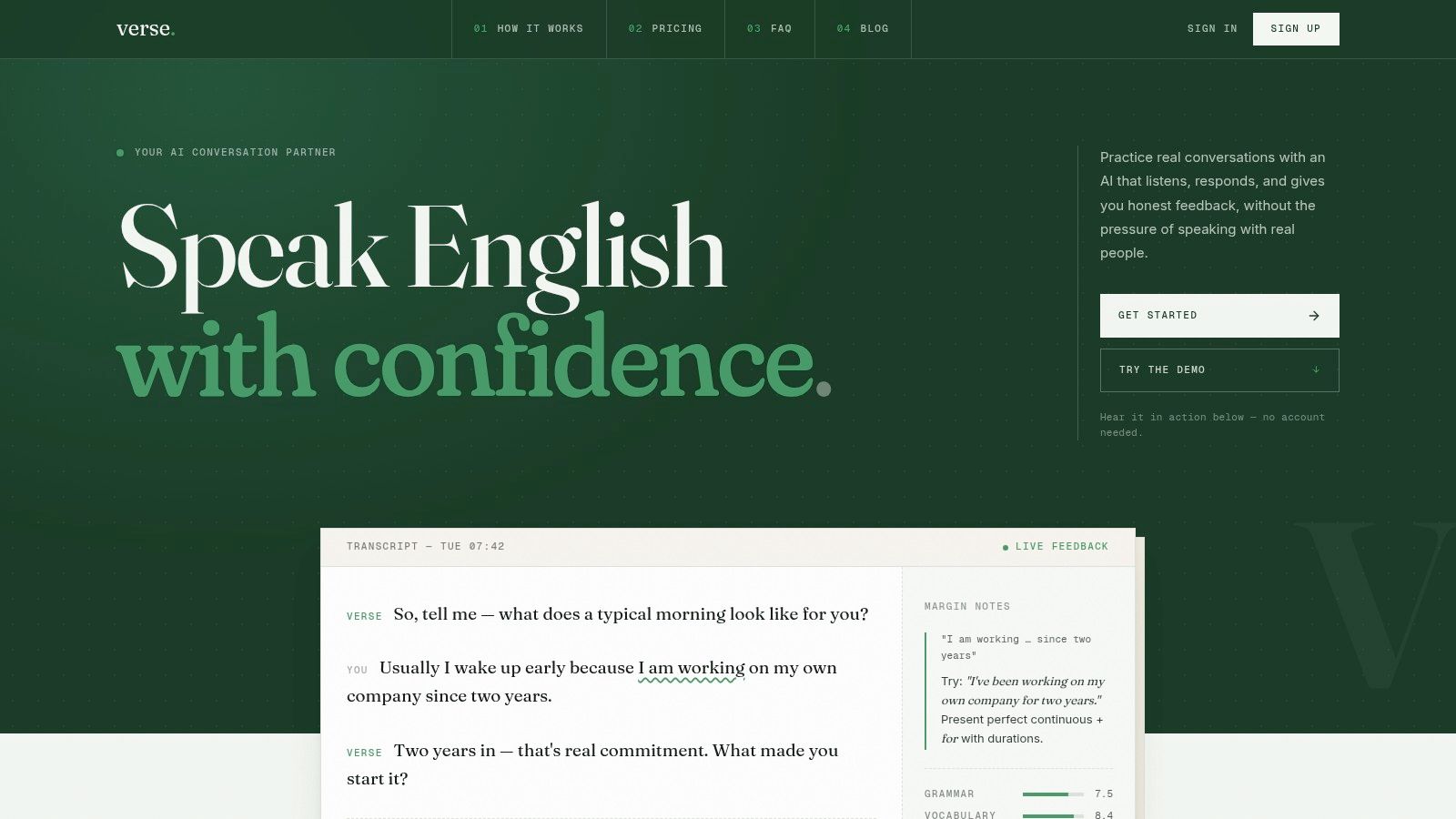
Verse is built for learners who want to speak English out loud and get honest, specific feedback after every turn. Instead of following a fixed script, you press record, speak, and continue the conversation in a more natural way.
A typical session works well for common real-life needs. You can practise small talk, a work meeting, an interview answer, or an exam style response. After you speak, the feedback focuses on grammar, vocabulary, fluency, and pronunciation. It also points out phrasing that is correct but not very natural.
What stands out: The feedback doesn't only tell you what is wrong. It helps you see how to sound more natural in context.
That matters for learners who are no longer beginners. Many people at this stage can already make correct sentences. Their next challenge is sounding smoother, more natural, and less translated.
If you want a closer look at this style of practice, this guide to English conversation practice apps shows what to look for in tools that focus on actual speaking.
Structured Roleplay Apps
Some learners do better with a clear path. In these apps, a session usually starts with a prompt such as introducing yourself, ordering food, or answering a simple work question.
This is useful when open conversation feels too hard. You don't have to invent the topic. The structure lowers pressure and helps you get early repetitions.
The downside is that you can outgrow the format. If every conversation is tightly guided, you may become good at completing tasks but still struggle when a real person changes the topic.
Structured roleplay is often best when your biggest problem is starting, not when your biggest problem is flexibility.
Scenario Based Speaking Apps
These apps organise practice around situations such as travel, customer service, presentations, or interviews. They are often practical because they teach language in context.
A typical session might ask you to check into a hotel, explain a delay, or describe your experience in a job interview. That's useful if you need speaking for one clear purpose.
They can be less helpful if you want broad fluency. Real conversations move. People interrupt, ask follow-up questions, and use unexpected phrasing. Scenario practice helps, but it works best as one part of a wider routine.
Open Conversation Apps
Open conversation apps are usually the closest to real speaking. You can talk more freely, change direction, and test longer answers.
This format is especially helpful for intermediate and advanced learners. It lets you practise transitions, opinions, stories, and repair strategies. In simple words, you learn how to continue when the conversation doesn't go exactly as planned.
The challenge is that open conversation can feel difficult on low-energy days. If the app gives no guidance, some learners don't know what to say. The best version of this format gives freedom, but also offers conversation starters or guided situations when needed.
Best Speaking Apps for Your Specific Goals
The right app depends less on features and more on your real goal. “I want to improve speaking” is too broad. You need to know what kind of speaking you want to improve.
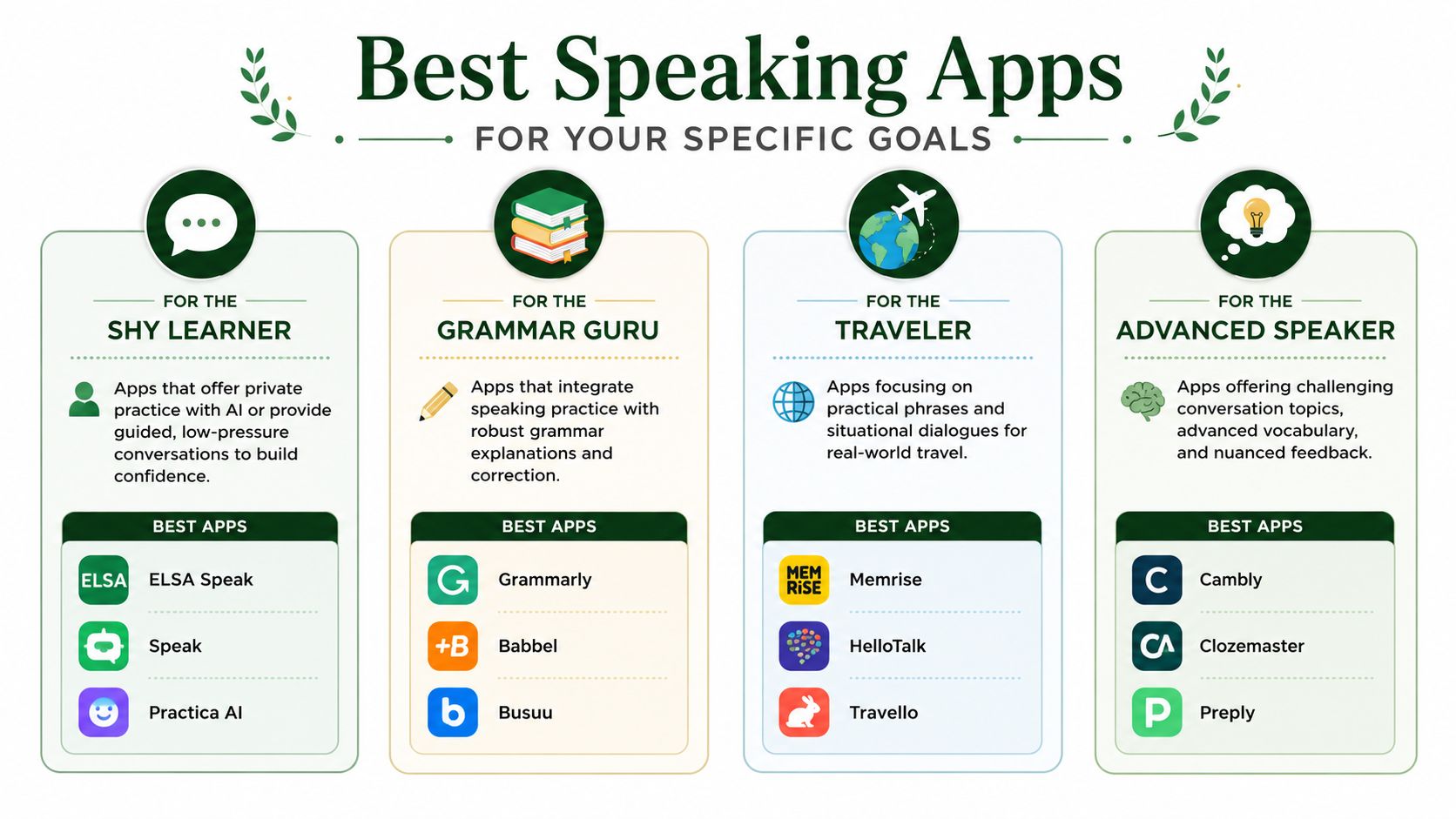
For the Shy Learner Who Needs Confidence
If speaking makes you nervous, private practice matters more than almost anything else. You need a space where you can pause, try again, and make mistakes without feeling judged.
For this learner, the best app is usually one with:
- Private speaking time, so there is no social pressure
- Fast feedback, so you learn while the moment is fresh
- Short sessions, because long practice can feel heavy at first
A guided or AI-based tool often works well here because it removes the fear of bothering another person. You can speak badly and keep going. That is a gift when confidence is low.
For the Professional Preparing for Meetings
Work English is not only grammar. It is also tone, clarity, and speed.
A professional learner often needs to practise:
- Giving updates, such as “Here's where the project stands”
- Handling questions, especially unexpected ones
- Polite disagreement, for example “I see your point, but I'd suggest another option”
For this goal, choose an app that lets you practise longer answers and realistic work situations. Open conversation is useful here because meetings are rarely fully scripted. You need room to explain, clarify, and react.
A simple habit works well. Record one short meeting update every day. Then practise one follow-up question, such as “Can you clarify the timeline?” or “What's the main priority for this week?”
For the Student Practicing for an Exam
Exam speaking is a special kind of pressure. You often need to answer within a time limit, stay organised, and sound clear even when you feel nervous.
The best app for this goal usually gives you:
- Prompt based speaking, so you can practise common task types
- Feedback on fluency and grammar, because both affect performance
- A chance to repeat, so you can improve your answer the second time
For exam learners, structure matters. It helps to use a simple answer frame, such as opinion, reason, example, conclusion. That keeps your speech moving when your mind feels blank.
For the Advanced Learner Who Wants to Sound Natural
This is the most ignored group.
Many advanced learners are already understandable. Their problem is different. They sound correct, but slightly stiff. Their word choice may be accurate, but not quite natural for the situation.
Independent reviews note this gap clearly. Advanced learners often need unscripted conversation practice and nuanced feedback on idiomatic phrasing, not only beginner-style drills, as discussed in this analysis of AI speaking apps.
If you're advanced, don't ask only, “Did I make a mistake?” Ask, “Is this how people really say it?”
For this level, open conversation plus detailed phrasing feedback is usually the strongest combination. It helps you improve turn-taking, natural transitions, and more native-like wording.
How to Choose the Right Speaking App for You
A lot of learners spend too much time searching and too little time speaking. The goal is not to find the perfect app forever. The goal is to find the right app for your next stage.
Five Questions to Ask Yourself
Ask yourself these before you choose:
- Do I need privacy or social pressure? If speaking anxiety is high, private practice may help you stay consistent.
- Do I want structure or freedom? Some people need a daily path. Others get bored unless they can talk freely.
- Do I need correction after every turn? Some learners want immediate feedback. Others mainly need more speaking time.
- Am I practising for life, work, or an exam? The answer changes what kind of prompts and feedback will help most.
- Can I use this on a normal day? Not your best day, your normal day. That is the ultimate test.
If you answer these truthfully, your choice gets easier.
What Matters More Than Features
Many learners prefer AI-based practice for convenience, privacy, and lower speaking pressure, as reflected in learner-facing app positioning on Google Play. That doesn't mean human practice is bad. It means many people speak more often when they feel safe.
This is why consistency matters more than app prestige.
Look for an app that helps you do these things:
- Start quickly, without too many decisions
- Speak out loud often, not just read
- Review mistakes easily, without feeling overwhelmed
The best speaking app for you is the one that makes tomorrow's practice feel possible.
If an app is excellent but you avoid opening it, it isn't the right fit right now.
Building a Speaking Habit with Your App
Good speaking practice is usually short, regular, and boring in the best way. It becomes part of life, like brushing your teeth.
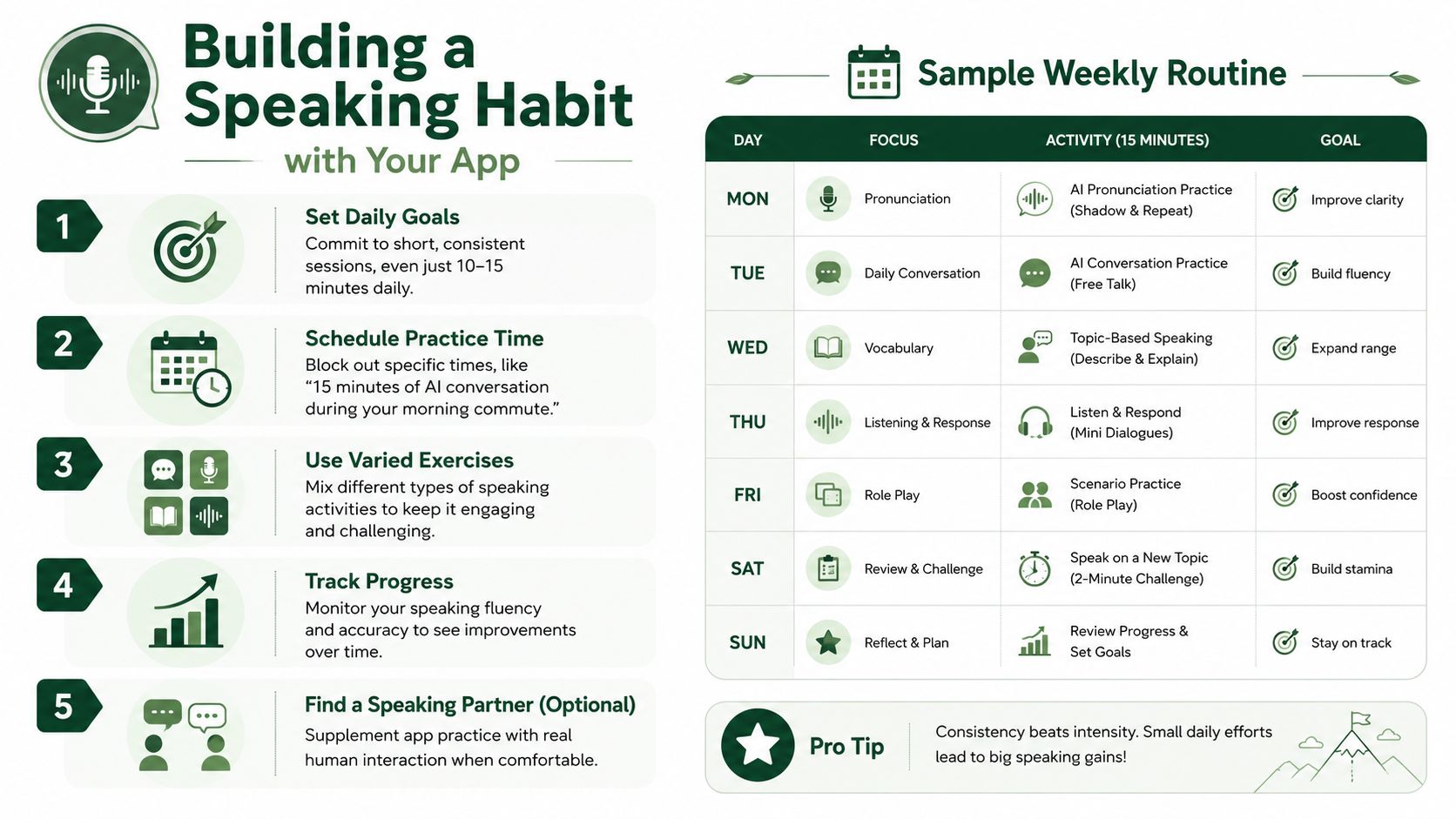
A Simple Weekly Routine
You do not need a long daily session. A small routine is often stronger.
Try this:
- Monday, speak for 10 to 15 minutes about your weekend
- Tuesday, answer three work or study questions out loud
- Wednesday, describe a photo, room, or memory
- Thursday, practise one opinion topic for one or two minutes
- Friday, retell something you watched or read
- Saturday, do a longer free conversation
- Sunday, review common mistakes and repeat better versions aloud
This kind of routine works because it is light. You can do it before work, after dinner, or during a quiet break.
If you want more ideas for flexible daily routines, this guide to practising English speaking online gives simple ways to fit speaking into busy days.
What to Talk About When You Don't Know What to Say
This is a common problem, especially for shy learners. Keep a small list of safe topics on your phone.
Useful prompts:
- Your day, what happened and how you felt
- Your work, one task you finished or one problem you solved
- Your opinion, for example whether remote work is better
- Your future, plans for the weekend or this year
- A story, something funny, stressful, or surprising
Say less, but say it out loud. That is better than reading more and staying silent.
If you're ready to stop only studying and start speaking, Verse gives you a calm place to practise spoken English with honest feedback on grammar, vocabulary, and fluency. If you want to see how it feels before committing, you can also try the no-signup demo and have your first conversation at your own pace.