Best English Learning App for Adults: Top Picks 2026

You may know a lot of English already. You can read emails, watch videos, and understand grammar rules. But when it's time to speak, your mind goes blank. You pause, translate in your head, and worry that your sentence sounds wrong.
If that feels familiar, you're not behind. You're dealing with a very common adult learning problem. Many apps help you study English, but far fewer help you speak it with calm, steady confidence.
That's why choosing the best English learning app for adults can feel confusing. The actual question isn't “Which app is most popular?” It's “Which app helps me speak more easily in my real life?”
Table of Contents
- Why Choosing an English App Feels So Hard
- First Find Your English Learning Goal
- Four Types of English Learning Apps
- Essential Features for Speaking Practice
- Your Checklist for Testing a New App
- Start Speaking with More Confidence Today
Why Choosing an English App Feels So Hard
A lot of adults download an English app with hope. For a few days, it feels good. You answer quizzes, learn new words, and keep a short streak. Then a real speaking moment comes. A meeting. A phone call. A chat with a stranger. Suddenly, all that study doesn't feel enough.
That gap is frustrating because it makes you think the problem is you. It usually isn't. Often, the underlying issue is that you chose a tool for studying about English, not for using English out loud.
Many adult learners have the same pattern. They know basic grammar. They can often spot mistakes when reading. But they freeze when they need to answer quickly. They worry about pronunciation, word choice, or sounding awkward. If that sounds like you, you might enjoy these practical ideas for building confidence when speaking English.
Practical rule: If speaking is your goal, the app must ask you to speak often, not just tap, match, and read.
The hard part is that app stores mix everything together. A vocabulary trainer, a grammar course, a live lesson platform, and a speaking tool might all sit under the same label. They all promise “learn English,” but they solve very different problems.
That's why a simple “top picks” list often doesn't help much. An adult preparing for job interviews needs something different from a traveler who wants easy small talk. A shy learner needs something different from a person who enjoys live classes.
The best English learning app for adults is usually the one that matches your speaking goal, your personality, and your daily routine. Once you know how to judge that fit, the choice gets much easier.
First Find Your English Learning Goal
Before you choose any app, stop and ask one simple question. What kind of speaking do I need English for?
That answer changes everything. An app can look impressive and still be the wrong choice for you if it trains the wrong skill.

Start with one real situation
Think about the moment when you most want better English. Be very specific.
Maybe it's one of these:
- Work conversations: You need to explain your ideas clearly in meetings, interviews, or presentations.
- Travel situations: You want to ask questions, solve problems, and chat politely without stress.
- Exam speaking tasks: You need to answer quickly, stay organized, and speak for a set time.
- Daily conversation: You want to make friends, join group chats, or talk more naturally with colleagues.
- Customer-facing communication: You need calm, clear English when helping clients or solving issues.
A broad goal like “I want to be fluent” is too hard to use. A clearer goal would be, “I want to answer interview questions without freezing,” or “I want to handle travel problems at the airport and hotel.”
Turn a big wish into a clear target
Try this short exercise. Write down your answers in one minute.
- Where do I need English most often?
- Who do I speak English with?
- What do I usually struggle with?
- What would make me feel proud after one month of practice?
Your answer might look like this:
“I need English for weekly team meetings. I understand most things, but I speak too slowly and lose words. I want to give a short update without long pauses.”
That kind of goal helps you choose better. It tells you to look for conversation practice, quick-response training, and useful corrections. It also tells you what you can ignore. If an app mainly teaches isolated words or long reading exercises, it may not be a strong fit.
Here's another helpful filter:
- If your problem is fear, you need low-pressure speaking practice.
- If your problem is accuracy, you need clear correction.
- If your problem is speed, you need more real-time speaking turns.
- If your problem is topic-specific language, you need realistic scenarios.
A lot of confusion disappears when you do this first. You stop asking, “What is the best app?” and start asking, “What is the best app for my kind of speaking?”
That's a much smarter question.
Four Types of English Learning Apps
You open the app store, search for an English app, and see dozens of options that all promise progress. One says it will build your habit. Another focuses on grammar. Another offers live speaking. Another gives you AI chat practice at any hour. For many adults, the hard part is not finding an app. It is knowing which type matches the kind of speaking problem they want to fix.
That is why it helps to sort apps into a few clear groups first. Once you can recognize the type, you can judge it by your goal instead of by its design, popularity, or marketing.
Why the market feels crowded
There are a lot of language apps competing for your attention. According to Business of Apps' language-learning app market data, the global language-learning app market generated $1.08 billion in revenue in 2023 and reached 231 million downloads that year.
That size explains a lot. Many apps are built to keep learners returning every day. For adults who want to speak with more confidence, that can be misleading. An app can be good at building a streak and still give you very little real speaking practice.
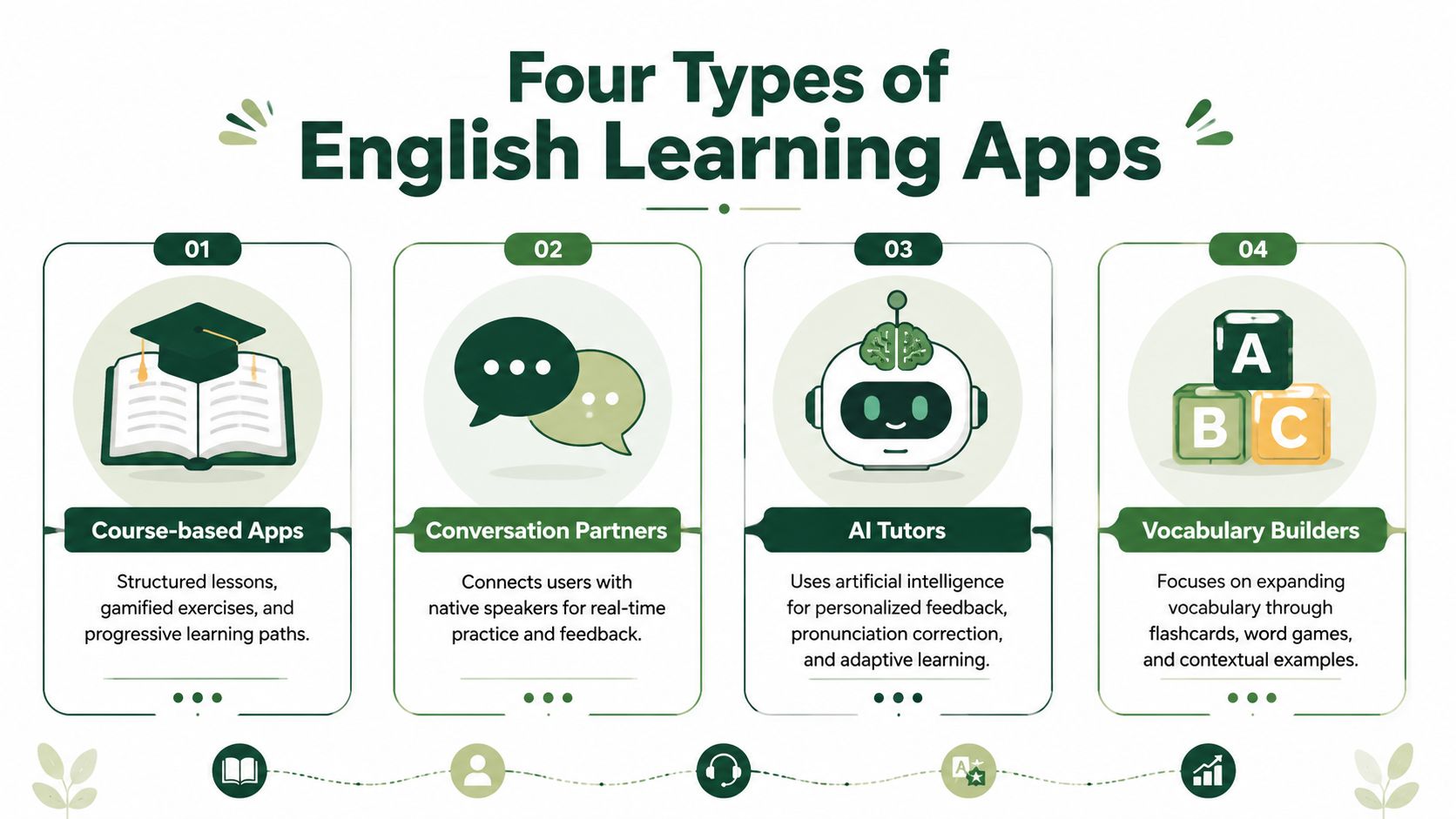
The four main groups
1. Course-based apps
These apps follow a lesson path. You move step by step through short activities, review key words, and practice sentence patterns. That structure works well for adults who want a routine or need to rebuild basics after a long break.
The limit is simple. Guided lessons often check recognition more than real production. You may understand the correct answer on screen and still freeze when a real person asks you a question. If your goal is to speak more easily under pressure, this type usually needs to be paired with something more interactive.
2. Tutor marketplaces
These apps connect you with a real teacher for live sessions. That gives you something many self-study tools cannot give clearly: human timing, natural follow-up questions, and correction that fits your exact mistake.
This type is often strong for adults preparing for interviews, meetings, presentations, or daily conversation with coworkers. It can also be helpful if anxiety is part of the problem, because a good teacher can lower the pressure and guide you one step at a time. Still, live lessons are not the best first step for everyone. Some learners need private rehearsal before they feel ready to speak with another person.
3. Grammar and vocabulary builders
These apps focus on memory and accuracy. They help you review words, phrases, verb forms, and common sentence patterns. Used well, they are like a toolbox. They give you materials you can use later in conversation.
But a toolbox is not the same as building the house. Many adults stay in review mode because it feels safe. They keep collecting words, yet they do not practice pulling those words out quickly in real time. If your main struggle is hesitation, this category supports speaking, but rarely solves the problem by itself.
4. AI conversation partners
These tools let you practice on demand. You speak, the app responds, and you try again. For busy adults, that can remove two common barriers at once: scheduling and fear of being judged too early.
This type is especially useful for learners who know enough English to start speaking but need more low-pressure repetition. You can practice the same situation several times, such as introducing yourself, answering a meeting question, or making small talk. That repeatability matters. Confidence usually grows from many small speaking turns, not from one perfect lesson. If you want to explore tools built around that kind of practice, this guide to language learning apps for speaking practice offers a helpful next step.
One simple way to choose is to ask: Where do I need the most speaking turns?
Comparing English Learning App Types
| App Type | Best For | Main Activity | Example |
|---|---|---|---|
| Course-based apps | Building routine and basic structure | Short lessons and guided exercises | Daily study path |
| Tutor marketplaces | Live speaking and personal correction | One-on-one conversation sessions | Scheduled lesson with a teacher |
| Grammar and vocabulary builders | Reviewing language forms | Flashcards, drills, and word review | Phrase practice set |
| AI conversation partners | Flexible speaking practice | Real-time spoken interaction and feedback | On-demand conversation session |
Many adults do best with a mix. A structured app can help you stay consistent. A vocabulary tool can help you remember useful phrases. A speaking tool, whether human-led or AI-based, gives you the practice that turns knowledge into action.
If speaking anxiety is your biggest obstacle, start with the type that makes practice feel safe enough to repeat. The best app for you is not the one with the most features. It is the one that helps you open your mouth and keep going.
Essential Features for Speaking Practice
You open an app after work, ready to practice English for ten minutes. Instead of speaking, you tap matching exercises, fill in blanks, and answer multiple-choice questions. By the end, you studied English, but you still did not say much out loud.
That gap matters for adults who want to speak with more confidence. Many apps help you recognize English. Fewer help you produce it under pressure, recover from mistakes, and keep talking when you feel nervous.
Speaking improves through a simple cycle. You say something. You notice what feels hard. You get clear feedback. Then you try again. That repeatable cycle matters far more than flashy design or long feature lists.
What Helps Adults Speak
If your goal is conversation, judge the app by behavior, not branding. Ask a practical question: what does this app train me to do every day?
An app can be good for vocabulary and still be weak for speaking. That confuses many learners. They assume progress in one area will automatically transfer to conversation. Sometimes it does. Often it does not, at least not fast enough to reduce speaking anxiety.
A useful speaking app works like a driving lesson, not a manual. Reading rules has value. Real improvement comes from practice on the road, with guidance while you are doing the hard part.
If you want more examples of what strong speaking tools include, this guide to language-learning apps for speaking practice is a helpful next step.
Five features worth checking carefully
1. Spoken output is built into the practice
Adults who feel shy often stay in the safest lane. They read, tap, and type because those tasks feel easier to control. A better app gently removes that escape route and makes speaking a normal part of the session.
Look for tasks that ask for full spoken answers, not one-word responses. The goal is to build the habit of opening your mouth even when you are unsure.
2. Feedback tells you what to fix
Good feedback is specific and easy to use. If your sentence sounds unnatural, the app should show what changed and why. Was the problem grammar, pronunciation, word choice, or sentence order?
For example, if you say, “I have much work today,” useful feedback should guide you toward “I have a lot of work today” and help you hear the difference. That kind of correction teaches faster than a simple red X.
3. Practice sounds like real life
Adults learn faster when practice matches the situations they care about. If you need English for meetings, interviews, travel, customer calls, or casual small talk, the app should let you rehearse those moments directly.
Here is a simple check. If the app cannot help you practice a conversation you expect to have next week, it may not fit your real speaking goal.
4. The environment feels private and low pressure
This feature is easy to underestimate. Many adults do not avoid speaking because they are lazy. They avoid it because speaking can feel exposing. Mistakes are public. Pauses feel long. Your brain goes blank.
A low-pressure practice space helps you speak more often, and frequency matters. Confidence usually grows from many manageable speaking turns, not from one perfect performance.
5. Progress is visible in a way you can feel
Speaking progress can be hard to notice from day to day. You may still feel awkward and assume nothing is changing. Then one morning you answer faster, search less, or recover from a mistake without freezing.
A helpful app makes that progress easier to see. It might show improvements in fluency, pronunciation, response length, or repeated errors. Clear signs of growth help adults stay consistent, especially during the stage when confidence is still fragile.
You can judge these features with five quick questions:
- Output: Does the app ask you to speak in full sentences?
- Feedback: Are corrections explained in plain language?
- Relevance: Do the topics match your work, travel, study, or daily life?
- Comfort: Do you feel calm enough to keep going after a mistake?
- Progress: Can you tell what improved from one session to the next?
For many adults, the best English learning app is the one that reduces avoidance. It gives you enough support to start speaking, enough safety to continue, and enough feedback to improve without feeling overwhelmed.
Your Checklist for Testing a New App
A good app on paper can still feel wrong when you try it. That's why testing matters. You don't need a long trial period to learn a lot. One focused session can tell you whether the app supports your speaking goal or just looks attractive.
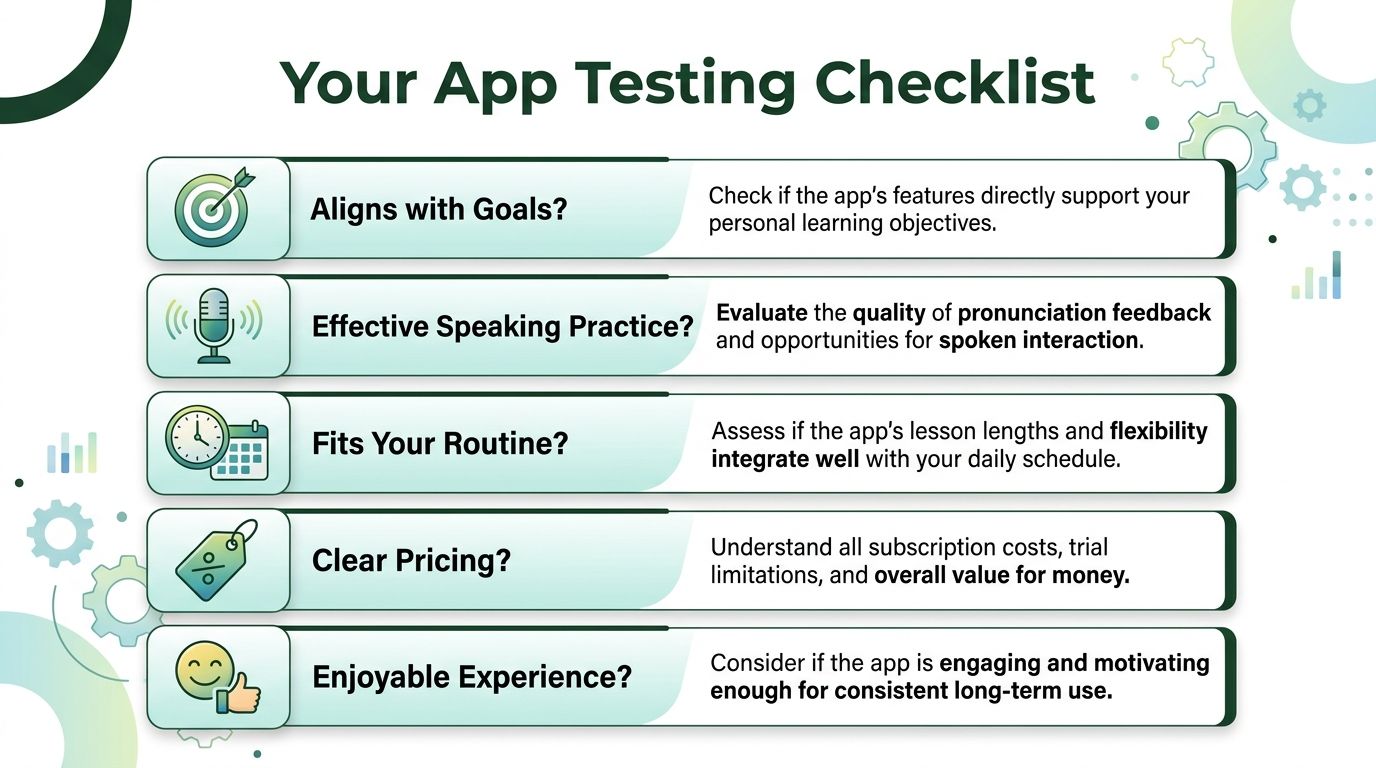
Try the app like a real learner
Don't test it by clicking around for ten seconds. Use it the way you'd really use it on a normal day.
Pick one simple topic first. For example, talk about your job, your weekend, or a problem you often explain in English. Speak for a few minutes, even if your sentences are not perfect.
Then pay attention to your experience:
- Goal fit: Does the practice match the kind of English you need?
- Speaking time: Are you talking, or mostly reading prompts?
- Feedback quality: Are the corrections easy to understand and useful?
- Emotional comfort: Do you feel embarrassed, rushed, or calm enough to continue?
- Routine fit: Could you see yourself using this on a busy weekday?
If a tool offers a demo, use it. A short test is often enough to notice whether the speaking experience feels natural and supportive.
Questions to ask after one short session
After you test the app, answer these truthfully.
- Could I speak for at least a few minutes without getting stuck by the format?
- Did the app help me notice one real speaking habit I should improve?
- Would I want to come back tomorrow, or did it feel like homework?
- Can I imagine using this for my exact goal, not just general study?
- Is the pricing clear before I commit?
If an app makes you avoid speaking, it doesn't matter how pretty the design is.
You can also try one comparison test. Use the same topic in two short sessions on different apps. Talk about “Describe your job” or “Tell me about a difficult day at work.” Then compare how much you spoke, how useful the feedback was, and how you felt during practice.
That emotional part is important. Adults often ignore it and only look at features. But comfort matters because it affects consistency. If the app feels stressful in a bad way, you probably won't use it enough.
The best app is not the one with the longest feature list. It's the one that helps you speak again tomorrow.
Start Speaking with More Confidence Today
Choosing the right app gets easier when you stop searching for a universal winner. You need a tool that fits your life, your goal, and your current speaking problem.
A good app should fit your real life
If you need English for work, the app should help you practice work-like conversations. If you freeze when speaking, the app should give you a calm place to try, fail, correct, and try again. If your schedule is busy, the app should make short practice sessions easy.
That's why many adults do better when they choose for usefulness, not popularity. A tool can be famous and still not help with your exact kind of speaking.
For readers who want more ideas for regular practice, this guide to an English conversation practice app for daily speaking may help you build a routine that feels manageable.
Confidence grows from use, not from collecting apps
A lot of learners spend months choosing tools and very little time speaking. That's understandable. Researching feels safe. Speaking feels risky.
But confidence usually grows in a simpler way. You speak a little. You get feedback. You notice one improvement. Then you speak again.
Try to keep your next step small. Don't promise yourself two hours a day. Promise yourself one short speaking session on a real topic. Introduce yourself. Describe your work. Explain your weekend plans. Ask and answer common questions out loud.
That is how English starts to feel more available, not just more familiar.
The best English learning app for adults is often the one that helps you build this habit with the least fear and the clearest support. When you choose with that standard, you're much more likely to find something that helps.
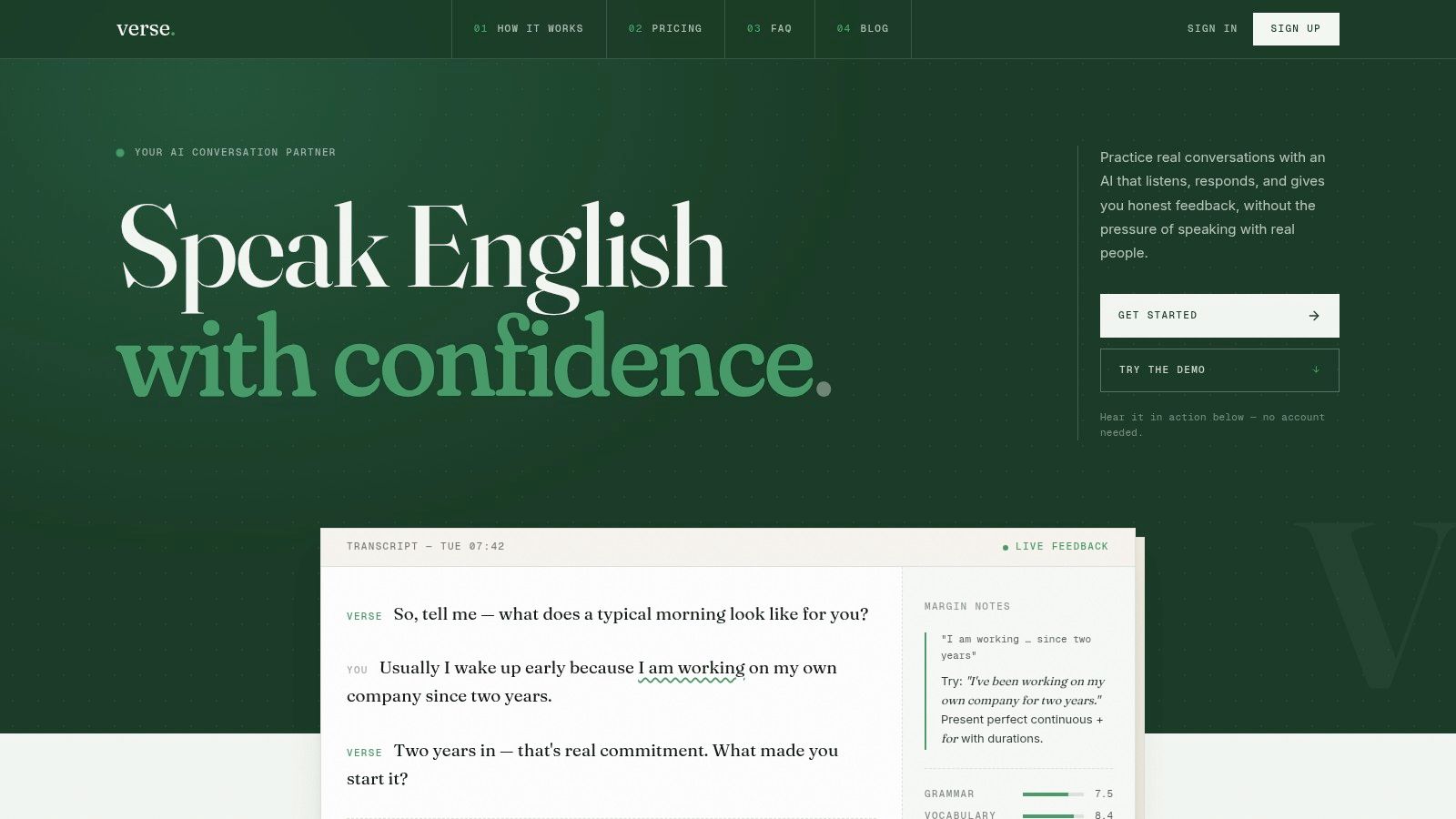
If you want a calm place to practice spoken English, Verse is built for that. You can speak out loud, get honest feedback on grammar, vocabulary, fluency, and pronunciation, and practice private conversations without pressure. If you're curious, you can try Verse's no-signup demo and see whether it feels like a good fit for your daily speaking practice.