How to Practice Pronunciation in English a Practical Guide
Many English learners know the feeling. Grammar looks fine on the page, vocabulary is ready, but the moment it's time to speak, the voice gets quieter. A word comes out the wrong way, someone asks for repetition, and confidence drops fast.
That's why learning how to practice pronunciation in English matters so much. Pronunciation isn't about sounding perfect. It's about being understood, feeling calmer, and making real speaking easier. For many learners, the best progress starts in private, with simple exercises that make speaking out loud feel safer.
Table of Contents
- Why Clear Pronunciation Builds Speaking Confidence
- Mastering the Building Blocks of English Sounds
- Finding the Music of English Rhythm and Intonation
- Turn Listening into Speaking with Active Practice
- How to Get Feedback and Correct Your Mistakes
- Your Simple Daily Pronunciation Routine
Why Clear Pronunciation Builds Speaking Confidence
A common problem isn't grammar. It's fear. A learner may know exactly what to say, but still worry that other people won't understand the words clearly.
That fear is very common. The often ignored topic of private pronunciation practice matters because 70% of intermediate learners report fear of making mistakes in public settings, according to the British Council's discussion of improving English pronunciation. So if speaking feels stressful, that doesn't mean anything is wrong. It means the learner is having a very normal experience.
Clear pronunciation matters more than a perfect accent
Many learners think pronunciation means copying a native accent exactly. That belief creates pressure, and pressure makes speech tighter and less natural.
Clear pronunciation has a simpler goal. It helps the listener understand the speaker without extra effort. That means:
- Words sound distinct, so similar sounds don't get mixed up
- Sentence stress is clearer, so meaning is easier to follow
- The speaker feels calmer, because there's less guessing and repeating
Practical rule: The target is clear communication, not a perfect accent.
Private practice helps because it removes the social risk. A learner can slow down, repeat a line five times, or test a difficult sound without feeling embarrassed. That kind of low-pressure work often leads to stronger speaking confidence later in real conversations.
Confidence grows from small wins
Pronunciation improves step by step. One clear vowel, one easier sentence, one successful short conversation. Those moments build trust in the speaker's own voice.
A learner who practices out loud regularly usually notices a change before the accent changes much. Speech starts to feel less blocked. The mouth moves more easily. The speaker stops avoiding certain words.
That is why pronunciation practice should feel manageable. The best methods aren't always the most technical. They're the ones a learner can do often, especially in private, until speaking out loud feels normal.
Mastering the Building Blocks of English Sounds
English pronunciation gets confusing because spelling doesn't always match sound. A word may look familiar but sound very different from what the learner expects.

Why English spelling feels confusing
English has 26 letters but over 40 different sounds, so learners often need more than normal spelling to understand pronunciation. That's why phonemic symbols from the International Phonetic Alphabet, or IPA, are useful, and why it helps to focus on two or three very specific aspects of pronunciation at a time instead of trying to fix everything at once.
The IPA may sound academic, but it can be treated like a map. It shows the precise sound of a word, not just its spelling. When a learner checks a dictionary and sees a symbol for a vowel or a consonant, that symbol gives a clearer target.
For learners who struggle with vowel sounds, this guide to English vowel pronunciation can help make those patterns easier to see and hear.
Two small drills that work
The first useful drill is mirror practice. It sounds simple because it is. The learner watches the mouth while making a vowel sound slowly. Holding each vowel for 5 to 10 seconds helps the speaker notice lip shape, mouth opening, and tongue position. That extra time often shows why one sound is unclear.
The second drill is minimal pairs. These are two words that are almost the same except for one sound.
Examples include:
- ship / sheep
- live / leave
- thin / tin
A learner says each pair slowly, then faster, and listens for the difference. This trains both the ear and the mouth.
Many pronunciation problems don't come from speaking too slowly. They come from speaking before the mouth has learned the new shape.
A smart way to keep practice manageable is to choose only a few targets. For example:
| Focus area | What to practice |
|---|---|
| Short and long vowels | ship and sheep |
| One consonant contrast | r and l, or th and t |
| One sentence pattern | question intonation |
That's often enough for a week of practice. Small focus brings better control.
Finding the Music of English Rhythm and Intonation
Good pronunciation isn't only about single sounds. English also has rhythm. It rises, falls, stretches, and connects. That's why a sentence can be grammatically correct but still sound flat or hard to follow.

Why sentences have a melody
English speech works a bit like music. Some words are stronger, some are softer, and the voice moves up and down to show meaning. This is called stress and intonation.
A clear example is the sentence: “I didn't say he stole the money.”
If the speaker stresses a different word each time, the meaning changes. Stress on I suggests someone else said it. Stress on stole suggests maybe he borrowed it. The words stay the same, but the message changes.
This is one reason learners sometimes sound “robotic.” They pronounce each word carefully, but every word has the same weight. Natural English doesn't work that way.
A simple way to practice natural flow
A learner can take one short sentence and mark the important word. Then the sentence is spoken once in a flat way, and once with natural stress. That comparison teaches a lot very quickly.
Helpful sentence examples:
- I really need to go
- Are you coming today
- That was a great idea
In natural speech, words also connect. “Want to” may sound closer to “wanna” in fast conversation. Those changes are part of connected speech, which makes listening and speaking feel more natural. This explanation of connected speech in English gives a helpful next step for learners who want to understand fast spoken English better.
English often sounds smoother when the speaker practices the whole phrase, not each word alone.
One gentle way to build rhythm is to copy short lines from songs, films, or podcasts. The learner doesn't need to understand every grammar point in the sentence. The main job is to hear the beat of the phrase and repeat that beat.
A useful private exercise looks like this:
- Choose one short line, not a full paragraph.
- Listen for the strongest word in the sentence.
- Copy the rise and fall of the voice.
- Repeat it several times, keeping the same rhythm.
This kind of practice makes speech sound more natural, but it also helps listening. When learners hear rhythm better, fast English becomes less confusing.
Turn Listening into Speaking with Active Practice
Many learners spend a lot of time listening, reading, and studying rules. That helps, but pronunciation changes most when the learner starts speaking out loud on purpose.

How shadowing works
One of the strongest methods is shadowing. The learner listens to a speaker, pauses after a few words, and repeats the same sounds at the exact same pace as closely as possible. This trains the ear and the mouth together.
Research in the verified material notes that shadowing yields a 50% improvement in speech rhythm accuracy within 6 weeks of daily practice, and that the highest success comes when learners use varied content and practice 10 to 15 minutes daily, as described in this video explanation of shadowing practice.
A simple shadowing pattern looks like this:
- Pick a short clip with clear speech
- Listen to a few words
- Pause immediately
- Repeat at the same pace
- Copy rhythm and intonation, not just individual sounds
The learner should focus on sound mechanics first. Meaning can wait for a moment.
Why recording helps
Self-recording is one of the most useful habits in pronunciation work. Without a recording, many learners can't hear the difference between what they intended to say and what they said.
A smartphone is enough. The learner records a short sentence or paragraph, then compares it with the original audio. The comparison should focus on:
- Rhythm, whether the sentence sounds smooth or broken
- Stress, whether the important words stand out
- Intonation, whether the voice rises and falls naturally
Passive listening transitions into active speaking. The learner isn't just hearing English. The learner is testing physical speech and making small changes.
A good starting point is a short clip from a film scene, podcast line, or short interview answer. Short material works better because the learner can repeat it many times without getting tired.
How to Get Feedback and Correct Your Mistakes
Practice helps, but feedback shows what needs to change. Without feedback, a learner may repeat the same unclear sound again and again.
Low-pressure ways to check clarity
One easy method is voice transcription. A learner says a word or sentence into a phone and checks what appears on the screen. If the text matches the intended words, pronunciation is probably clear. If the device writes something different, that's a sign to adjust.
This works because voice assistants like Siri, Google Assistant, or Alexa can help test pronunciation accuracy by checking whether the system correctly transcribes what the user says, which gives immediate feedback on clarity, as explained in this video about using voice assistants for pronunciation practice.
This method is helpful because it feels private. There's no need to worry about another person's reaction. The learner can repeat a sentence many times and experiment with different mouth shapes or stress patterns.
More detailed feedback through spoken practice
Voice transcription is useful, but it doesn't explain why something was unclear. More detailed feedback comes from regular spoken interaction where the learner talks out loud and receives notes on what happened.
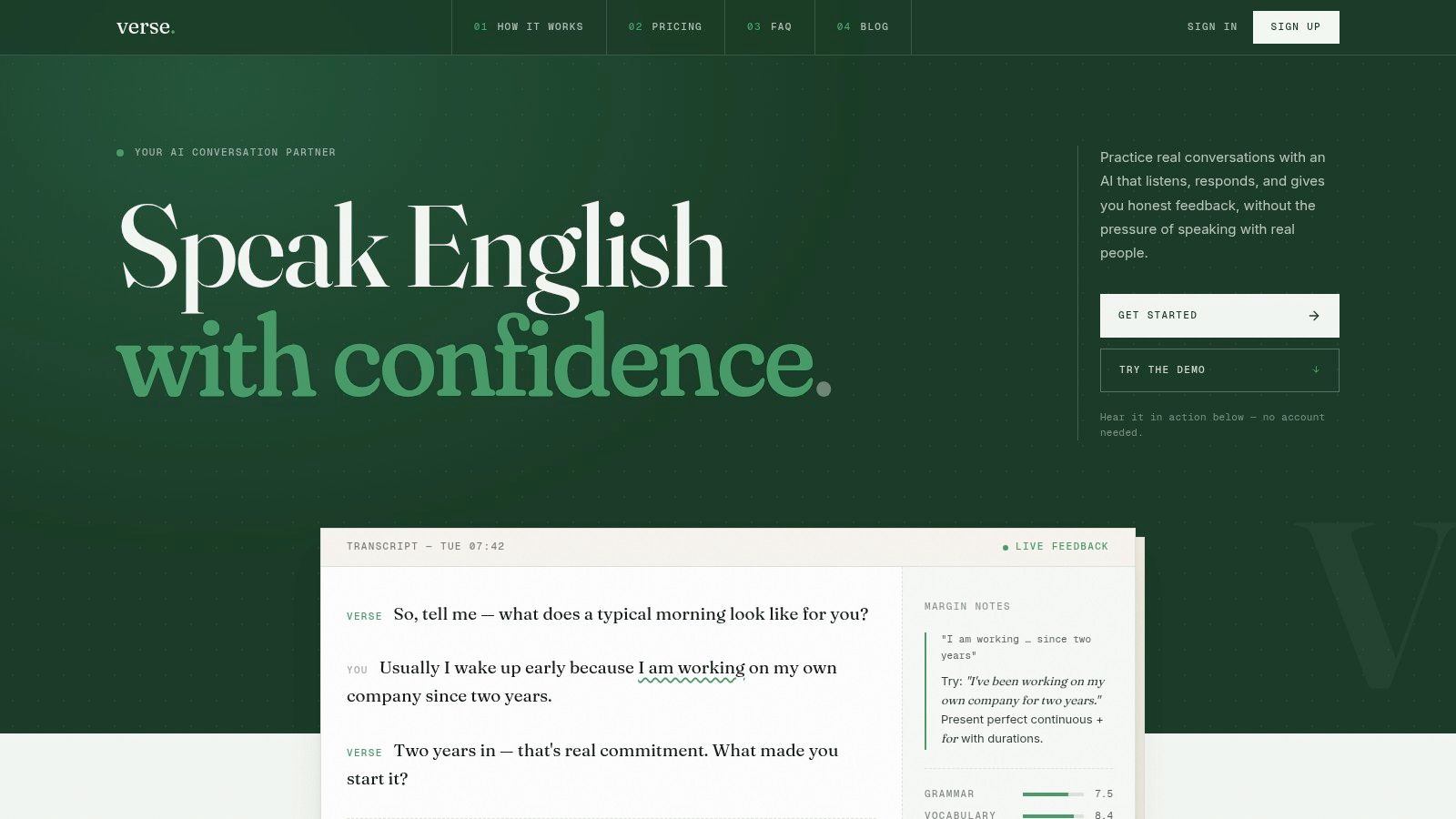
That's where an AI conversation partner can be helpful. Instead of silent drills, the learner speaks naturally, gets a response, and then reviews feedback on pronunciation, grammar, vocabulary, and fluency. This keeps practice close to real conversation while staying private and low-pressure.
Verse is built for that kind of spoken practice. It gives learners a judgment-free place to speak out loud, receive instant feedback, and choose a British, American, or Australian accent. It's different from passive grammar study because the learner is talking, not only reading rules. The homepage also includes a free, no-signup demo from Verse for learners who want to try a short spoken session before paying for the full subscription.
A simple comparison can help:
| Feedback method | What it helps with | Limitation |
|---|---|---|
| Voice transcription | Basic clarity check | Doesn't explain the mistake |
| Self-recording | Hearing stress and rhythm | Requires careful self-listening |
| AI conversation practice | Spoken practice with instant feedback | Best used consistently over time |
For shy learners, private feedback often matters as much as technical accuracy. A calm space makes it easier to keep speaking.
Your Simple Daily Pronunciation Routine
A good routine doesn't need to be long. It needs to be repeatable. Short daily practice usually works better than one long session that feels tiring.
A short routine for busy days
A learner can use this simple routine in about 10 minutes:
Start with one sound pair
Practice a contrast such as ship and sheep, or live and leave. Say each word slowly, then in a short sentence.Do mirror work for vowels
Hold one difficult vowel and watch the mouth shape. Keep the lips and jaw steady.Use shadowing for 5 minutes
For effective shadowing, the learner should use a 2 to 3 minute audio or video section, pause, and repeat what was heard as soon as possible, ideally for 5 minutes daily to improve intonation and stress patterns, as described in this discussion of shadowing practice.Record one sentence
Choose a useful sentence from daily life, work, or study. Record it, listen back, and try again once or twice.
For learners who want more ideas for regular spoken habits, this article on English speaking practice fits well with a daily routine.
What matters most
The routine only works if the learner speaks out loud. Silent study can support pronunciation, but it can't replace mouth practice.
A few minutes of daily spoken practice can feel small, but that's how confidence grows.
Progress may feel slow at first. That's normal. Clearer speech comes from repetition, patience, and the courage to keep using the voice. The important step is simple. Keep practicing out loud, a little every day.