Your Daily English Speaking Practice Plan
You might know this feeling very well. You read an article in English and understand almost everything. You watch a video and follow the ideas. But when you need to answer a question out loud, your mind goes blank.
You know more English than you can say.
That gap is frustrating, but it's normal. Speaking is not the same as reading, listening, or even doing grammar exercises. It's a separate skill, and it grows best when you practice it out loud, in small and steady ways.
Table of Contents
- Why Speaking Feels Harder Than Studying
- How to Build a Daily Speaking Habit
- Powerful Speaking Exercises for Solo Practice
- Getting Feedback to Improve Your Speaking
- Sample Practice Plans for Different Goals
- Start Your English Speaking Practice Today
Why Speaking Feels Harder Than Studying
A learner can spend months with English every day and still freeze in a simple conversation. That doesn't mean the learner is lazy or “bad at languages.” It usually means one thing. They have built a lot of passive knowledge, but not enough active speaking skill yet.
You understand more than you can produce
Passive knowledge means you can recognise words and ideas when you read or listen. Active skill means you can pull those words out fast enough to speak. These are connected, but they are not the same.
Think about a common moment. Someone asks, “How was your weekend?” You know all the words in that question. You probably know how to answer too. But in that short pause, your brain starts searching. Which verb tense? Which phrase sounds natural? What if I make a mistake?
That pressure makes speaking feel harder than studying.
Speaking isn't proof of what you know. It's proof of what you can access quickly under pressure.
English also matters to a huge number of people, so you are not struggling alone. English is the most studied language globally, with over 1.5 billion learners. This need is driven by the fact that 54% of all websites are in English, making it essential for digital communication and professional life, according to these English language learning statistics.
You are not behind
Many learners privately believe, “I should already be able to speak better by now.” That thought creates shame, and shame makes practice even harder.
A better way to see it is this:
- Reading builds recognition, because you see language.
- Listening builds familiarity, because you hear language.
- Speaking builds retrieval, because you must create language in real time.
If you mostly study without speaking, your mouth and brain don't get enough practice working together. That's why speaking can feel slow, even when your level is good on paper.
Here's the encouraging part. You don't need a perfect accent, perfect grammar, or perfect confidence to start. You need a regular habit of saying something out loud, even if it feels simple at first.
How to Build a Daily Speaking Habit
A daily habit works best when it feels easy to start. If your plan feels too big, you'll avoid it. If it feels private and manageable, you're much more likely to keep going.
Make practice feel safe
For many learners, the biggest problem isn't grammar. It's fear. Fear of sounding slow. Fear of making mistakes. Fear of being judged.
That fear is common. A 2024 study found that 68% of non-native English speakers experience speaking anxiety. However, learners who practice in private, AI-mediated environments improve fluency 3.2x faster, mainly due to reduced anxiety, based on research on private English speaking practice.
That matters because a safe environment changes your behaviour. When you feel watched, you speak less. When you feel safe, you try more.
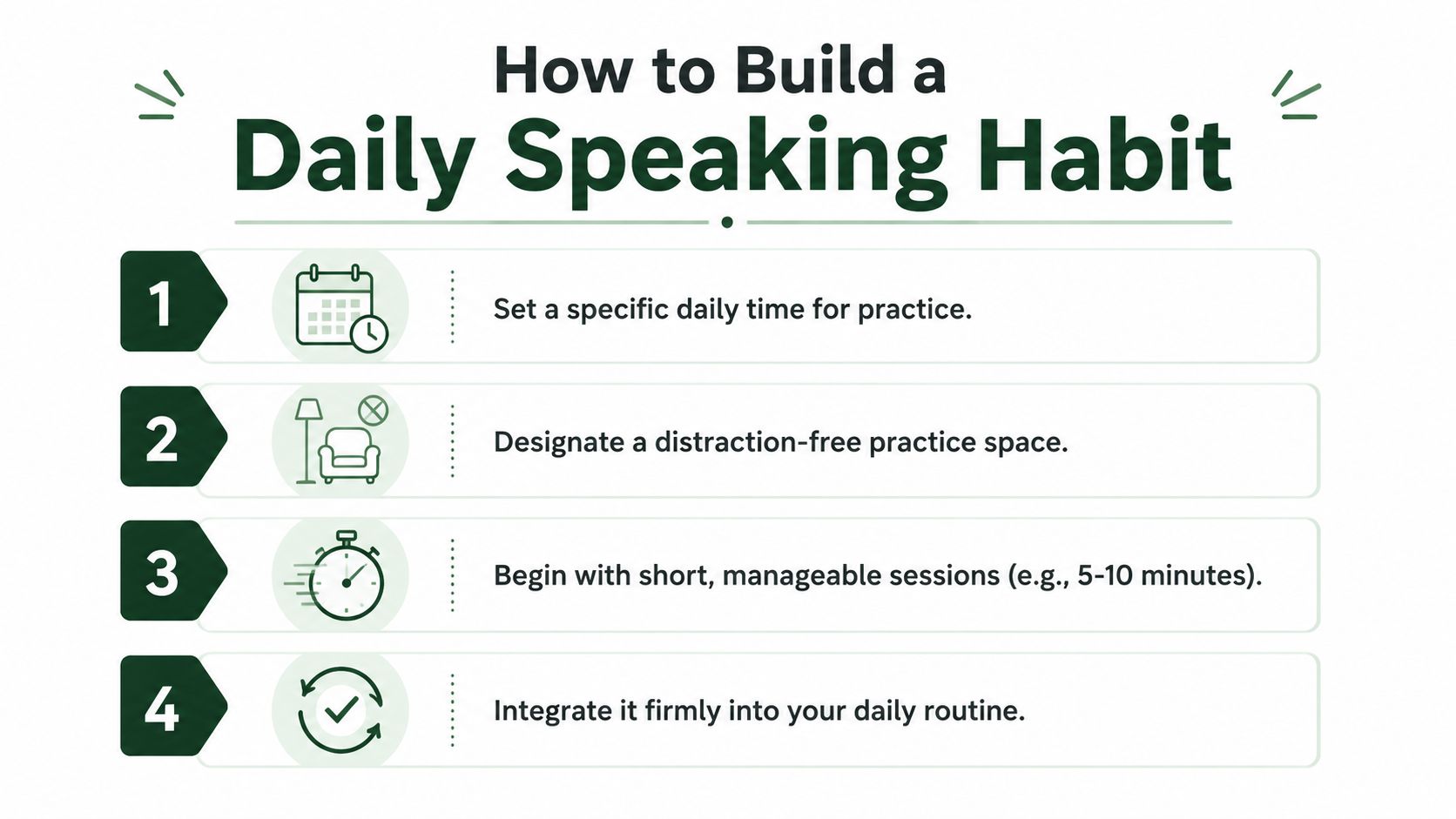
Try these simple rules:
- Choose one fixed time: Practice after coffee, after work, or before bed. The exact time matters less than repeating it.
- Use one private place: A bedroom, parked car, quiet walk, or empty meeting room can work.
- Remove small distractions: Put your phone on silent if you are not using it for practice. Close extra tabs. Sit down or stand still.
- Accept rough first attempts: Your first version doesn't need to sound good. It only needs to exist.
If you want extra ideas for building English into daily life, this guide on how to live the language every day can help.
Keep the routine small
A strong habit often starts with a tiny promise. Not “I will practice for one hour every day.” Just “I will speak for five minutes.”
Use this starter plan:
- Minute 1, warm up. Say the date, the weather, and one plan for today.
- Minutes 2 to 4, main speaking. Talk about one topic only.
- Minute 5, reflect. Say one sentence about what felt easy and one about what felt hard.
Practical rule: Make your practice so small that you can do it even on a tired day.
After a week, you can make it longer if you want. But don't rush. Confidence grows when practice feels repeatable, not heavy.
Powerful Speaking Exercises for Solo Practice
Solo practice is useful because it removes social pressure. You still get mouth movement, sentence building, and speaking speed, but without the stress of another person waiting for your answer.

Shadowing for rhythm and pronunciation
Shadowing means you listen to short audio and repeat it almost immediately. You are not translating. You are copying the sound, rhythm, and stress.
This exercise helps when your English is correct on paper, but your speech sounds flat or hesitant.
Try it like this:
- Play a short clip with clear speech.
- Listen once without speaking.
- Play it again and repeat sentence by sentence.
- Focus on matching the speaker's rhythm, not on being perfect.
- Repeat the same clip again.
A useful detail is to copy the music of the sentence. English has stress. Some words are stronger, some are weaker. Shadowing trains your ear and your mouth at the same time.
Monologues for fluency
A monologue is when you speak alone on one topic for a few minutes without stopping to check words. This is one of the best ways to build flow.
Practicing monologues for 3 to 10 minutes daily is a high-impact technique. Learners who do this and use circumlocution, talking around unknown words, increase speaking confidence by approximately 40% in just four weeks, according to this discussion of monologue speaking practice.
Circumlocution is a very useful word, but the idea is simple. If you forget a word, don't stop. Explain it another way.
For example:
| If you forget this word | You can say this instead |
|---|---|
| kettle | “the thing we use to boil water” |
| gloves | “the clothes you wear on your hands” |
| pharmacy | “the shop where you buy medicine” |
Use monologues on easy topics first:
- Daily life: What you did today
- Opinion: Whether remote work is good or bad for you
- Story: A small problem you solved this week
- Description: Your town, your job, or your routine
If you want more ideas for solo sessions, this article on how to practice English speaking alone gives more examples.
If you can keep talking when a word is missing, you are already becoming a stronger speaker.
Scenario practice for real life
Scenario practice means pretending you are in a real situation. This helps because real speaking is usually connected to a purpose.
Pick one scene:
- Travel: Checking into a hotel
- Work: Giving a short project update
- Social life: Meeting a new person
- Study: Answering a speaking exam question
Then build it in three steps:
- Say where you are.
- Say what you need.
- Answer one follow-up question.
Example:
“I'm at a train station. I need to ask which platform my train leaves from. If the worker asks me where I'm going, I'll explain my route.”
This kind of practice feels more natural than random sentence drills because your brain connects language to action.
Getting Feedback to Improve Your Speaking
Practice helps, but practice alone can turn weak habits into strong weak habits. If you always repeat the same mistakes and nobody points them out, progress becomes slower.
What to notice in your own recordings
The easiest feedback method is recording yourself. You don't need special equipment. A simple voice recording is enough.
When you listen back, don't judge your voice too harshly. Listen like a coach, not like a critic.
Focus on a short checklist:
- Clarity: Can you understand each sentence easily?
- Speed: Are you rushing, or speaking so slowly that ideas break apart?
- Filler words: Do you say “um,” “uh,” or “you know” too often?
- Grammar patterns: Do the same mistakes appear again and again?
- Word choice: Did you use a sentence that feels correct but not natural?
Write down only one or two things to improve next time. Too many corrections at once can make you tense.
Why outside feedback matters
Self-review is useful, but it has limits. You may not notice awkward phrasing because it sounds normal to you. You may also know a sentence is “not quite right” without knowing how to fix it.
That problem is common. A 2025 analysis showed 74% of intermediate learners struggle with phrasal inflexibility. AI tools that provide instant, native-phrasing feedback after each turn can improve naturalness scores by 41% within 3 months, based on analysis of common speaking mistakes and natural phrasing feedback.
A private feedback loop can help. One option is Verse, an AI conversation partner for spoken English practice. It lets you speak, get a response, and receive direct feedback on grammar, vocabulary, fluency, and more natural phrasing, with British-accent coaching.
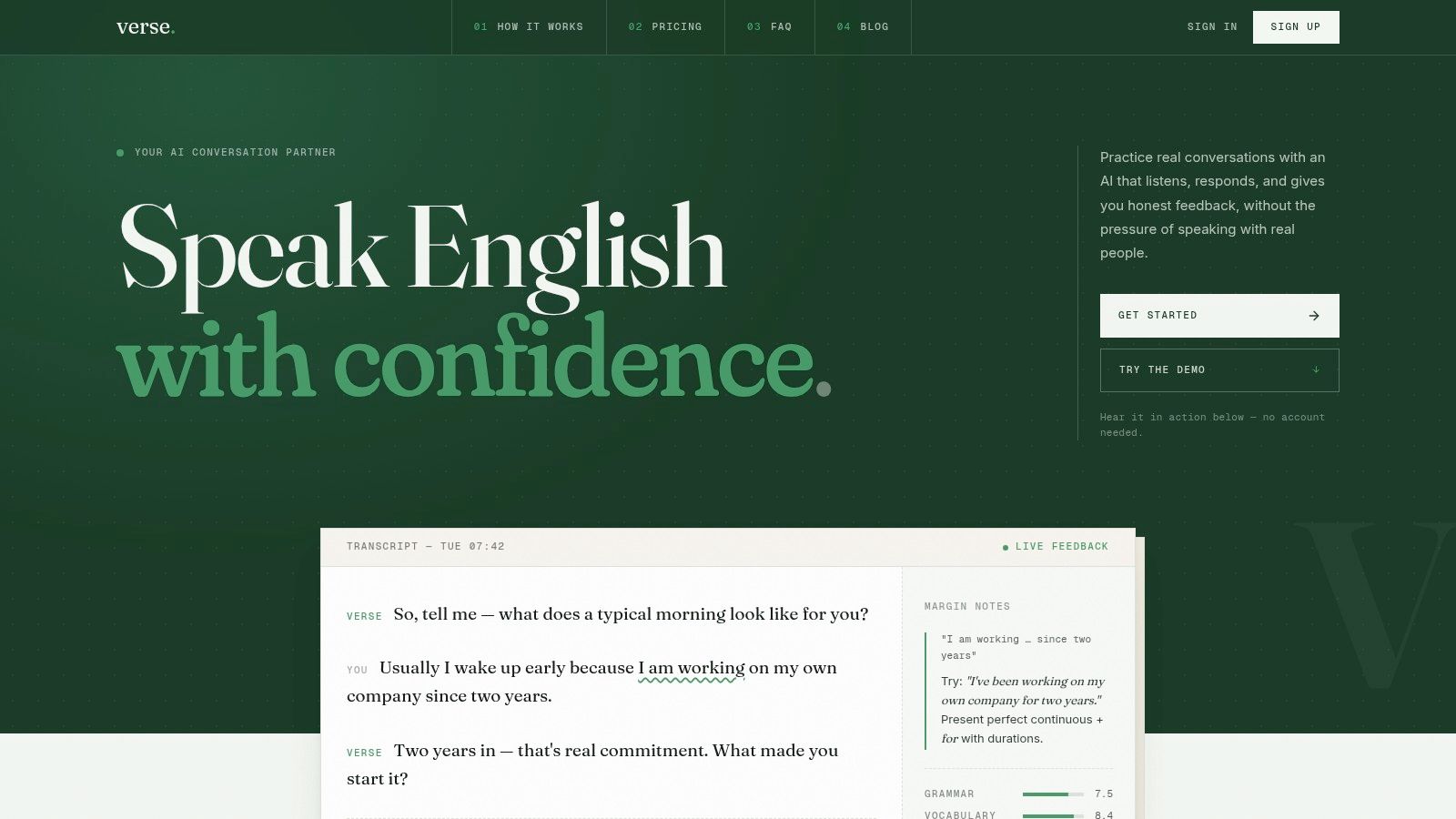
A setup like that can be helpful if you want honest correction without the pressure of a live class or social conversation. The key point is not the technology itself. The key point is getting clear feedback while you still remember what you were trying to say.
Good feedback should answer two questions. What sounded off, and what can you say instead?
Sample Practice Plans for Different Goals
A clear plan removes decision stress. You don't have to ask, “What should I do today?” You just begin.
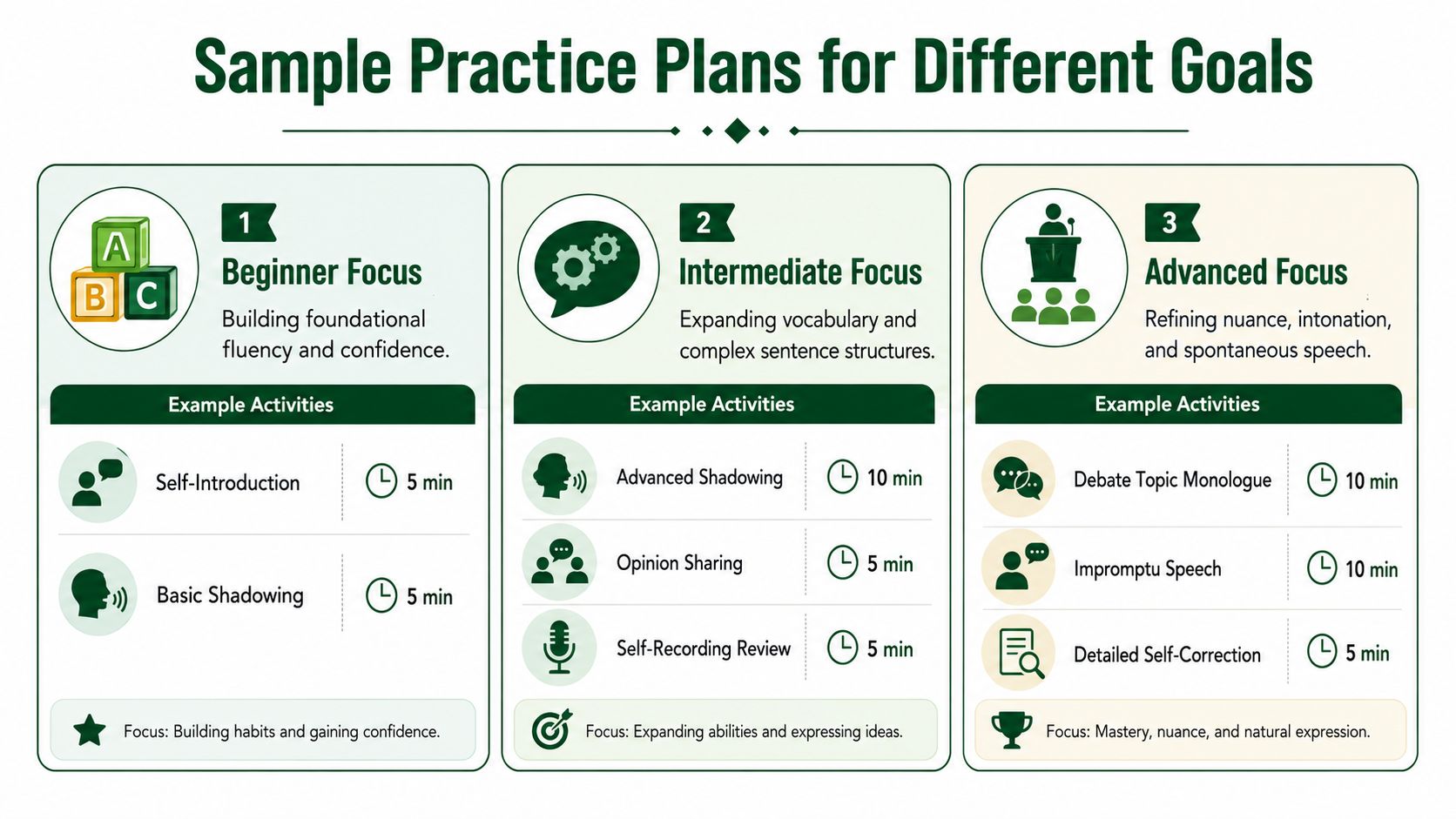
For everyday conversation
Use this when you want smoother, more natural daily speech.
| Part | Time | What to do |
|---|---|---|
| Warm up | 3 minutes | Talk about your day so far |
| Main practice | 7 minutes | Do one monologue on a simple topic |
| Real-life drill | 5 minutes | Practise a small social scenario |
| Review | 5 minutes | Listen back and note one change |
This plan works well for learners who often know what they want to say, but need more speed and ease.
For work and interviews
Use a more focused structure when your goal is professional speaking.
Start with a short answer to a common question such as “Tell me about yourself” or “What are you working on this week?” Then repeat the answer with stronger structure. Add a beginning, one example, and a clear ending.
After that, do one pressure drill. Answer follow-up questions with no script. Keep your answer organised, but don't try to memorise every word.
A useful prompt set:
- Professional summary: Explain your role in simple terms
- Problem solving: Describe a challenge and your response
- Opinion: Give a view on teamwork, deadlines, or communication
For speaking exams
Exam speaking needs fluency, timing, and calm thinking. Visualising the situation before you answer can help.
Data shows that learners who use shadowing and visualizing real-world scenarios achieve a 50% improvement in communicative fluency scores, with 78% of users reporting measurable progress in IELTS/TOEFL speaking modules after three months of daily practice, according to daily speaking exercise data on shadowing and visualization.
Try this exam-style routine:
- Shadowing, 5 minutes. Copy clear spoken English to warm up rhythm.
- Timed answer, 6 minutes. Answer one exam-style question out loud.
- Extended response, 6 minutes. Speak longer, with reasons and examples.
- Review, 3 minutes. Notice where your answer became unclear.
A good practice plan doesn't need to be long. It needs to match the kind of speaking you actually want to do.
Start Your English Speaking Practice Today
Most learners don't need more English in their head. They need more English coming out of their mouth, in a calm and regular way.
If speaking makes you nervous, start private. If you often stop when a word is missing, practise talking around it. If you don't know whether your speech sounds natural, add a feedback step. Small actions are enough to begin.
You don't have to wait until you feel confident to speak. Speaking is how confidence grows.
A simple start for today could be this:
- speak for five minutes about your day
- record it
- listen once
- repeat the same topic tomorrow with one small improvement
That is real english speaking practice. Not perfect, but real. And real practice is what builds a stronger voice over time.
If you want a calm place to practise out loud, Verse gives you a private conversation partner with honest feedback on grammar, vocabulary, and fluency. You can try the free no-signup demo, have a short conversation, and see whether that kind of low-pressure practice helps you keep going.