Overcome English Speaking Anxiety: A Practical Guide
A meeting starts. A name is called. The listener knows the answer in English, but the words suddenly disappear.
The mind goes blank. The heart beats faster. The mouth feels stiff. A simple sentence becomes hard to say.
That experience has a name. It is English speaking anxiety. It does not mean the speaker is bad at English. It often means the speaker is under pressure, and the brain reacts as if something dangerous is happening.
Many learners carry this internally. They study grammar, read well, and understand a lot, but speaking out loud still feels heavy. That gap can feel confusing. It can also be changed, especially when practice is private, small, and regular.
Table of Contents
- What Is English Speaking Anxiety and How Does It Feel
- Understanding the Causes of Your Speaking Fear
- Calm Your Nerves with Mindful Speaking Techniques
- Build Speaking Confidence with Private Practice
- Your Weekly Plan for Consistent Speaking Practice
- Managing Anxiety in High Stakes Moments
What Is English Speaking Anxiety and How Does It Feel
English speaking anxiety is a specific kind of stress that appears when a person needs to speak in English. It can happen in class, during a work call, in a job interview, or even in a simple conversation. The strange part is that the speaker may already know the words and grammar, but still can't use them smoothly in the moment.

It is more than simple nervousness
A clear explanation appears in this overview of foreign language anxiety. It describes English speaking anxiety as a situation-specific cognitive block. In simple language, anxiety uses part of the mind's working memory, so there is less mental space left for grammar, vocabulary, and sentence building.
A useful way to picture this is a road. Normally, words travel from memory to the mouth like a delivery truck moving on an open street. Anxiety fills that street with traffic. The truck still exists, and the package is still there, but delivery becomes slow and messy.
That is why a learner may think, "This is easy. Why can't it come out?" The problem often isn't knowledge. The problem is interference.
Practical rule: When speech becomes harder under pressure, that doesn't prove weak English. It often proves that stress is blocking access to English.
What the block feels like in real life
This block often shows up in familiar ways:
- Frozen starts: The speaker knows how to begin, but can't say the first sentence.
- Smaller language: A learner uses short, simple sentences instead of the richer language they can use in writing.
- Word loss: Common vocabulary suddenly feels far away.
- Physical tension: The jaw, throat, or face can feel tight.
- Self-monitoring: The speaker watches every word and starts judging each sound.
These reactions can feel personal, but they are common. One source of confusion is that people often blame character. They think they are shy, slow, or not talented. In many cases, the underlying issue is performance stress tied to speaking.
That difference matters. If the problem is seen as a personal weakness, the learner often avoids speaking. If the problem is seen as a stress response, the learner can start training for it.
A learner who can write a good paragraph but struggles to answer a simple spoken question is not failing. The speaking system is under pressure. Once that pressure is lowered, speech usually becomes clearer and more natural.
Understanding the Causes of Your Speaking Fear
The fear behind speaking rarely comes from one single place. It usually grows from a mix of inner pressure and outside pressure. When these are separated, many learners can finally see what is happening more clearly.
Psychological causes inside the mind
For many learners, the strongest causes are internal. A study reported in the International Journal of Multicultural and Multireligious Understanding found that fear of negative evaluation affected 80% of learners regarding grammar and vocabulary, and fear of making mistakes affected 70% regarding pronunciation.
Those two fears create a very common pattern. A learner doesn't just want to communicate. The learner wants to avoid sounding wrong.
This can lead to thoughts like:
- "If grammar isn't perfect, people will judge me."
- "If pronunciation sounds different, people won't respect me."
- "If a word is missing, everything will fall apart."
Perfectionism makes this worse. The speaker starts aiming for a flawless sentence instead of a clear message. That raises pressure, and pressure makes speaking harder.
Negative memories can also stay in the mind for a long time. One laughed-at mistake in class, one awkward meeting, or one impatient listener can train the brain to expect danger the next time.
Fear grows when the mind treats speaking like a test of worth, not a normal part of learning.
Situational causes around the moment
Other causes come from the setting itself. Some moments are harder than others. A phone call with a manager feels different from chatting with a friend. A job interview feels different from ordering coffee.
Situational triggers often include:
- High stakes moments: interviews, presentations, meetings, exams
- Unfamiliar topics: technical subjects, fast questions, abstract discussion
- Fast listeners: people who speak quickly or interrupt
- Accent pressure: worry about how pronunciation sounds, not just what the words mean
- Public attention: several people listening at once
There is also an important detail many guides miss. Some learners are not most afraid of grammar mistakes. They are most afraid of how their accent will be judged. A 2024 Cambridge study introduced the Accent Anxiety Scale, with three areas: fear of negative evaluation about accent, fear of intergroup rejection, and anxiety about communication problems caused by intelligibility issues, as described in the Cambridge paper on accent anxiety.
That matters because the solution changes with the cause. A learner who fears public judgment needs a different approach from a learner who mainly struggles during exams. A learner who worries about accent needs more than generic advice to "practice more."
Naming the cause is often the first real relief. It turns a vague fear into something specific, and specific problems are easier to work on.
Calm Your Nerves with Mindful Speaking Techniques
When anxiety rises, advice like "just relax" doesn't help much. The body needs a simple action. The mind needs a small task. That is where mindful speaking techniques become useful.
Speaking anxiety isn't only emotional. According to this neuroscience review on speech anxiety, it can trigger a threat response in the brain, a fight, flight, or freeze response. That response increases heart rate and muscle stiffness, which can disrupt the thinking and mouth control needed for fluent speech.

Slow breathing to calm the body
This works because the body often gets alarmed before the mind can think clearly.
A simple version looks like this:
- Breathe in gently through the nose.
- Pause for a moment.
- Breathe out longer than the inhale.
- Repeat a few times before speaking.
The goal isn't deep dramatic breathing. The goal is to tell the body, "This moment is safe." A longer exhale often helps loosen throat and face tension, which can make speech sound less forced.
A learner can use this before answering a question, before entering a meeting, or while waiting for an interview to start.
Reframe the thought before it grows
Anxious thoughts often sound true because they arrive fast. They need a response, not blind trust.
A useful pattern is to replace the harsh thought with a workable one:
| Unhelpful thought | More helpful replacement |
|---|---|
| I will make a mistake | Mistakes happen in real conversation |
| People will think badly of me | Most listeners care more about meaning than perfection |
| I need perfect grammar | I need a clear message |
| If I pause, I look weak | Pausing often makes speech clearer |
This isn't fake positivity. It is a more balanced thought. The speaker is not pretending everything is easy. The speaker is choosing a thought that reduces panic and supports action.
A pause is not failure. It is often how clear speakers organize their thoughts.
Ground attention in the present
Grounding helps when the mind starts racing ahead. Instead of thinking about all possible mistakes, attention returns to what is happening now.
A short grounding routine can be very plain:
- Feel the feet: Press both feet into the floor.
- Notice one object: Look at a pen, a chair, or the edge of a table.
- Mentally state one goal: "One clear sentence."
- Start small: Answer with one idea, not five.
This works well because anxiety pulls attention into imagined judgment. Grounding brings it back to the body and the actual task.
A learner doesn't need to use all three techniques every time. One person may find breathing most useful. Another may need thought reframing. Another may feel best with grounding. The key is to practice the technique before the high pressure moment, so it feels familiar when needed.
Build Speaking Confidence with Private Practice
Confidence usually doesn't appear first. Practice comes first, then confidence follows.
That order matters because many learners wait to feel ready before they speak. But speaking skill grows through use, especially in places where the learner doesn't fear being watched.
Why private speaking practice works
Some English learners say limited speaking time is one reason anxiety stays strong. In a qualitative study, learners reported that they spoke with teachers and friends for about two hours per week, which reinforced self-inferiority and fear of making mistakes, as described in this ERIC study on speaking anxiety.
That helps explain why silent study often isn't enough. Reading grammar rules can improve knowledge, but it doesn't train the mouth, ears, and nerves to work together in real time. Speaking out loud is a different skill.
A private setting changes the emotional cost of practice. There is no class waiting, no impatient face, and no social risk if a sentence comes out wrong. That gives the brain a chance to build a new pattern. Speaking no longer always equals danger.
A short guide on how to practice English speaking alone can help learners turn that idea into a daily habit.
Low pressure exercises that build real skill
Private practice works best when it is specific. These exercises are simple, but they train real speaking.
- Read aloud for one minute: Choose a short article or dialogue. Read it slowly and clearly. This helps with rhythm, mouth movement, and sentence flow.
- Narrate daily actions: Say what is happening while cooking, cleaning, or getting ready. "Now the water is boiling." "Next, the email needs a reply." This builds automatic speaking.
- Retell a short story: Listen to something brief, then explain it in simple English without looking at notes.
- Shadow a speaker: Listen to one short sentence and repeat it with the same speed and stress pattern. This helps pronunciation and natural rhythm.
- Answer one question out loud: Try topics like work, travel, goals, or opinions. Keep the answer short. Then say it again with one improvement.
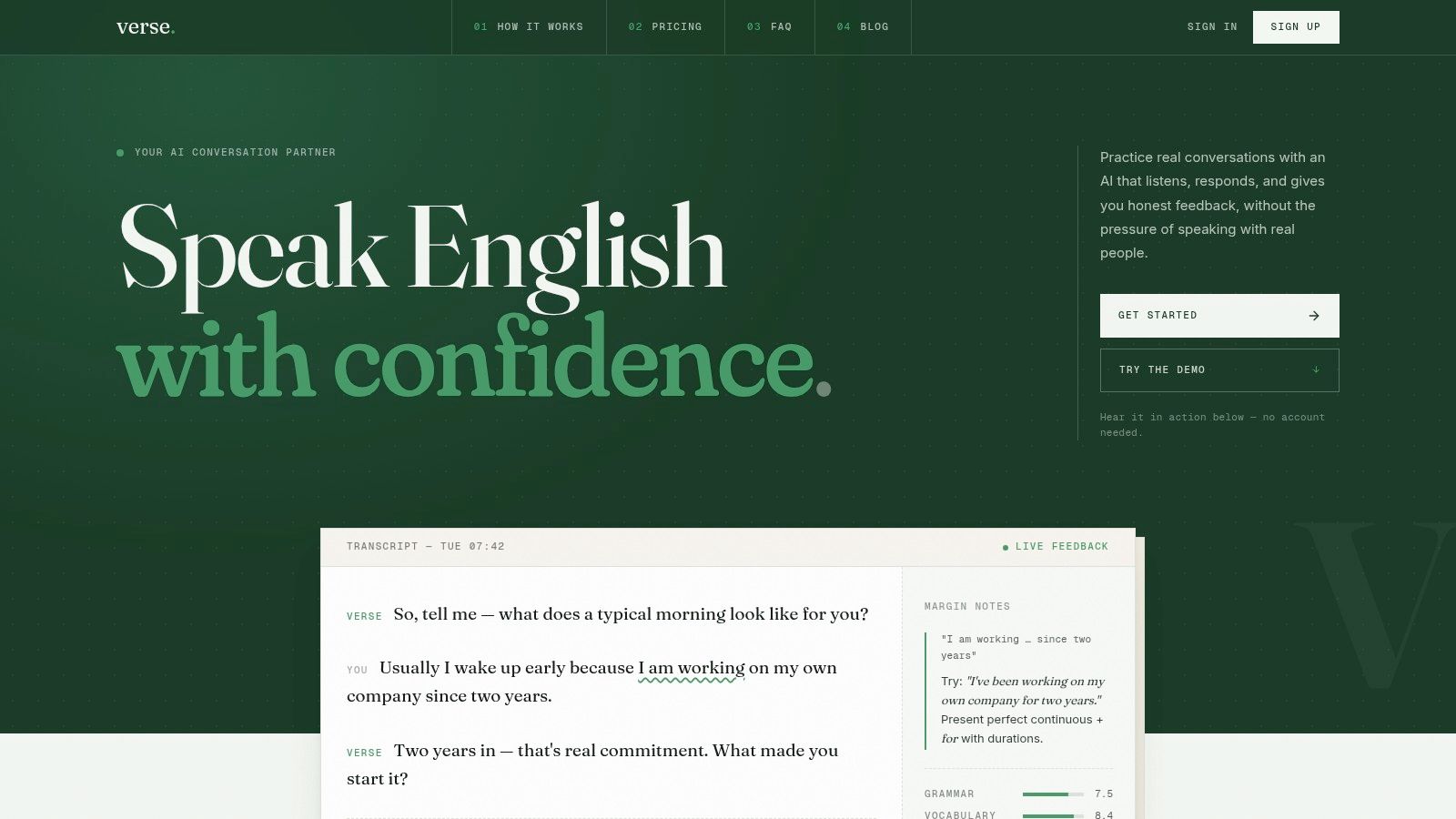
Another private option is a conversation partner that lets learners speak out loud and receive immediate feedback. That kind of practice is useful because it is active, not passive. It is closer to real conversation than flashcards or silent grammar review.
Verse is built for this kind of spoken practice. It is an AI conversation partner that lets learners talk out loud, get honest feedback on grammar, vocabulary, and fluency, and choose a British, American, or Australian accent. For learners who feel nervous about speaking in front of people, the private setting can reduce pressure. There is also a free, no-signup demo on the homepage, while full access is a paid subscription at $12/month.
Private speaking practice helps the brain learn a new lesson. Speaking can feel safe, repeatable, and manageable.
What matters most is consistency. Five honest minutes of speech can do more than a long session of silent study if it happens regularly.
Your Weekly Plan for Consistent Speaking Practice
A weekly routine works better than random effort. Small sessions are easier to repeat, and repetition helps the nervous system stop treating English like an emergency.
This also matters in work life. Among American adults, fear of public speaking has been linked to a 10% impairment in wages and a 15% reduction in the likelihood of obtaining managerial or leadership positions because people avoid speaking opportunities, according to this glossophobia statistics summary. That is one reason regular speaking practice is worth protecting, even on busy weeks.
Sample weekly speaking practice plan
A fuller set of ideas appears in this guide to English speaking practice. The table below keeps the routine simple.
Sample Weekly Speaking Practice Plan (15 Minutes a Day)
| Day | Activity | Focus |
|---|---|---|
| Monday | Read a short text aloud, then repeat it more naturally | Pronunciation and rhythm |
| Tuesday | Describe the day, room, or current task out loud | Fluency and sentence building |
| Wednesday | Answer two simple speaking questions | Confidence and organization |
| Thursday | Shadow short audio clips and copy stress patterns | Intonation and clarity |
| Friday | Have a short private spoken conversation | Real time response |
| Saturday | Retell a video, article, or podcast in simple English | Vocabulary retrieval |
| Sunday | Review one recording and notice one thing to improve | Reflection and self-awareness |
Why this kind of routine helps
This plan stays short on purpose. Long sessions can feel heavy, especially for anxious speakers. A short plan is easier to start, and starting matters more than perfection.
A few habits make the plan stronger:
- Keep the topic familiar: Use daily life, work, study, hobbies, or recent events.
- Repeat before changing: Saying a similar answer twice often builds more confidence than always choosing a new task.
- Record sometimes: Listening back can feel uncomfortable at first, but it helps learners notice progress and patterns.
- Track one small win: Maybe the speaker paused less, used a new phrase, or sounded clearer.
The weekly plan should feel gentle, not punishing. If one day is missed, the next day still counts. Progress comes from returning, not from doing everything perfectly.
Managing Anxiety in High Stakes Moments
Some moments feel bigger than everyday conversation. Interviews, presentations, exams, and important meetings can make even strong speakers tense. The answer isn't to become fearless. The answer is to reduce surprise and increase control.
Before interviews and presentations
Preparation should be spoken, not silent. Writing notes is useful, but high stakes speaking needs rehearsal with the voice.
For interviews, it helps to prepare short spoken answers to common topics such as experience, strengths, goals, and problem solving. For exams, targeted speaking practice can also help. This guide to an IELTS speaking practice test is useful for learners who want a more specific exam format.
A simple preparation method looks like this:
- Choose key answers: Prepare the opening answer, one example story, and one closing sentence.
- Practice out loud: Say each answer several times until it feels more natural.
- Trim long sentences: Shorter spoken answers are easier to control under pressure.
- Use a start phrase: A line like "That's a good question" can create one calm second before the main answer begins.
- Breathe before the first sentence: That first moment often decides the tone of the next minute.
For presentations, learners often try to memorize every word. That can increase panic if one word is forgotten. It usually helps more to know the structure clearly: opening, point one, point two, example, close.
Preparation lowers anxiety because it removes uncertainty. The speaker does not need perfect control, only a reliable next step.
When extra support may help
Sometimes speaking anxiety is more than a practice issue. If it regularly causes avoidance of important classes, meetings, interviews, or relationships, extra support may be a wise next step.
Helpful signs to notice include:
- Frequent avoidance: the learner keeps turning down chances that matter
- Strong physical distress: shaking, racing heart, or freezing happens often
- Long lasting self-criticism: one speaking mistake leads to hours or days of shame
- Daily impact: anxiety affects work, study, sleep, or quality of life
Support can come from a teacher, coach, counselor, or mental health professional, depending on the situation. Seeking help is not weakness. It is a practical response to something that is getting in the way of life.
Many learners improve through a mix of low pressure speaking practice, better preparation, and kinder self-talk. Progress often looks small at first. One calmer answer. One shorter pause. One meeting with more voice than last time.
English speaking anxiety can feel loud, but it doesn't have to stay in charge. Small spoken practice, done often and done kindly, can change how the brain responds. A few minutes out loud today is enough to begin.