How to Practice English Speaking Alone: A 2026 Guide
You probably know this feeling. You understand a lot of English when you read or listen, but when it's time to speak, your mind goes blank. You know words, but they don't come out fast enough. Or you worry that your grammar sounds wrong, so you stay quiet.
If that's you, you're not behind. You're facing a very common speaking problem. English speaking improves when you speak out loud, even if you're alone in your room, in your car, or walking to work. Solo practice can feel strange at first, but it can also be private, calm, and much easier than waiting for the perfect partner.
This guide gives you a full system to practice English speaking alone. Not just random exercises, but a simple way to build confidence, catch mistakes, and prepare for real situations like meetings, interviews, and exams.
Table of Contents
- Why Speaking Alone Is a Powerful Way to Learn
- Start Speaking Today with These Three Solo Exercises
- How to Use Technology for Better English Practice
- Find and Fix Your Own Speaking Mistakes
- Build a Daily Speaking Habit with a Practice Plan
- Advice for Anxious Speakers and Exam Takers
- Start Your Speaking Journey Today
Why Speaking Alone Is a Powerful Way to Learn
You sit down to practice English after work. No partner is available. No class is starting. For many learners, that moment feels like a dead end. In fact, it can become one of the most useful parts of your routine.
Speaking alone gives you something conversation often cannot: room to practice without social pressure. You can pause, repeat a sentence five times, restart when your mind goes blank, and test new words without worrying about how you sound. For anxious speakers, that quiet space is often the first place confidence starts to grow.
Speaking works like learning a sport or a musical instrument. Grammar study helps you understand the rules, but speaking asks your mouth, ears, and brain to work together in real time. You need practice shaping sounds clearly, finding words fast, and keeping your sentence moving even when you are unsure.
That is why solo speaking is not just a backup when no partner is around. It is training. If your goal is to handle job interviews, meetings, presentations, or exam questions, solo practice gives you a low-pressure place to build the habits those situations require. If you also want live support, online English speaking practice with structure and feedback can complement what you do on your own.
What speaking alone actually trains
Done well, solo practice builds more than one skill at a time.
- Fluency, so you can keep talking instead of stopping after every few words
- Pronunciation, so your speech is easier for others to follow
- Confidence, because repetition reduces the fear of making mistakes
- Response speed, so common questions feel less surprising
- Professional readiness, because you can rehearse the kinds of answers work and exam settings often demand
Speaking alone is rehearsal, and rehearsal changes performance.
Why the method matters
Many learners speak alone in a random way. They talk for a minute, stop, switch topics, and hope it helps. A better approach is to use solo practice as a system. Each type of exercise trains a different part of speaking, just as a good workout targets strength, balance, and endurance separately.
Shadowing trains your ear and your mouth together. You hear a short line and repeat it right away, trying to match rhythm, stress, and tone.
Narration trains flow. You describe what you are doing, what you did today, or what you plan to do next. That helps you connect simple ideas without freezing.
Simulation trains response under pressure. You answer realistic prompts such as “Tell me about yourself” or “How would you handle a difficult client?” This is especially useful for learners who need English for work, interviews, meetings, or exams.
Each method has a job. Shadowing improves how you sound. Narration helps you keep going. Simulation prepares you for real situations where you need to respond clearly and calmly. Together, they turn solo practice from “just talking to yourself” into a purposeful routine that builds confidence step by step.
Start Speaking Today with These Three Solo Exercises
You open your phone recorder, press start, and suddenly your mind goes blank. That happens to a lot of learners. Speaking alone can feel strange at first because there is no other person to keep the conversation moving.
A simple structure solves that problem. Instead of asking yourself, "What should I talk about?" you follow three exercises in order. Each one trains a different part of speaking, so you are not relying on confidence alone. You are building a repeatable system you can use for everyday English, work situations, interviews, and exams.
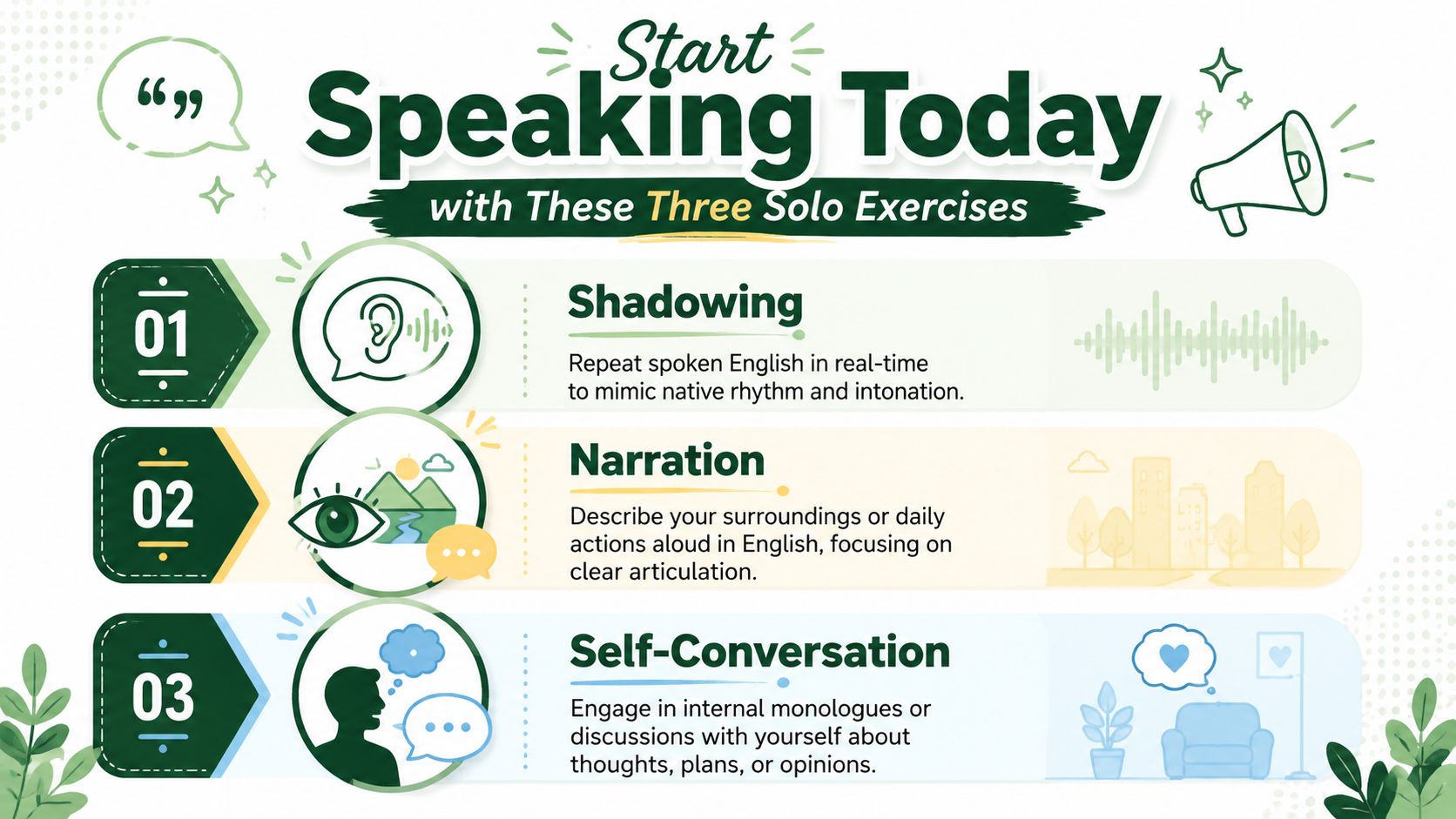
Exercise 1, Shadowing
Start with shadowing. It is the easiest entry point because you borrow the sentence instead of creating one from scratch. For anxious speakers, that matters. Your brain can focus on rhythm and pronunciation first.
Use this process:
- Pick a short audio clip with clear, natural English.
- Listen to one sentence.
- Repeat it right away.
- Copy the speaker's stress, pace, and tone.
- Repeat the same sentence several times.
If the line is, "I'd like to reschedule our meeting for tomorrow afternoon," say the full sentence as one unit. Listen for the strong words. Notice how the voice rises or falls. English rhythm works a bit like music. If you pause too much between words, the sentence loses its shape.
A common mistake is waiting too long before repeating. Try to answer almost on top of the audio. That close timing helps your mouth get used to natural English patterns.
Exercise 2, Narration
After shadowing, move into narration. Now you stop copying and start producing your own ideas, but you stay in safe territory. You talk about things you already know well.
Good topics include:
- Morning routine, "I woke up late today, so I skipped breakfast."
- Commute, "The bus was crowded, and I had to stand."
- Work task, "First I answered messages, then I joined a meeting."
- Home life, "I'm cleaning the kitchen because friends are coming over."
Set a short time limit, such as one or two minutes, and keep talking until the time ends. The goal is flow, not perfection. If you stop every few seconds to fix grammar, your speaking practice turns back into writing practice.
One useful pattern is 1 fact plus 2 details. It gives you a small frame to build on when your mind feels empty.
| Prompt | Simple answer | Better speaking answer |
|---|---|---|
| What did you eat? | I ate pasta. | I ate pasta. It was spicy and had tomatoes. I'd eat it again. |
| How was your day? | It was busy. | It was busy. I had two meetings and finished a report. I'm tired now. |
| What are you doing tonight? | I'm staying home. | I'm staying home. I need to rest and do some reading. It should be a quiet evening. |
That pattern is especially helpful for professional speaking. In meetings, interviews, and exams, short answers often sound incomplete. One clear point plus a little support sounds more confident and more natural.
Exercise 3, Simulation
Simulation is the final step because it prepares you for pressure. You ask yourself a realistic question, then answer out loud as if a real person asked it. This exercise connects solo practice to real-world speaking.
Use prompts like these:
- Interview style, "Tell me about a challenge you solved."
- What if question, "What would you do if you missed a flight?"
- Professional scenario, "How would you explain a delay to a client?"
- Opinion prompt, "Do you prefer working alone or in a team?"
If a full answer feels hard, build it in levels:
- Level 1, give one clear sentence
- Level 2, add a reason
- Level 3, add an example
- Level 4, answer a follow-up question you create yourself
This gradual build matters. Many learners think confidence comes before speaking. In practice, confidence usually grows after repeated, structured speaking. Simulation helps you rehearse the exact moments that often cause anxiety, especially in job interviews, presentations, meetings, and speaking tests.
If you only have ten minutes, use a simple routine. Spend three minutes on shadowing, three minutes on narration, and four minutes on simulation. That gives you pronunciation practice, fluency practice, and response practice in one short session.
How to Use Technology for Better English Practice
Speaking alone works best when you can hear yourself clearly and notice patterns. Technology helps because it gives you a second pair of eyes and ears, even when no teacher is there.
Start simple. You don't need complex tools. What matters is using them in a calm, repeatable way.
Use the tools you already have
Your phone recorder is enough for day one. Record a short answer, then listen for three things:
- Pauses, where did you get stuck?
- Repeated words, did you say “very” or “nice” too often?
- Unclear sounds, were some words hard to understand?
After that, use speech-to-text on your phone or computer. This gives you a rough transcript of what you said. It won't be perfect, but that's useful. If the system misunderstands a word, your pronunciation may need work. If the text shows broken sentences, your grammar or sentence structure may need attention.
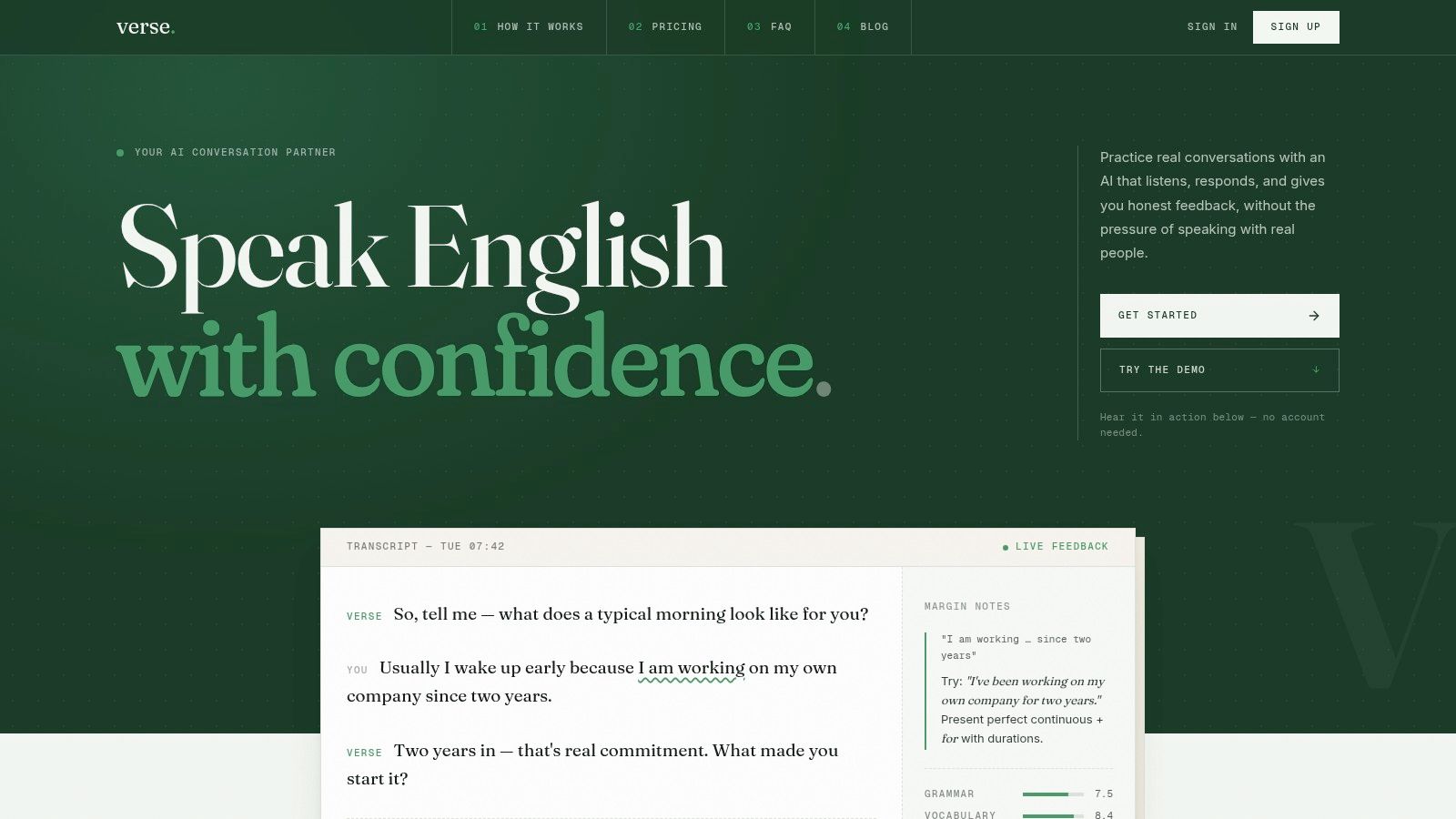
A private conversation tool can take this a step further. Instead of only recording yourself, you speak, get a reply, and receive feedback after each turn. That matters because solo learners often need help with grammar, vocabulary choice, and fluency, not just pronunciation.
Turn feedback into a habit
Many learners avoid feedback because they think it will feel discouraging. Usually the opposite is true. When feedback is clear and calm, it reduces confusion. You stop guessing what's wrong.
A simple process looks like this:
- Speak first, without notes if possible.
- Read the transcript, and mark awkward parts.
- Rewrite one or two lines, into clearer English.
- Say the improved version, out loud.
- Repeat the same topic later, and check if it feels easier.
Feedback should be specific enough to help, but small enough to use right away.
If you tend to practice in isolation, technology can make the process less lonely and more structured. You still do the speaking. The tool helps you notice what to improve next.
Find and Fix Your Own Speaking Mistakes
You finish a one-minute answer, and for a moment it feels good. Then the doubt starts. Did I use the wrong tense? Did I repeat the same word five times? Did that sentence even make sense?
That uncertainty is one of the hardest parts of solo speaking practice. You are both the speaker and the coach. The good news is that you do not need perfect self-correction to keep improving. You need a small system that helps you notice one problem, fix it, and say the answer again. That is how solo practice becomes real speaking training instead of random repetition.
Use a simple correction loop
A good correction loop works like a mirror. It does not judge you. It shows you what is happening.
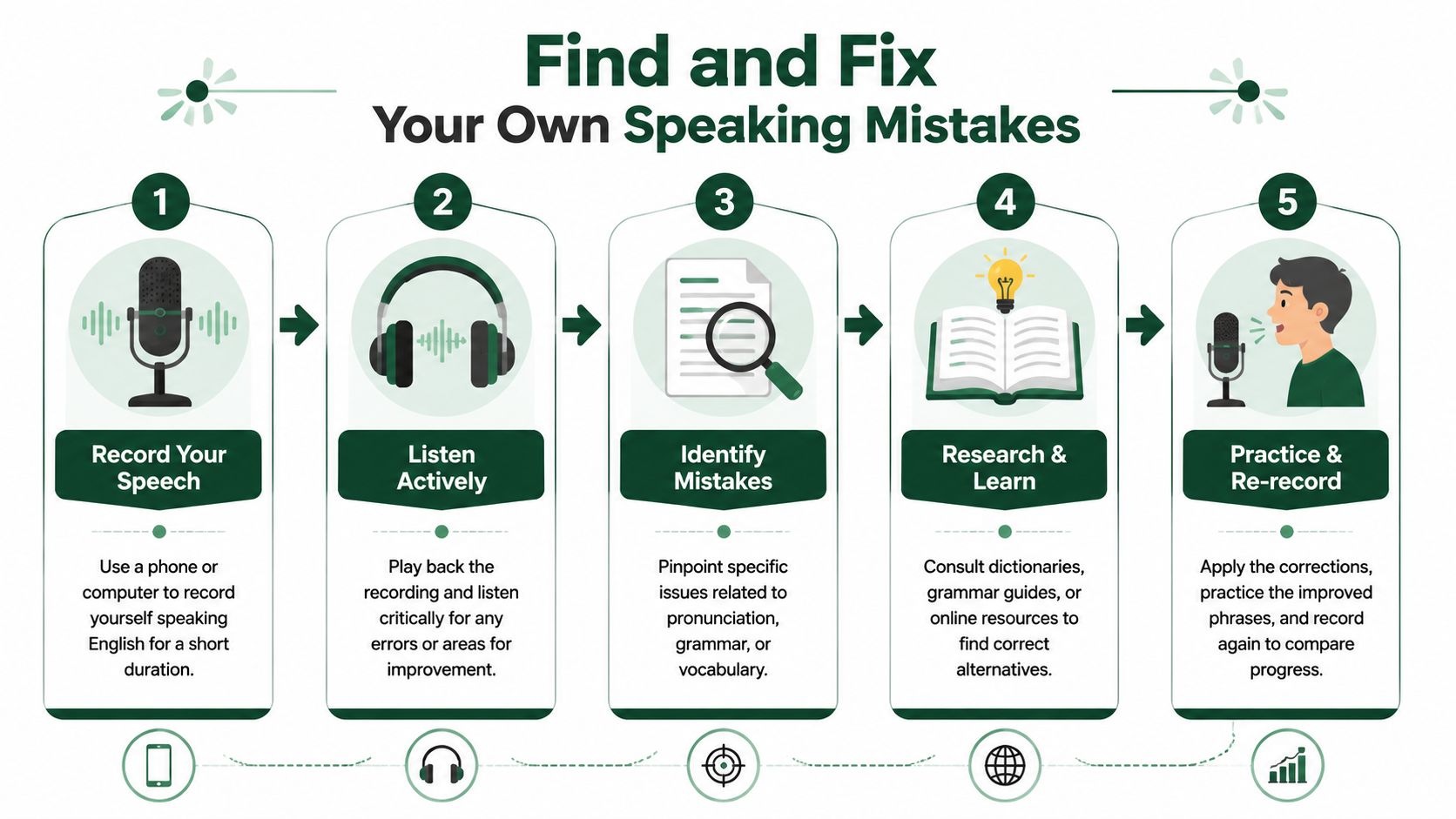
Choose one short, practical topic, especially one you might need in real life. For example, explain your job, describe a project update, or answer a common interview question. Speak for one or two minutes. Then review your answer in this order.
Listen for meaning first
Ask one question. “Could a listener follow my main point?”Check the words on the page
Write a transcript yourself or use speech-to-text and clean it up.Mark only three issues
Focus on patterns, not every tiny mistake. Good categories are grammar, word choice, and unclear phrasing.Improve one or two sentences
Keep the same idea. Make it clearer and more natural.Record the answer again
This second attempt matters most. It turns feedback into a new habit.
Many learners skip step five. That is like a tennis player studying their swing but never hitting another ball. Review helps you notice the problem. Repeating helps you change it.
What to look for in your recording
If you are not sure what counts as a mistake, start here.
| Problem type | What it sounds like | What to do |
|---|---|---|
| Grammar pattern | The same tense error appears again and again | Fix one sentence and build two more with the same pattern |
| Repeated vocabulary | You rely on words like “good,” “big,” or “interesting” | Replace one repeated word with two stronger options |
| Unclear phrasing | The sentence is too direct, too vague, or hard to follow | Shorten it or split it into two sentences |
| Hesitation points | You stop at the same place each time | Prepare a useful phrase for that moment |
| Pronunciation trouble | A word is hard to understand each time | Slow down and repeat that word inside a full sentence |
This method helps anxious speakers because it gives them a job to do. Instead of thinking, “My English is bad,” you can think, “My past tense needs work,” or “I need better phrases for explaining my role.” That shift builds control, and control builds confidence. If speaking still feels tense even in private, this guide on building confidence when speaking English can help.
A quick example
Here is what this looks like in practice.
| First version | Improved version |
|---|---|
| Yesterday I go to office and many work. | Yesterday I went to the office and had a lot of work. |
| I am agree with this idea. | I agree with this idea. |
| My job is very hard because many things. | My job is demanding because I handle many tasks at the same time. |
Notice the goal. Clearer English, not fancier English.
That matters for professional situations. If you are preparing for meetings, interviews, or presentations, clear structure usually helps more than complex vocabulary. A short, accurate answer is stronger than a long answer full of avoidable mistakes.
Keep your review light and consistent
Use a short template so feedback does not turn into a long study session.
Daily review
- Topic: one real situation or question
- First answer: speak without stopping
- Error check: mark 3 patterns
- Fix: rewrite 1 to 2 sentences
- Second answer: say the full response again
Weekly review
- One sentence I said well
- One mistake I keep repeating
- One useful phrase to keep
- One focus for next week
An audio diary can also help. Record a short update at the same time each day, then listen back after several days. Patterns become easier to hear when you compare multiple recordings, not just one.
Small correction loops work because they answer both the how and the why. You know exactly what to do, and you know why you are doing it. Each round makes your English a little clearer, and each clear answer makes speaking alone feel less lonely and more purposeful.
Build a Daily Speaking Habit with a Practice Plan
The best plan is one you'll stick with when you're busy, tired, or not feeling confident. A huge routine isn't necessary; a stable one is.
Below is a simple weekly structure. It mixes repetition and variety, which is exactly what solo speaking needs.
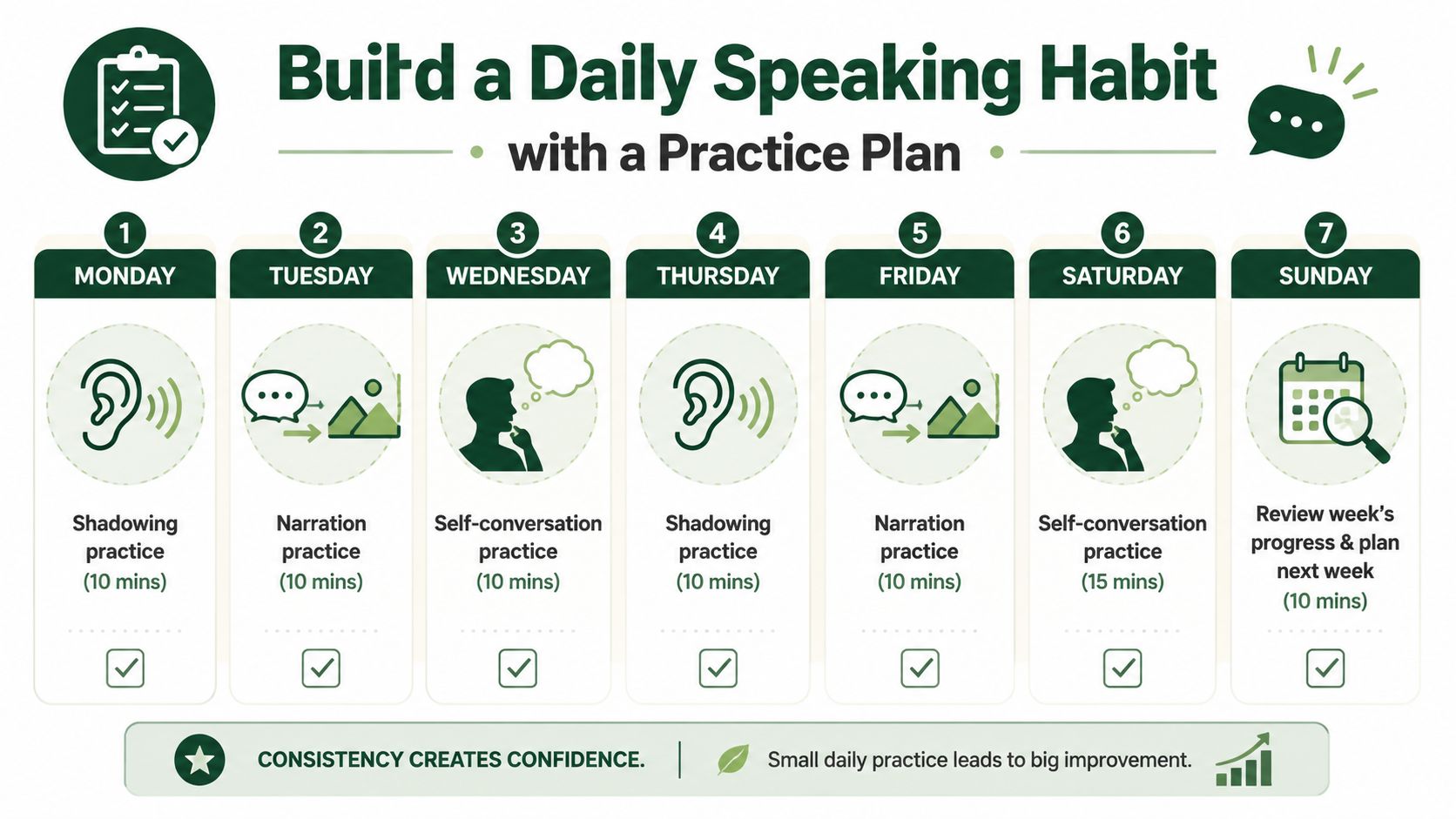
Three learners, three routines
The anxious speaker practices best in private and starts small. On Monday, they shadow a short clip to warm up. On Tuesday, they narrate their morning for a few minutes. On Wednesday, they answer one easy personal question. The goal isn't speed. The goal is to prove, day after day, “I can speak without panic.”
The exam learner needs timing and structure. They use solo practice for speaking prompts, follow-up questions, and longer answers. They also repeat the same topic twice, once naturally, once more clearly. That helps them organise ideas faster.
The professional learner focuses on real work language. They rehearse introductions, updates, explanations, polite disagreement, and short presentations. A strong starting point is to build practice around situations from living the language in daily life, then turn those ideas into spoken work scenarios.
A weekly plan you can actually follow
Try this as a starting schedule:
- Monday, shadowing
- Tuesday, narration
- Wednesday, self-conversation
- Thursday, shadowing again
- Friday, narration again
- Saturday, longer simulation
- Sunday, review your recordings and plan next week
Here's how the week can feel in real life:
| Day | Focus | What to do |
|---|---|---|
| Monday | Sound | Copy a short clip and match rhythm |
| Tuesday | Flow | Narrate your day without stopping too much |
| Wednesday | Ideas | Answer one question and add examples |
| Thursday | Sound again | Repeat a new clip or the same one better |
| Friday | Flow again | Describe a routine, problem, or plan |
| Saturday | Real-life speaking | Simulate an interview, meeting, or exam task |
| Sunday | Review | Listen back and choose next week's focus |
If you miss a day, don't restart the whole plan. Just continue the next day. Habit grows from returning, not from being perfect.
Advice for Anxious Speakers and Exam Takers
You open your mouth to answer a simple question, and your mind goes blank.
That moment is frustrating, but it does not mean your English is weak. It usually means pressure has become louder than your language. Solo practice helps because it lowers the pressure first, then builds your speaking step by step. For many anxious learners, that is the missing part. They do not need more grammar before they speak. They need a safer way to speak often enough that their brain stops treating English like a threat.
A quiet room can become a safe training space. That is an important benefit people often overlook.
If speaking makes you freeze
Start below your fear level. If a mock interview makes you panic, it is too hard for day one. Begin with topics your brain already knows well, so you can spend your energy on speaking instead of inventing ideas.
Try prompts like these:
- What I'm doing right now
- What I did this morning
- What I'm planning this weekend
- What I think about a film or meal
Use a small rule: speak for 30 to 60 seconds, stop, and repeat the same topic once more. The first round gets the words out. The second round is where confidence starts to grow, because your brain has already seen the path once.
If fear shows up, make the task smaller. Shorter time. Easier words. Slower speed. Keep the habit, even if the practice is tiny.
Many learners also feel strange hearing their own English voice. That is normal. Your English voice may sound more careful, more direct, or less expressive than your first-language voice. Treat it like wearing new shoes. It can feel awkward at first, but that does not mean the fit is wrong. If you want extra help with that stage, this guide on building confidence when speaking English can give you a few simple mindset tools to use before your next session.
If you need English for exams or work
Anxious speakers often improve faster when practice has a clear structure and a real purpose. That is especially true for exam takers and professionals. Random self-talk can help with fluency, but high-pressure situations need drills that match the situation.
For exams, practice under light timing. Answer one common question aloud, then answer the same question again with a clearer structure. Repeating the prompt teaches your brain two skills at once: how to respond, and how to recover when the first answer feels messy.
For work, build practice around situations you will face:
- Meeting update, explain project progress in simple terms
- Client issue, apologise and offer a next step
- Interview answer, describe your experience and strengths
- Presentation opening, introduce your topic clearly
A simple speaking frame helps in both cases. Use one main point, two supporting details, one closing line. It works like a shelf with three levels. Your idea has somewhere to go, so you are less likely to ramble or stop too early.
Here is what that sounds like:
“I'd handle the delay by telling the client early. I'd explain the reason clearly and give a new timeline. Then I'd confirm the next step so they know what to expect.”
That answer is not fancy. It is organised. Under pressure, organised speech is often stronger than impressive speech.
If anxiety is high, do not judge your session by how confident you felt. Judge it by whether you spoke, finished, and tried again. Confidence usually comes after repeated action, not before it.
Start Your Speaking Journey Today
You don't need to wait for a tutor, a class, or a brave mood. You can practice English speaking alone today, with your own voice, your own phone, and a short plan. Start with one exercise. Keep it small. Repeat it tomorrow.
Progress in speaking usually looks quiet at first. Fewer pauses. Clearer sentences. Less fear. Then one day, you answer faster, and English feels more available.
If you want a calm way to practice out loud and get honest feedback, Verse can help. It's an AI conversation partner for spoken English practice, with judgment-free feedback on grammar, vocabulary, and fluency, plus British-accent coaching. If you'd like a simple first step, try a short practice conversation in the demo and see how it feels.