English for Job Interviews: Questions, Answers and Key Phrases
June 4, 2026 · 19 min read
You may be reading this with an interview date already in your calendar. Maybe you've written notes, searched for common questions, and practised a few answers in your head. But one worry stays the same. What if the interview is in English, and your mind goes blank at the worst moment?
That fear is common. It doesn't mean your English is bad. It usually means the situation feels important, and it is. English for job interviews is not only about grammar. It's about speaking clearly under pressure, understanding what the interviewer wants, and showing your value in a calm, professional way.
Table of Contents
- Feeling Nervous Is Normal, Being Prepared Is Your Power
- First Steps Your Research Plan
- Answering Common Questions with the STAR Method
- Essential Vocabulary and Professional Phrasing
- Speaking Fluently Under Pressure
- Navigating Interview Culture and Etiquette
- Your Pre-Interview Checklist and Final Practice
Feeling Nervous Is Normal, Being Prepared Is Your Power
Mina had strong experience. She knew her field well. She could do the job. But when she got an interview invitation in English, her confidence dropped fast. She worried about small things first. What if I don't understand a question? What if I use the wrong tense? What if I sound less intelligent than I am?
Those thoughts can grow quickly. Many non-native speakers feel them, even when their English is already good enough for work. The problem usually isn't knowledge. It's pressure.

There's a practical reason interviews feel so intense. Job interviews are competitive. One report says a typical posting can attract about 250 applications, but only about six candidates reach the interview stage, according to these job interview statistics. That means your interview time is limited and valuable.
Practical rule: You don't need perfect English. You need clear English that helps the interviewer understand your experience fast.
Confidence comes from preparation, not from talent
When learners say, "I want to sound natural," they often think they need advanced vocabulary or a perfect accent. Usually, they need something simpler. They need a plan.
A good plan helps you do three things:
- Understand the role clearly, so your answers match the company's needs.
- Speak in examples, not vague opinions about yourself.
- Recover calmly, if you forget a word or need a moment to think.
That is what builds real confidence. Not memorising twenty answers word for word. Memorised answers often sound stiff, and they can fall apart when the interviewer asks a question in a new way.
A better goal for interview English
Try replacing this goal:
- Old goal: "I must speak perfectly."
With this one:
- Better goal: "I will answer clearly, give real examples, and stay calm if I need time."
That second goal is realistic. It also sounds more like real professional communication.
If you're preparing for English for job interviews, be kind to yourself. Feeling nervous doesn't mean you're not ready. It means this opportunity matters to you. Preparation turns that nervous energy into something useful.
First Steps Your Research Plan
You sit down for the interview, hear the first question, and suddenly your mind starts searching for English words and job details at the same time. That is a heavy load. Research helps by reducing one part of that pressure. If you already understand the company and the role, your brain has more space to focus on speaking clearly.
Good research does not turn you into a different person. It gives you a map. And when you have a map, it is much easier to answer naturally instead of trying to remember perfect lines.
What to research before the interview
Start with four areas. Keep your notes short and simple, in English if possible, so the language feels familiar on interview day.
The company
Find out what the company offers, who its customers are, and how it describes its mission or style of work. Notice repeated words on the website or job pages. If you keep seeing words like "accuracy," "teamwork," or "customer care," those are clues. They show what the company is likely to value in your answers.
The job description
Read it more than once. The first reading gives you the big picture. The second reading helps you spot patterns. Highlight the tasks, skills, and qualities that appear again and again. Repetition often shows priority.
The team or department
Learn where the role fits. Will you speak with customers? Work mostly with internal teams? Handle technical tasks? This helps you choose examples that match the real work, not just your general strengths.
Recent news or updates
Look for a new product, a recent expansion, a hiring announcement, or a change in direction. You do not need detailed expert knowledge. You need enough context to understand what matters to the company right now.
One simple test helps here.
If your answer could fit fifty different companies, it is too broad.
Turn research into useful speaking points
Research only helps if you can turn it into clear speech. Many learners collect too much information and then freeze because they do not know what to say with it.
A better method is to connect each piece of research to one part of your experience. It works like matching puzzle pieces. The company says what it needs. You show where you have done something similar.
| What you found | What it may mean | What you can say |
|---|---|---|
| The role asks for teamwork | They want someone who works well with others | "In my last role, I worked closely with design and support teams." |
| The company values customer experience | They care about communication and service | "I try to solve problems in a way that's clear and helpful for the customer." |
| The job mentions deadlines | They need someone organised | "I've handled tasks with fixed timelines and changing priorities." |
This is also how you reduce pressure in real time. You are not inventing answers from zero. You are choosing from prepared building blocks.
Keep notes short enough to speak from
Many non-native speakers feel safer with a full script. That feeling is understandable, but scripts often create a new problem. The moment the interviewer changes the wording, the memorized answer no longer fits.
Short prompts work better because they support natural speaking. Write notes like these:
- Why this company
- Why this role
- My best matching skills
- One teamwork example
- One problem-solving example
- One question I want to ask
These prompts act like road signs. They guide you, but they do not force you into one exact sentence.
Questions that sharpen your answers
Before the interview, try answering these in plain English, out loud if you can:
- What problem does this company solve?
- What will a person in this job probably do each day?
- Which parts of my experience match this work best?
- What do I want the interviewer to remember about me?
- Which example shows that I can do this job well?
If speaking out loud feels difficult, start small. Answer each question in two or three sentences. Then say it again in a slightly different way. That second version is good practice for real interviews, because real interviews rarely go exactly as planned.
Prepare for getting stuck
Research also helps when your English pauses. That matters more than many learners expect.
If you forget a word, your research notes can help you keep going with a simpler sentence. For example, if you cannot remember a specific term, you can still say, "I noticed this role includes a lot of teamwork across departments, and I have experience working with different teams to finish projects." The vocabulary may be simpler, but the answer still fits the job.
That is the goal. Clear, relevant communication under pressure.
Good research makes your answers more specific, easier to remember, and easier to say in your own words. That is how preparation builds confidence.
Answering Common Questions with the STAR Method
Many interview questions sound simple, but they are not asking for simple opinions. When an interviewer says, "Tell me about a time you handled a challenge," they usually want proof. They want a real example from your past.
That is why STAR works so well. It gives your answer a shape that is easy to follow.
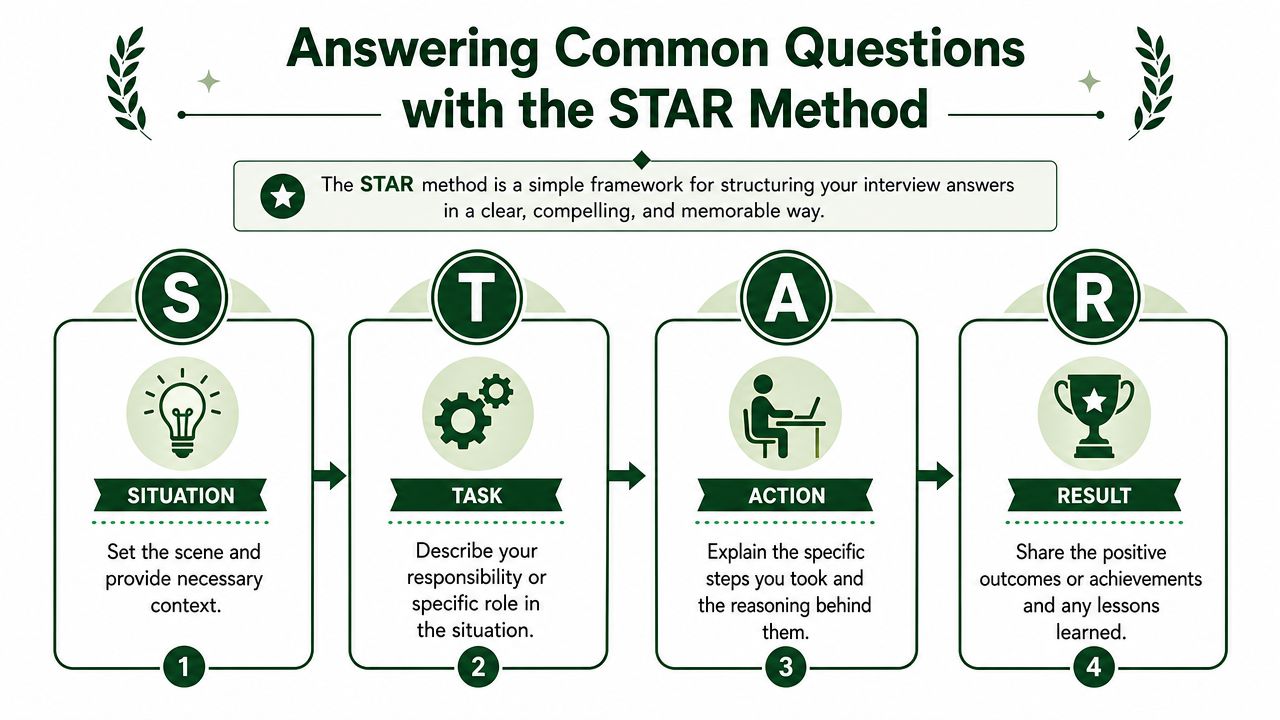
A strong reason to use it is that structured interviews are better at predicting job performance. One meta-analysis reported a validity coefficient of 0.42 for structured interviews, and the same source explains that unstructured interviews are much weaker. You can read that in this overview of structured interviews and job performance prediction. In simple terms, interviewers often score candidates on specific criteria, so structured answers help.
Why structure helps
STAR stands for:
Situation
Give the background. Where were you working? What was happening?Task
Explain your responsibility. What did you need to do?Action
Describe the steps you took. This is the most important part.Result
Share the outcome. What changed? What did you learn?
A common mistake is spending too long on the background and not enough time on the action. The interviewer wants to know what you did.
Keep the situation short. Spend most of your time on the action and result.
A weak answer and a stronger answer
Let's use a common question.
Question: Tell me about a time you faced a challenge at work.
Weak answer:
"I had a difficult project once. There were some communication problems in the team, but I worked hard and we finished it. I learned a lot from that experience."
This answer isn't wrong, but it is too broad. It doesn't show enough evidence.
Stronger STAR answer:
"In my previous role, our team was preparing a client report, and two team members were using different data sources. That created confusion just before the deadline. My task was to help finalise the report and make sure the information was consistent. I compared both versions, checked the original source files, and organised a short call so we could agree on one final set of numbers and responsibilities. We submitted the report on time, and after that I suggested a shared template for future reports. That experience taught me that clear process matters as much as hard work."
Notice why this works better. It is specific. It shows responsibility. It shows action.
Build your own STAR bank
Prepare a small set of stories before the interview. Don't prepare twenty. Prepare four or five that you can adapt.
Try these topics:
- A challenge you solved
- A time you worked in a team
- A mistake and what you learned
- A time you handled pressure
- A success you are proud of
Then practise saying each story in about one to two minutes. That is usually long enough to show substance, but short enough to stay clear.
A simple STAR template you can copy
You can start with this:
"In my previous role, we were dealing with... My responsibility was to... I decided to... As a result..."
Say it out loud several times until it feels natural. You are not trying to sound memorised. You are training yourself to organise your thoughts quickly.
Essential Vocabulary and Professional Phrasing
Professional interview English doesn't need to sound complicated. In fact, simpler is often better. The best words are usually the ones that make your experience easy to understand.
Action verbs that sound clear and professional
These verbs help you describe what you did in past roles.
Managed
You were responsible for people, tasks, or processes.
Example: "I managed weekly client updates."Developed
You created or improved something.
Example: "I developed a new onboarding guide."Coordinated
You organised work between people or teams.
Example: "I coordinated communication between sales and support."Improved
You made something better.
Example: "I improved our response process."Resolved
You solved a problem.
Example: "I resolved customer issues by checking the details first."Supported
You helped a team, project, or customer.
Example: "I supported new team members during training."
Useful phrases for careful, confident speaking
You also need phrases for opinions, explanations, and transitions.
Here are some safe, natural choices:
To describe your strength
"One of my strengths is staying organised."
"I'm comfortable working with different teams."To give an opinion politely
"In my experience, clear communication helps avoid mistakes."
"I think the most important part is understanding the customer's need."To explain a choice
"I chose that approach because the deadline was tight."
"I focused on that first because it had the biggest impact on the team."To be honest about growth
"That's something I've been working on."
"I didn't know it at first, but I learned quickly."
Good interview language is specific, calm, and easy to follow.
Words to avoid
Some words make answers weaker because they are too vague.
| Weaker word | Better option |
|---|---|
| nice | helpful, clear, supportive |
| good at | experienced in, comfortable with |
| stuff | tasks, projects, responsibilities |
| many things | a range of tasks, several responsibilities |
You don't need to sound formal in every sentence. You just need to sound precise.
If you want more practice with professional language in service-focused situations, this article on English for hotel customer service gives useful examples of polite, work-ready phrasing.
A good habit is to build your own interview word bank. Write ten verbs, five strengths, and five phrases you can imagine using naturally. Then record yourself using them in full answers.
Speaking Fluently Under Pressure
Many learners prepare good ideas, then lose them under stress. The problem isn't only vocabulary. It is speed, pressure, and self-monitoring. You start speaking, hear a small mistake, panic, and then your answer becomes less clear.
Fluency in interviews doesn't mean speaking fast. It means speaking at a pace you can control.
How to sound clearer right away
Try these changes in your next practice session:
Speak a little slower
Most learners become clearer when they slow down slightly. Fast speech often creates more grammar mistakes and unclear pronunciation.Pause between ideas
A short pause sounds professional. It also gives your brain time to plan the next sentence.Stress key words
Put a little more voice energy on important words like project, customer, deadline, solution, or result. This helps the listener follow you.Finish the sentence you started
Don't abandon one sentence and start three more. Simpler structure usually sounds stronger.
If pronunciation is one of your main worries, focused practice on English vowel pronunciation can help you sound more understandable in interview answers.
What to say when you need time
This is one of the most useful skills in English for job interviews. Many guides teach answer content, but they don't teach recovery. That is a gap. Advice on conversational repair skills for interviews highlights how important "thinking phrases" and clarification language are for non-native speakers under pressure.
Here are phrases you can use naturally:
When you need a moment
"That's a good question."
"Let me think about that for a moment."
"I'd say there are two parts to that."When you didn't understand
"Could you please repeat the question?"
"Could you clarify what you mean by that?"
"Just to make sure I understand, are you asking about my current role or my previous one?"When you lose a word
"What I mean is..."
"Let me say that another way."
"The main point is..."
A better response than freezing
Suppose the interviewer asks a difficult question, and your mind goes empty. Silence for a second is okay. Long silence feels harder.
Try this pattern:
Buy time politely
"That's an interesting question."Name your direction
"I think the best example is from my last job."Start clearly
"We had a problem with..."
This keeps you moving. Movement matters.
Silence feels longer to you than it does to the interviewer.
One more thing helps a lot. Practise out loud in realistic conditions. Sit upright. Answer in full sentences. Don't stop after every error. If you want a private speaking partner for that kind of repetition, Verse is one option. It lets you speak, get feedback on grammar, vocabulary, fluency, and pronunciation, and repeat answers until they feel steadier.
Navigating Interview Culture and Etiquette
Even strong English can feel awkward if the style is wrong for the situation. Some candidates focus only on words and forget the social side of the interview. But tone, body language, and small moments at the start can shape the whole conversation.
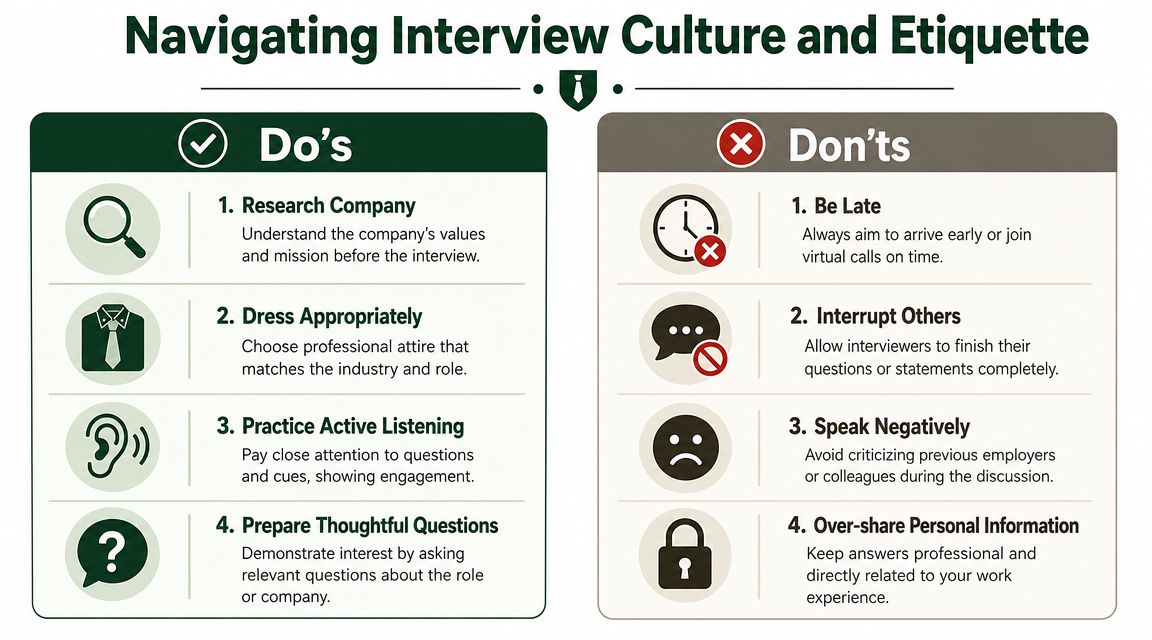
Recent advice for American interviews highlights nonverbal signals such as upbeat posture, smiling, and nodding to show engagement. You can see that in this guide to job interview do's and don'ts in English. These cues are not the same in every culture, but they often matter in English-speaking business settings.
Nonverbal signals matter
You don't need to perform or act like a different person. Small adjustments are enough.
Posture
Sit upright. It helps you breathe and sound more confident.Eye contact
Keep natural eye contact, but don't stare. In video interviews, look at the camera sometimes, not only at your own image.Facial expression
A light smile at the beginning and during friendly moments can make you seem more open and engaged.Listening signals
Small nods can show attention. They tell the interviewer you are following the conversation.
Simple do's and don'ts
A short list is easier to remember than a long set of rules.
| Do | Don't |
|---|---|
| Greet warmly and professionally | Start too casually |
| Listen fully before answering | Interrupt the question |
| Keep answers relevant | Tell very long stories without a point |
| Speak respectfully about past jobs | Complain about former managers or teams |
A professional interview style is usually warm, calm, and respectful.
Small talk is part of the interview
The first minute may include simple questions like "How's your day going?" or "Was it easy to find us?" Don't ignore these as unimportant. They help create tone.
You can answer:
- "I'm doing well, thank you."
- "Yes, everything went smoothly."
- "Thank you for having me today."
If this feels unnatural in your home culture, that's okay. Think of it as part of communication in that setting, not as fake behaviour. You are learning the local rhythm of professional conversation.
Your Pre-Interview Checklist and Final Practice
The day before the interview isn't the time to learn everything. It's the time to make your preparation easier to use. Keep things simple and calm.
A simple final-day routine
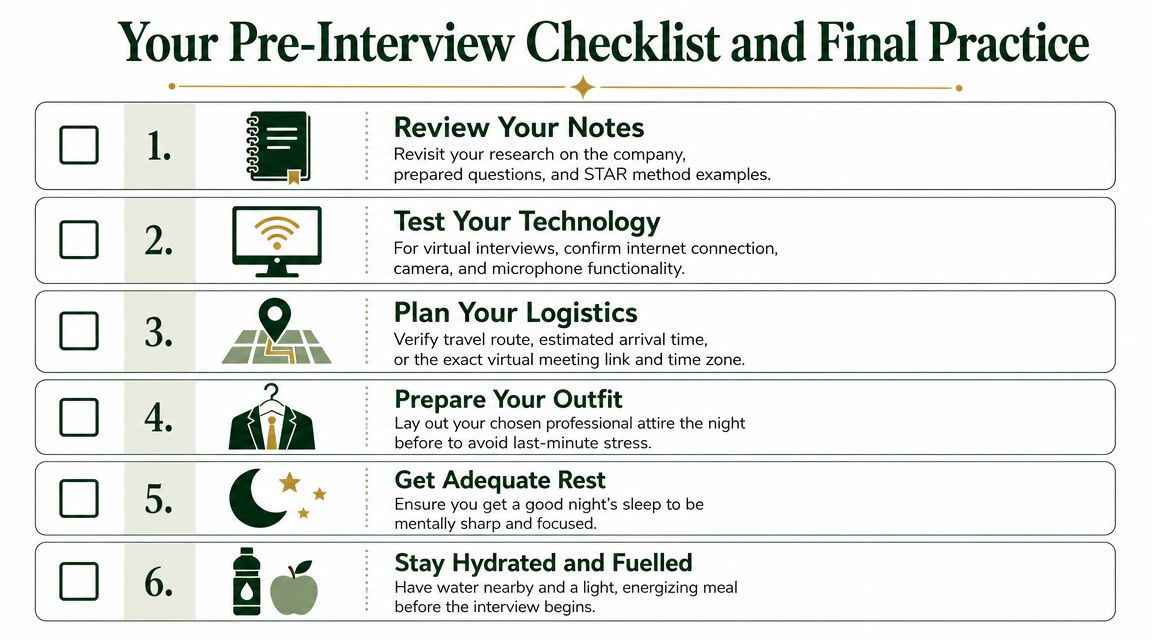
Use a checklist like this:
Review your key notes
Read your short research notes, your main strengths, and your STAR stories.Check the practical details
Confirm the time, location, or video link. Test your microphone and camera if the interview is online.Prepare your questions
Bring two or three thoughtful questions about the role, team, or work style.Choose your outfit early
Decide the night before. Small decisions feel bigger when you're nervous.Sleep and eat sensibly
Try to rest well and have water nearby.
Practice out loud, not only in your head
This is the step many learners skip. Silent preparation feels productive, but speaking practice is different. Your mouth, breath, timing, and confidence all need rehearsal.
Try this short practice schedule:
Morning
Answer "Tell me about yourself" out loud two times.Afternoon
Practise two STAR stories and one question about your strengths.Evening
Do one short mock interview. Wear headphones if that helps you focus.
If you want extra speaking prompts, this set of IELTS speaking practice ideas can also help you get used to answering questions clearly under time pressure.
Don't try to sound perfect the night before. Try to sound steady. Clear beats complicated. Calm beats fast. Prepared beats memorised.
Reading helps, but confidence grows fastest when you speak. If you want a low-pressure way to practise interview answers out loud and get honest feedback on your grammar, vocabulary, fluency, and pronunciation, try Verse. You can use the no-signup demo to start practising straight away.
Frequently Asked Questions
How can I improve my English for a job interview quickly?
Focus on preparation, not perfection. Research the company, build a bank of 4 to 6 STAR stories about your experience, learn a small set of professional phrases, and practice answering common questions out loud every day in the week before the interview.
What are the most common job interview questions in English?
The most common questions are: tell me about yourself, why do you want this job, what are your strengths and weaknesses, tell me about a challenge you faced, and where do you see yourself in five years. Prepare a structured answer for each one using the STAR method.
What should I say if I do not understand a question in an English interview?
Ask for clarification calmly. Phrases like 'Could you rephrase that, please?' or 'Just to make sure I understand, are you asking about...?' sound professional and give you time to think. Interviewers expect these questions from all candidates, not only non-native speakers.
Do I need perfect English to pass a job interview?
No. Interviewers care about clear communication, relevant experience, and confidence. A structured answer with a small accent and a few mistakes beats a perfect sentence you cannot finish. Aim for clarity and preparation instead of perfection.