English Fluency App: Practical Tips for 2026

A lot of learners know this feeling well. They can read emails, understand subtitles, and answer grammar questions, yet the moment a real person expects a spoken reply, the mind goes blank. An english fluency app helps most when it creates a private place to speak out loud, get honest feedback, and try again without embarrassment.
That matters because fluency is not the same as knowing rules. It is the ability to produce English in real time, under pressure, without freezing. The strongest apps focus on speaking practice, not passive study, because talking gets better by talking.
Table of Contents
- Why Speaking Out Loud Is the Core Objective
- Setting a Realistic Goal and a Daily Routine
- Choosing the Right Type of Speaking Practice
- Reading AI Feedback Without Getting Discouraged
- Tracking Progress Over Weeks and Months
- Personalizing the App for Your Learner Profile
- Staying Calm and Troubleshooting Common Pitfalls
Why Speaking Out Loud Is the Core Objective
A learner can know the right sentence in their head and still say nothing aloud. That gap is the problem. Reading and listening build understanding, but speaking needs a different kind of practice, one where the mouth, the brain, and the timing all work together, and where the learner gets used to producing words under a little pressure.
That is also why so many people look for an english fluency app that goes beyond silent study. What English fluency means in practice makes the point clearly, fluency is less about having perfect knowledge and more about being able to respond, explain, and keep a conversation moving. An app can support that only if it gives the learner repeated chances to speak out loud, hear what came out, and try again.
The market reflects how much demand there is for this kind of practice. Language learning apps generated $1.54 billion in revenue in 2025, up 18.8% year over year, and were downloaded 327 million times that year, according to Business of Apps. A separate market view places the broader market at $4.21 billion in 2023, with a projection to reach $16.2 billion by 2033 at a 14.40% CAGR, which shows that mobile learning is no small side trend, but a large, growing category.
Talking is a skill built by talking
Practical rule: if the goal is speaking, the practice must include speech, not just recognition.
That sounds simple, but many tools still lean on taps, matches, and silent review. A review in Education and Information Technologies found that quiz apps mainly support vocabulary, puzzle apps support vocabulary and grammar, while categories like augmented reality and virtual reality are the ones linked more closely to listening and speaking development (ERIC review PDF). In plain words, quiet study can help with knowledge, but spoken output needs spoken output.
A shy learner often notices this during a meeting rehearsal. They can choose the correct answer on a screen, then freeze when asked the same thing aloud. An app built around speech changes that pattern because it gives repetition with pressure, then feedback on the exact words that came out.
The app should feel like a private speaking gym. Short reps matter more than streaks, because each spoken attempt trains pronunciation, sentence shape, and timing in a way silent review cannot. A learner who says the sentence out loud, hears the result, and repeats it is building the habit that real conversations require.
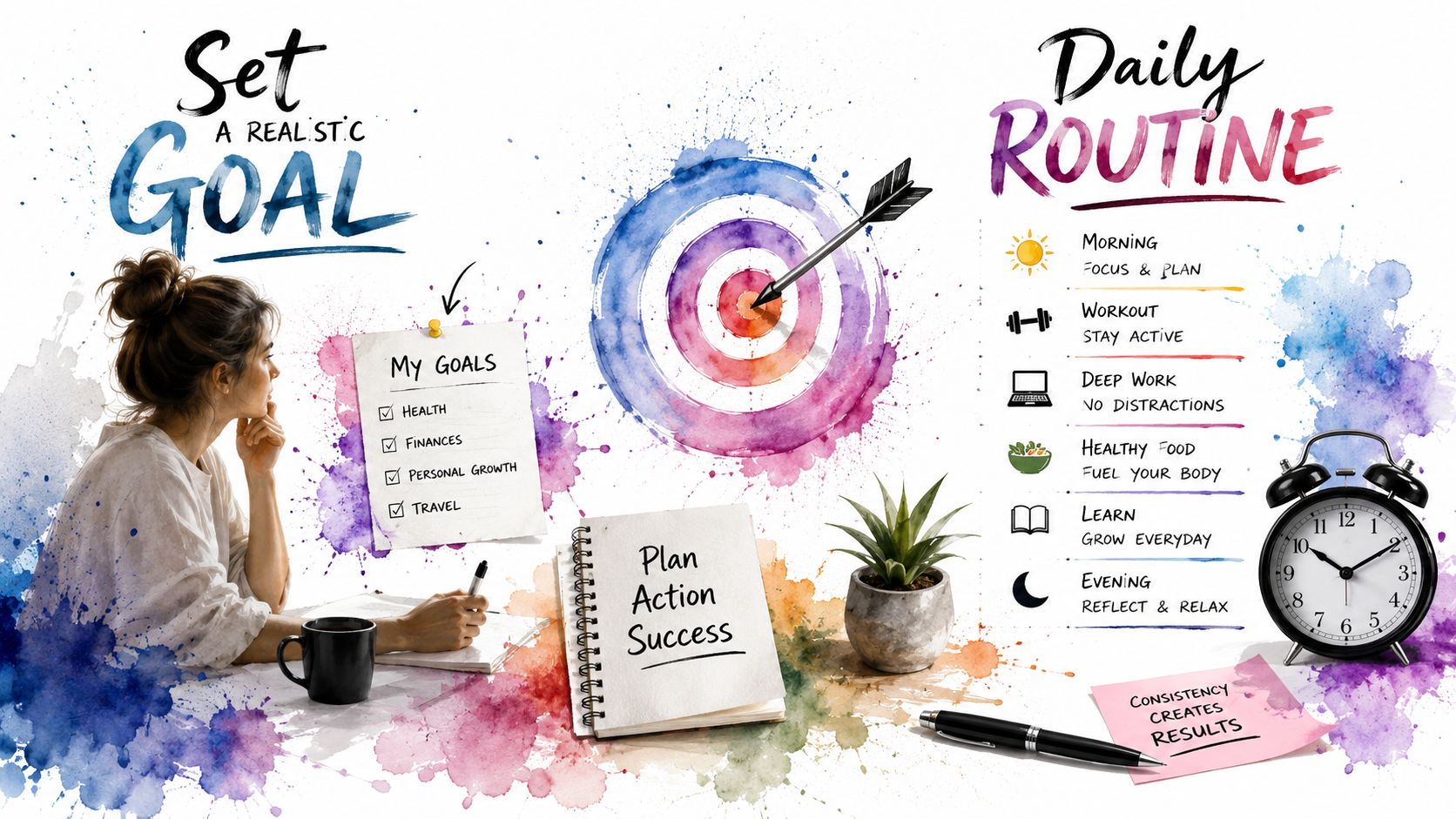
Setting a Realistic Goal and a Daily Routine
A useful goal is small enough to survive a busy week. One 10-minute speaking session a day is more realistic than a dramatic plan that lasts three days. The reason is simple, a habit that fits into an ordinary morning or evening is more likely to stay alive.
Build the habit around a real reason
A goal works better when it is tied to something concrete. A work call, a trip, a job interview, or a classroom presentation gives the practice a purpose. The learner is not “doing English,” they are preparing to speak in a specific situation.
A simple routine can look like this. Start with one minute of easy warm-up speaking, maybe describing the day or reading a short prompt aloud. Then spend a few minutes on guided conversation. Finish by reading the feedback once, choosing one fix, and writing a single line in a notebook about what felt hard.
Simple rule: keep the routine short enough that skipping it feels more awkward than doing it.
A morning session can work well because the day is still quiet. An evening review can also help, especially for learners who want to notice one pattern before sleep. The exact time matters less than the fact that it happens in the same place and at roughly the same hour.
The clearest routine is often the least fancy. A learner does not need a perfect plan, just a repeatable one. That is why speaking practice works best when it feels ordinary, like brushing teeth, not like a performance review.
English speaking practice tips can support this routine if the learner wants a simple place to start. The core idea stays the same, speak first, review second, repeat tomorrow.
Choosing the Right Type of Speaking Practice
Not all speaking practice feels the same. A learner who needs job English will not benefit from the same prompts as someone getting ready for travel or exam speaking. The best app use is matched to the gap, not to a ranking or a trend.
Match the practice to the speaking need
Guided scenarios are useful when the learner wants a safe starting point. A prompt like ordering coffee in a café gives structure, which helps when confidence is low. Roleplays feel looser, since the learner has to respond to a changing situation, such as asking for a refund or handling a missed delivery.
Exam-style practice is different again. It asks for clear answers, timing, and organized speech, so it suits learners preparing for speaking tests. A typical example is answering a short prompt about a favorite city and then expanding the answer with reasons and details.
Workplace conversations serve another purpose. They train the language used in meetings, status updates, and requests. A learner might practice saying a deadline needs to move, or explaining a problem without sounding rude.
A few minutes spent in each type can keep practice fresh. One day can focus on everyday life, the next on work, and the next on test-style pressure. That variety matters because real life does not stay in one mode.
Accent choice can help too. Picking a British, American, or Australian voice gives the ear a target, so the learner hears the rhythm they want to use day to day. The goal is not imitation for its own sake, just clearer listening and more natural response timing.
The youngest adult learners are often highly active on mobile learning, with the 18 to 24 group showing the highest engagement at 48%, according to Market.us. That does not tell any one learner what to choose, but it does show that frequent, mobile-based speaking practice fits the way many people already learn.
Reading AI Feedback Without Getting Discouraged
Feedback can feel harsh the first few times. A learner hears a correction on pronunciation or grammar and assumes the whole answer was wrong. That reaction is common, but it is also unhelpful, because the feedback is there to guide the next attempt, not to judge the person.
Read the notes as separate signals
Grammar feedback usually points to sentence shape. Vocabulary feedback usually shows a word choice that sounds unnatural or too vague. Pronunciation feedback focuses on sounds, stress, or syllables. Fluency feedback often reflects pauses, long hesitations, or sentences that needed more natural flow.
A corrected sentence can be very small. “I go to office yesterday” becomes “I went to the office yesterday.” That one change shows the kind of fix the learner can store and reuse later. The useful question is not, “Was everything perfect?” It is, “What one part should be different next time?”
Feedback is a map, not a verdict.
A simple logging habit helps. After one session, write down one grammar fix and one speaking fix. That's enough. Trying to correct every mistake at once usually creates overload, and overload makes the next session harder, not better.
Pronunciation notes can sting because they touch confidence. The best response is to slow down, repeat the phrase, and say it again more clearly. The mouth learns through repetition, and tricky sounds usually need many patient tries before they feel natural.
What an AI chatbot should do in a speaking lesson is less about being clever and more about being specific. For speaking practice, the useful part is not the novelty, it is the ability to hear a turn, correct it, and try again immediately.

Tracking Progress Over Weeks and Months
Speaking progress is easy to miss because it rarely feels dramatic from one day to the next. A learner may speak a little more smoothly, pause a little less, or recover from mistakes faster, but those changes can be hard to notice in the moment. That is why progress tracking matters.
Use history, not mood, to judge improvement
Session history gives the learner a record of what was practiced. Scores over time can show whether confidence is rising, but the more useful part is often the pattern behind the score. If the same grammar slip keeps appearing, that pattern is worth attention.
A monthly self-check is especially useful. Record the same short answer to a fixed prompt once a month, then listen back. The difference between the first and third recording can be more honest than memory, because memory tends to either flatter or punish the learner unfairly.
A simple checkpoint can also help. At around week four, a learner might aim for a two-minute casual conversation without stopping to translate every sentence. That target is not a promise, it is a benchmark that keeps practice concrete.
Progress markers should feel useful, not stressful. Daily streaks can be motivating for some people, but they do not always reflect speaking ability. A learner can keep a streak and still avoid real output, so the better question is whether the app history shows more comfort, more words, and less panic when speaking.
The best records are the ones the learner will revisit. A short note, a saved session, and one monthly recording usually tell a clearer story than a long spreadsheet ever could.
Personalizing the App for Your Learner Profile
No single routine suits every learner. A busy professional, a nervous beginner, a test candidate, and a traveler all need different kinds of practice. The app should bend around the learner's life, not the other way around.
Four common learner profiles
A busy professional usually needs short, focused sessions. Meeting practice, polite disagreement, and quick explanations matter more than broad lessons. A few tight conversations before work can prepare the mouth for real calls.
A student preparing for IELTS or TOEFL needs controlled speaking practice with clear prompts and timed answers. That learner benefits from answers that are recorded, reviewed, and repeated until the structure feels easier to control. Test work is less about casual chat and more about speaking on demand.
A shy speaker needs privacy first. A judgment-free space lowers the fear of sounding awkward, which is often the main barrier. For that learner, the most useful sessions are the ones that start small, stay private, and let mistakes happen safely.
A traveler usually needs practical everyday English. Asking for directions, handling transport, and solving small problems are more useful than advanced vocabulary. The practice should sound like real life, not a textbook.
One option in this category is Verse, an AI conversation partner that gives spoken practice, natural replies, and feedback on grammar, vocabulary, fluency, and pronunciation. It fits the same broader principle as any good speaking tool, the learner talks out loud, gets feedback, and keeps going.
The main point stays the same across every profile. An app is most useful as part of a broader routine that also includes listening and real conversation. The app gives reps, but the learner still has to use those reps with real people.

Staying Calm and Troubleshooting Common Pitfalls
Freezing before a speaking session is normal. Many learners hesitate at the record button because speaking out loud feels more exposed than reading or tapping answers. The fix is not more pressure, it is a smaller first step.
Start easier than you think you should
A very short prompt is better than waiting for the perfect one. Describing breakfast, naming three things in the room, or answering a simple question is enough to get the mouth moving. Once the first sentence is out, the rest usually feels less heavy.
Self-correcting in the middle of a sentence can break flow. A better rule is to finish the thought first, then check the feedback. That keeps the speaking rhythm alive and stops every mistake from turning into a pause.
Privacy helps more than many learners expect. Practicing in a calm, judgment-free space makes mistakes feel less personal, which matters when confidence is low. The point of the session is not to sound like a textbook, it is to be understood clearly enough to keep the conversation moving.
When motivation drops, use a tiny checklist.
- Open the app. Starting is often the hardest part.
- Choose one easy prompt. Small wins matter more than clever ones.
- Speak for one minute. Momentum usually follows action.
- Read one correction. One fix is enough for a tired day.
- Stop before burnout. Ending with some energy makes tomorrow easier.
Real fluency grows from repetition, honest feedback, and a willingness to sound imperfect while learning. That is the quiet work behind every confident reply. The learner who keeps showing up usually feels the shift before they can fully describe it, less panic, more breath, more room to think.
Open the app, say one short answer out loud today, and let that be enough for now.