What Is English Fluency? a Practical Guide for Speakers

English fluency is the smooth flow of speech, not perfect grammar, and a practical benchmark is B2 level, where a speaker can interact with spontaneity and produce clear, detailed speech on many subjects. It helps to think of fluency as a flowing river, not a speeding train. The goal isn't to rush. The goal is to keep meaning moving.
Many English learners know this feeling well. Reading goes fine. Listening is often better than expected. Then a real conversation starts, and the mind suddenly feels empty. The person knows more English than they can say.
That gap is common, and it doesn't mean anything is wrong. As of 2023, approximately 1.5 billion people worldwide speak English, with over 1.12 billion being non-native speakers, so the learner is part of a huge global community working through the same challenge, as shown in these English language statistics. For anyone working on spoken confidence, this guide sits well alongside practical advice on how to improve English speaking skills.
Table of Contents
- Introduction What Is English Fluency Really About
- Common Myths About English Fluency
- The Five Key Components of Speaking Fluently
- How to Measure Your Own English Fluency
- Actionable Strategies to Build Speaking Fluency
- Your Journey to Confident Speaking Starts Now
Introduction What Is English Fluency Really About
A learner reads a news article in English and understands most of it. That same learner watches a video and follows the main ideas. But in a meeting, or during a casual chat, the first sentence comes out slowly, the second sentence breaks, and the third sentence disappears.
That moment feels frustrating because it seems to say, "The English isn't ready yet." But the problem is often elsewhere. The learner may have knowledge, but speaking asks for something else. It asks for quick access, steady rhythm, and enough calm to keep going even when a mistake appears.
What is English fluency, then? It is the ability to express thoughts clearly and naturally in real time, even with small errors. It is less about perfection and more about connection. A fluent speaker can keep a conversation alive, adjust when a word is missing, and help the listener follow the message.
Fluency isn't spotless English. It's English that keeps moving and keeps connecting.
Many learners aim at the wrong target. They wait until every sentence feels perfect before they speak. That habit often creates more fear, not more fluency. Spoken English grows when the mouth practices what the brain already knows.
A simple way to think about fluency is this:
- It carries meaning forward, even if the grammar isn't flawless.
- It sounds natural enough to follow, even if the accent isn't native.
- It allows real interaction, not just memorized answers.
That definition is more encouraging because it gives the learner room to grow. Fluency is achievable. It is built through repeated speaking, listening, adjusting, and trying again.
Common Myths About English Fluency
Many learners feel blocked by ideas that sound true but aren't helpful. These myths make fluency look harder than it really is.
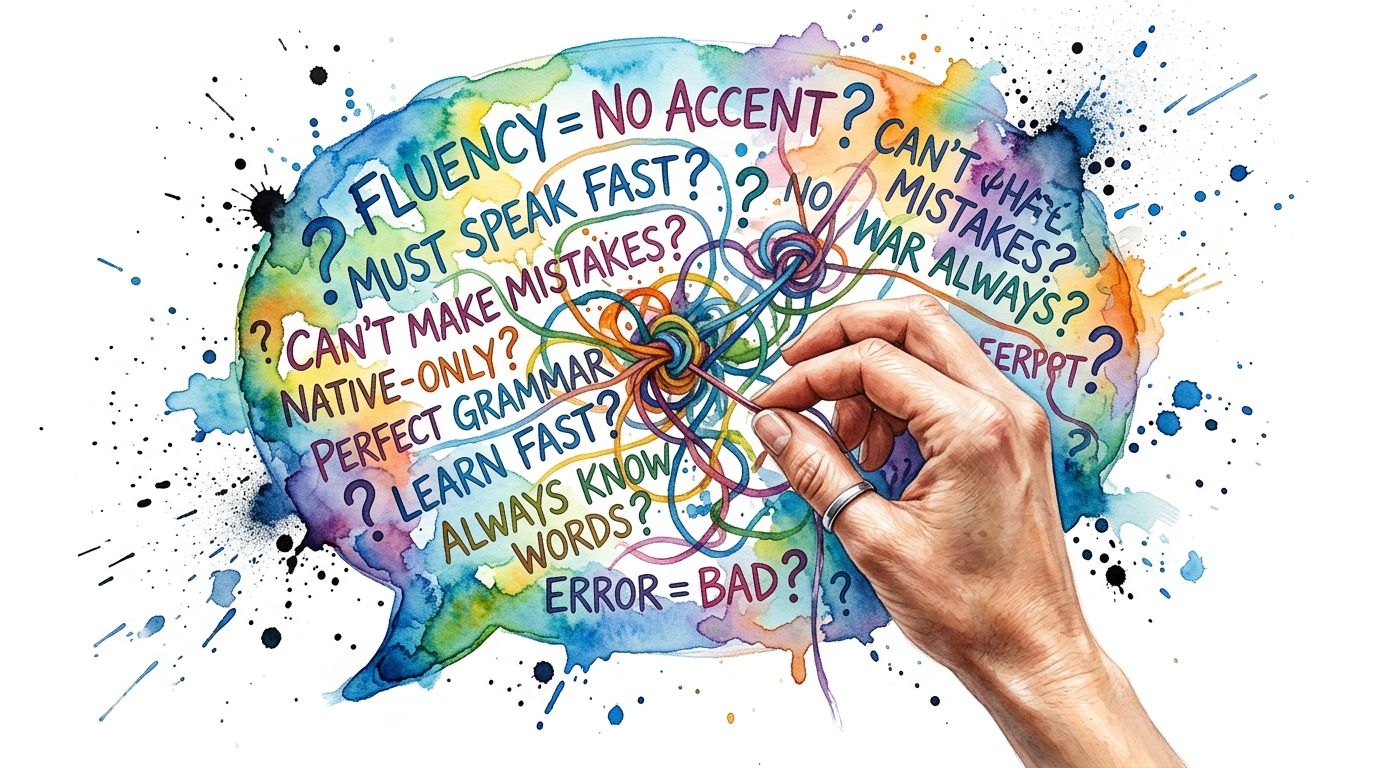
Myth one, fluency means no mistakes
This myth is one of the most discouraging. If fluency means zero mistakes, then almost nobody feels fluent for long. Real conversation is messy. People restart sentences. They choose a simpler word. They notice a small grammar problem and keep going.
A learner can be fluent and still say something imperfect. What matters more is whether the listener understands the meaning without much effort. A small mistake that doesn't block communication is often less important than a long silence caused by fear.
Myth two, fluent people speak very fast
Speed can look impressive, but speed alone doesn't create good communication. Fast speech with weak structure can confuse the listener. Steady speech with clear meaning is often much better.
Recent academic research shows that listeners' perception of fluency is influenced more by vocabulary range and turn-taking ability than by raw speed or the absence of pauses, as discussed in this research on perceived fluency in conversation.
That finding helps many learners relax. A short pause is not failure. Thoughtful speech can still be fluent if the speaker manages the conversation well.
A useful rule: clear and connected beats fast and stressful.
Myth three, fluency needs a perfect native accent
A strong accent doesn't cancel fluency. Many highly effective English speakers have accents from their first language. They work, study, travel, present ideas, and build relationships in English every day.
The better question isn't "Does this sound native?" It is "Can people understand this easily?" Fluency and accent are not the same thing. Accent is about sound. Fluency is about flow, meaning, and response.
A learner usually makes faster progress when the goal changes from "sound exactly like someone else" to "speak clearly enough to connect."
Three healthier replacements for these myths help:
- Replace perfection with clarity, because clear meaning carries conversation.
- Replace speed with rhythm, because natural pacing helps both speaker and listener.
- Replace accent anxiety with intelligibility, because understandable speech matters more than imitation.
The Five Key Components of Speaking Fluently
Fluency feels less mysterious when it is broken into parts. According to Pearson's explanation of speaking fluency, speaking fluency includes five measurable components: flow, coherence, automaticity, repair strategies, and interaction.

Learners who want smoother speech often benefit from understanding natural sound patterns too, especially connected speech in English.
Flow means speech keeps moving
Flow is the natural pace of speaking. It doesn't mean talking quickly. It means the speaker can continue without too many long, painful stops.
For example, a learner says, "Yesterday I went to the station, then I met a friend, and we had coffee." That sentence may be simple, but if it moves naturally, it shows flow.
Coherence helps ideas make sense
Coherence means ideas connect in a logical way. One sentence leads to the next. The listener doesn't feel lost.
A speaker with coherence might say, "The meeting was delayed, so the team started late. Because of that, the presentation was shorter than planned." The language isn't fancy, but the thought is easy to follow.
Automaticity reduces mental traffic
Automaticity means speaking without checking every grammar rule in the head before opening the mouth. The speaker uses familiar language more naturally.
This is the difference between stopping to build a sentence brick by brick and saying a common phrase smoothly. A learner with growing automaticity doesn't need to translate every word first.
Repair strategies keep conversations alive
Repair strategies are what a speaker uses when something goes wrong. This might be self-correction, rephrasing, or choosing a different word.
If the speaker forgets "receipt," they might say, "the paper from the shop that shows what you paid." That is still successful communication.
A fluent speaker doesn't always know the exact word. A fluent speaker keeps going anyway.
Interaction turns speaking into connection
Interaction is the social side of fluency. It includes turn-taking, responding appropriately, asking follow-up questions, and showing that the conversation is shared.
A learner may know many words but still struggle if they don't know when to reply, how to interrupt politely, or how to invite another person to speak. Fluency lives inside conversation, not inside isolated sentences.
These five parts also make practice easier to organize:
- One day can focus on flow, with easy retelling tasks.
- Another day can focus on coherence, by linking ideas with simple connectors.
- A different session can train repair, by practicing how to explain a missing word.
That approach feels much lighter than trying to "be fluent" all at once.
How to Measure Your Own English Fluency
Many learners ask the same quiet question. "Am I fluent yet?" The answer gets clearer when fluency is measured with a real benchmark instead of emotion.
According to the Cambridge English definition of fluency and its link to CEFR B2, English fluency is operationally linked to B2, or Upper Intermediate. At this level, a speaker can interact with a degree of spontaneity and produce clear, detailed speech on many subjects.
What B2 looks like in real life
B2 doesn't mean perfect English. It means functional, confident communication in many normal situations.
A B2 speaker can usually handle things like these:
- Join a conversation without long preparation, even if the topic changes.
- Explain opinions with reasons, not only short answers.
- Describe experiences in detail, such as work tasks, travel problems, or study plans.
- Keep speaking when a word is missing, by rephrasing.
This is why B2 is such a useful goal. It is high enough for meaningful conversation, but it doesn't require flawless language.
Fluency at Different CEFR Levels
| Level | Speaking Fluency Description |
|---|---|
| B1 | Can handle familiar topics and simple conversations, but may pause often to search for words or structure ideas. |
| B2 | Can speak with a degree of spontaneity, maintain conversation, and give clear, detailed responses on a wide range of subjects. |
| C1 | Can express ideas flexibly and smoothly in more demanding discussions, with stronger control over nuance and style. |
A table like this helps because many learners judge themselves too harshly. They may already be communicating at a solid level, even if speaking still feels uncomfortable.
Simple self-check questions
A useful self-check is not "Do mistakes still happen?" Mistakes happen at every level. Better questions are these:
- Can the speaker keep talking after a small error?
- Can the speaker explain the same idea in another way if one word is missing?
- Can the speaker answer follow-up questions without freezing?
- Can the listener follow the main point without constant effort?
- Can the speaker talk about both daily life and less familiar topics?
One practical idea from fluency coaching is the "next best option" test. If a word disappears, can the speaker find another way to express the idea? Strong fluency often shows up there. It is not about perfect recall. It is about flexible communication.
Actionable Strategies to Build Speaking Fluency
Fluency grows fastest when speaking becomes a regular habit instead of a rare event. Research highlighted in this discussion of automaticity and consistent daily practice explains that fluency requires automaticity, and that it develops through consistent, low-intensity practice, such as 15 minutes daily, rather than cramming.
That idea changes how practice should look. Long study sessions can help with knowledge, but short daily speaking sessions often help more with real-time speech.

Learners who want more practical routines can also explore English speaking practice ideas.
Build a daily speaking habit
The habit matters more than the mood. A learner doesn't need to feel confident first. Confidence often comes after repetition.
A simple weekly pattern can work well:
- Day one, think out loud. Describe what is happening while making coffee, walking, or working.
- Day two, retell something short. Summarize a video, a story, or a conversation.
- Day three, answer one question thoroughly. For example, "What makes a good manager?" or "Why is learning English hard sometimes?"
- Day four, describe a picture. Focus on detail, not beauty.
- Day five, compare two things. A city and a village. Online study and classroom study. Tea and coffee.
- Weekend, review and repeat. Say the same topic again and notice what feels easier.
Use short tasks with clear limits
Open tasks can feel overwhelming. Clear limits reduce pressure and help the brain stay focused.
These tasks are especially useful:
Thirty-second topic talks
Choose one topic and speak for only half a minute. If that feels easy, extend it a little. Short tasks teach the speaker to start quickly.Rephrase practice
Pick a common object and explain it without using its name. This builds flexibility. It also trains the skill of finding the next best option.Question chains
Answer one question, then ask and answer a related one. This supports interaction, not just monologue.
Short speaking tasks done often create better speaking habits than rare, exhausting study sessions.
Practice with feedback, not silence
Silent learning has value, but spoken fluency needs spoken output. A learner has to hear their own English, notice weak points, and try again.
That is why real spoken practice matters more than passive drills alone. Talking out loud and getting immediate correction on grammar, vocabulary, and fluency helps learners notice patterns quickly. For people who feel shy, a private conversation partner can make practice feel safer and more consistent. Verse is built for this kind of work. It focuses on real spoken practice, not silent flashcards or grammar-only drills, and it gives judgment-free feedback after each turn. Learners can also choose a British, American, or Australian accent. There is a free, no-signup demo on Verse for anyone who wants to try speaking out loud in a low-pressure way.
A few ground rules make feedback more useful:
- Record first, judge later, because stopping every few seconds hurts flow.
- Fix one pattern at a time, such as verb tense, missing articles, or weak endings.
- Repeat the improved version out loud, because corrected language needs a second spoken attempt.
The main goal is simple. Practice should sound like speech, not just feel like study.
Your Journey to Confident Speaking Starts Now
English fluency is easier to understand once the pressure is removed. It isn't perfect grammar, very fast speech, or a native accent. It is the ability to keep meaning moving, respond naturally, and stay connected in conversation.
That is why fluency feels so human. It grows through use. A learner speaks, hesitates, repairs, tries again, and gradually becomes more comfortable doing all of that in real time. Small mistakes don't cancel progress. They are part of spoken language.
Confidence usually doesn't arrive first. Practice does. Then confidence starts to follow.
A learner who speaks out loud regularly is already building fluency, even if the sentences are simple. A learner who rephrases instead of stopping is already thinking more fluently. A learner who keeps a conversation going for a little longer each week is moving in the right direction.
The goal isn't perfect English. The goal is confident connection.
Every spoken sentence is useful practice. Even a short daily conversation, a self-recording, or a simple spoken summary helps train the kind of English that real life asks for. Keep speaking out loud. That is how fluency becomes real.