Conversational English for Beginners: Your 2026 Guide
July 21, 2026 · 14 min read
A lot of beginners know more English than they think. They can read simple messages, understand familiar words, and remember grammar rules from school. But then a real conversation starts, and the mind goes blank.
A common moment looks like this. Someone asks, “How are you?” The learner knows the answer. They've seen the words before. Still, there's a pause, a quick translation in the head, and then worry about making a mistake. By the time the sentence is ready, the moment has already moved on.
That feeling is normal. Conversational English for beginners isn't really about knowing every grammar rule first. It's about learning how to respond a little faster, a little more clearly, and with a little more calm each day.
Table of Contents
- Starting Your English Speaking Journey
- Build Your Confidence Before You Speak
- A 30-Day Routine for Consistent Practice
- Essential Phrases for Everyday Situations
- Practice Drills You Can Do Anywhere
- Keep Speaking and Keep Growing
Starting Your English Speaking Journey
Many beginners start in the same place. They can say single words like “coffee,” “bus,” or “meeting,” but speaking a full sentence feels much harder. They often think the problem is grammar. Very often, the actual problem is fear of getting the sentence wrong.
That fear makes English feel like a school subject instead of a tool for daily life. But English is used every day for travel, work, study, and online communication. As of 2023, approximately 1.5 billion people worldwide speak English, either as a native language or as a second language. This means nearly one in five people on Earth uses English, making it a critical tool for global communication, according to these English language statistics.
For a beginner, that can sound big and intimidating. It can also be comforting. Nobody needs perfect English to begin. People use simple English every day to ask for help, introduce themselves, and handle small situations step by step.
Practical rule: The first useful sentence matters more than the perfect sentence.
A learner might begin with short speech like this:
- Introduction: “Hi, my name is Ana.”
- Basic feeling: “I'm a little nervous.”
- Simple need: “Can you help me?”
- Daily topic: “I work in a shop.”
Those are not advanced sentences. They are still real communication. That's the point.
It also helps to think in sentence chunks, not isolated words. Instead of memorizing only “name,” “from,” and “live,” a beginner can practise full patterns like “My name is…,” “I'm from…,” and “I live in…”. That habit makes speaking smoother. A helpful example of this idea appears in this guide on conversing in a sentence.
Mistakes will happen. That isn't a sign of failure. It's part of normal speaking practice. A beginner who says something imperfect out loud is already doing more useful work than someone who only studies without speaking and waits for confidence to appear first.
Build Your Confidence Before You Speak

Confidence usually doesn't come before speaking. It grows because of speaking. That's why many beginners stay stuck for too long. They keep waiting to feel ready, but readiness often comes after small practice, not before it.
Why beginners freeze
One of the biggest hidden problems is mental translation. A learner hears a question, builds the answer in the first language, and then tries to convert it into English. That process is slow, stressful, and tiring. A primary barrier for learners is the cognitive bottleneck of translating thoughts from their native language before speaking, which leads to slow, unnatural responses. The key is to curb this tendency to achieve more spontaneous speech, as explained in this discussion of beginner conversation barriers.
Another problem is perfectionism. A beginner thinks, “If the grammar isn't correct, it's better not to speak yet.” But silence doesn't build speaking skill. Speaking builds speaking skill.
A short, imperfect answer is better practice than a perfect answer that stays in the head.
Three ways to build confidence early
The first strategy is to shrink the speaking goal. Instead of trying to “speak English well,” a beginner can choose one tiny target for the day. For example:
- Say three full sentences about the morning routine.
- Answer one simple question out loud, such as “What did you eat today?”
- Describe one object in the room for a short moment.
Small goals reduce pressure. They also make success easier to notice.
The second strategy is to think about what's visible now. This helps break the translation habit because the learner isn't creating a complex idea first. They're reacting to the present moment.
Examples:
- About the room: “There is a blue chair next to the table.”
- About the weather: “It's cloudy today.”
- About an action: “I'm drinking tea and reading messages.”
This type of practice teaches the brain to connect English directly to real life.
The third strategy is to accept rough English at the start. Beginners don't need elegant speech. They need usable speech. These paired examples show the difference:
Too much pressure: “I must speak without grammar mistakes.”
Better mindset: “I must make my meaning clear.”
Too much pressure: “I need a fast answer.”
Better mindset: “I need a simple answer.”
Too much pressure: “I can't speak until I know more words.”
Better mindset: “I can speak with the words I already know.”
A private space helps many shy learners practice authentically. Talking out loud alone, recording a voice note, or using a spoken practice tool can feel much safer than speaking in front of a class. The key is real voice use. Silent study feels productive, but it doesn't train the mouth, ears, and mind to work together in real time.
A 30-Day Routine for Consistent Practice
A routine helps because it removes one common beginner problem. They don't know what to do each day, so they end up doing nothing or only reading. A simple plan makes speaking practice feel smaller and more manageable.
What makes a routine work
For beginners, mixed practice works better than doing only one skill. The most effective method for beginners combines different skills, recommending a daily practice of 30 to 60 minutes mixing listening and speaking, starting with materials where learners understand 70 to 80% of the content, according to this overview of beginner practice structure.
That doesn't mean every session must feel heavy. A learner can still keep it simple. The important part is to include both input and output. Input means hearing or reading English. Output means speaking or writing English. For conversation, speaking out loud matters most.
A useful support for that habit is daily English speaking practice ideas, especially for learners who need structure but don't want a long study plan.
Week 1 and a sample routine
Week 1 can focus on greetings and introductions. The topic is familiar, which lowers pressure. The learner can repeat the same patterns many times with small changes.
| Day | Focus | Action |
|---|---|---|
| Day 1 | Greetings | Listen to a short greeting dialogue and repeat three key phrases out loud |
| Day 2 | Name and country | Say name, country, and city in five different full sentences |
| Day 3 | Simple personal facts | Speak for a short time about work, study, or family |
| Day 4 | Questions | Practise asking and answering “What's your name?” and “Where are you from?” |
| Day 5 | Listening and copying | Repeat one short audio several times, copying rhythm and stress |
| Day 6 | Self-introduction | Record a basic self-introduction and listen back |
| Day 7 | Review | Repeat the easiest phrases, then try one longer introduction without notes |
This first week should stay easy on purpose. A beginner doesn't need new grammar every day. They need repetition with a small amount of change.
Small habit: If a session feels difficult, shorten it, but still speak out loud.
Weeks 2 to 4
Week 2 can move to everyday needs. This includes buying food, asking for help, using transport, and talking about time. Daily tasks can include listening to one short exchange, copying two useful phrases, and then changing the details. For example, “I'd like water” becomes “I'd like coffee” or “I'd like a sandwich.”
Week 3 can focus on routines and opinions. Learners can describe a normal day, talk about likes and dislikes, and answer simple open questions. Good prompts include:
- Morning routine: “What do you do before work or school?”
- Food: “What kind of food do you like?”
- Free time: “What do you do on weekends?”
Week 4 can focus on short real conversations. The learner can practise starting, continuing, and ending a talk. That means using phrases like greeting, follow-up questions, and polite closing lines.
A weekly pattern like this often works well:
- Two days for listening and repeating
- Two days for guided speaking
- One day for recording
- One day for review
- One day for a relaxed conversation practice session
A beginner can also keep one notebook page for “useful chunks.” These are short phrases, not single words. Examples include:
- Starting: “Can I ask something?”
- Clarifying: “Sorry, can you say that again?”
- Buying time: “Let me think.”
- Ending politely: “Nice talking to you.”
That kind of monthly routine does something important. It turns speaking into a normal daily action instead of a stressful test. That's one of the biggest shifts a beginner can make.
Essential Phrases for Everyday Situations
Many beginners study long vocabulary lists and then feel disappointed when they still can't speak. The problem is usually not effort. The problem is format. Isolated words are hard to use in real time. Short phrase groups are easier to remember and easier to say.

At a cafe or restaurant
Useful phrases:
- Ordering: “Can I have a coffee, please?”
- Checking: “Is this for here or to take away?”
- Clarifying: “What do you recommend?”
- Paying: “Can I pay by card?”
Mini-dialogue:
Customer: Hi, can I have a coffee, please?
Staff: Sure. Small or large?
Customer: Small, please.
Staff: Anything else?
Customer: No, that's all. Can I pay by card?
Asking for directions
Useful phrases:
- Starting politely: “Excuse me, can you help me?”
- Location question: “Where is the train station?”
- Checking understanding: “Is it far from here?”
- Following directions: “Do I turn left or right?”
Mini-dialogue:
Visitor: Excuse me, can you help me?
Local: Yes, of course.
Visitor: Where is the bus stop?
Local: Go straight and turn left at the corner.
Visitor: Thank you. Is it far?
Local: No, it's very close.
Useful phrases are easier to remember when they match a real situation the learner may face this week.
Shopping for basic items
Useful phrases:
- Finding something: “Do you have this in a different size?”
- Price question: “How much is this?”
- Preference: “I'm just looking, thanks.”
- Decision: “I'll take it.”
Mini-dialogue:
Customer: Hi, how much is this?
Staff: It's ten dollars.
Customer: Do you have it in a different size?
Staff: Yes, one moment.
Customer: Great, thank you. I'll take it.
The best way to use these phrases is simple. Read them once, cover the text, and say them out loud from memory. Then change one word. “Coffee” becomes “tea.” “Bus stop” becomes “bank.” “Different size” becomes “different color.” That small change turns memorization into conversation practice.
Practice Drills You Can Do Anywhere
Some beginners need more private practice before they feel ready to speak with another person. That's completely reasonable. Speaking alone can still be serious training if the drills are active and clear.
Shadowing for rhythm and pronunciation
One of the strongest solo drills is shadowing. The shadowing technique requires listening to native audio and repeating it out loud to imitate the speaker's rhythm, intonation, and pronunciation, which directly supports real spoken practice, as described in this explanation of shadowing for beginner speaking.
A beginner can do it like this:
- Choose short audio with clear speech.
- Listen once without speaking.
- Play it again and repeat immediately after each phrase.
- Copy the music of the sentence, not just the words.
- Repeat the same clip several times.
This drill helps because beginners often pronounce each word separately. Real speech connects sounds. Shadowing trains the ear and the mouth together.
Question practice out loud
Another good drill is simple question practice. The learner hears or reads a question, pauses, and answers out loud before checking a model answer. Repeating this daily helps responses come faster and with less stress.
Good beginner questions include:
- Personal: “What's your name?”
- Daily life: “What do you do in the evening?”
- Preferences: “What food do you like?”
- Practical: “How do you go to work or school?”
A stronger version of this drill adds one extra step. After giving the first answer, the learner says a second answer with more detail. For example:
- First answer: “I go by bus.”
- Second answer: “I go by bus because it's cheap and easy.”
That second sentence is where growth happens.
Private speaking practice that feels safer
Recording is useful too. The learner can choose one topic, speak for a short time, and listen back. The goal isn't to judge the voice harshly. The goal is to notice patterns.
A learner can listen for:
- Pauses: Where did the speech stop?
- Missing words: Which simple words were hard to find?
- Repeated mistakes: Did the same grammar problem happen again?
- Pronunciation: Which words sounded unclear?
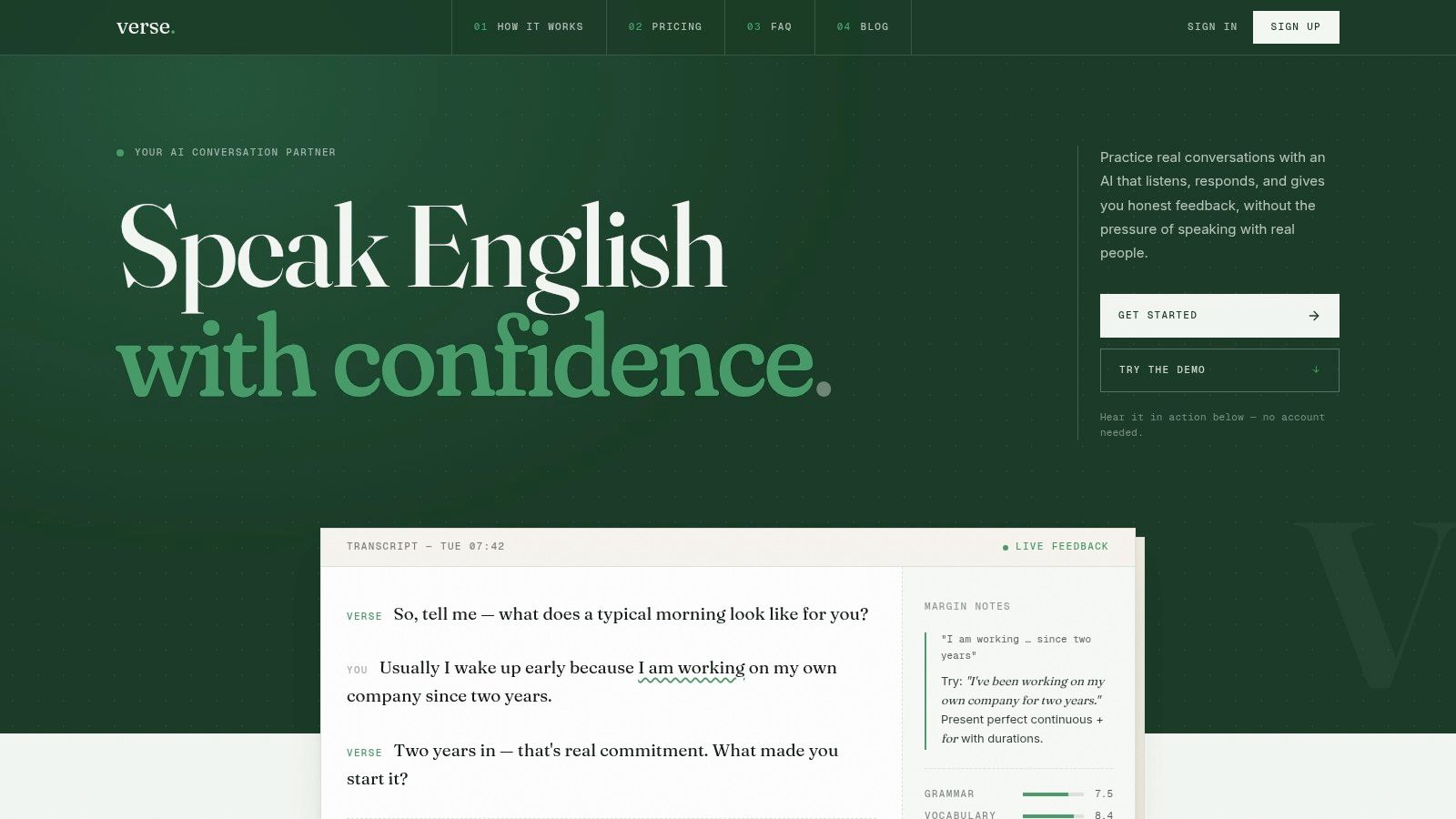
For shy learners, private tools can make this process easier. A spoken practice partner that allows real voice conversation and gives honest, judgment-free feedback can reduce the fear that often blocks beginners. The key difference is active speaking, not silent exercises. Some learners may find it helpful to explore ways to practice English speaking alone and, if they want a low-pressure place to talk out loud, try Verse's free, no-signup demo. Verse is a paid subscription at $12/month, and it focuses on real spoken practice with instant feedback on grammar, vocabulary, and fluency. Learners can also choose a British, American, or Australian accent.
Speaking alone still counts. If the learner is producing real sentences out loud, the practice is real.
Keep Speaking and Keep Growing
Progress in conversational English rarely comes from one perfect lesson. It comes from regular, spoken practice, especially when the learner stops waiting for perfect grammar and starts using simple English in real situations.
The most helpful path is usually the calmest one. Speak a little every day. Use short phrases. Repeat useful chunks. Notice mistakes, then try again. Confidence grows from action.
Even one minute of honest speaking out loud is a real step forward.