How Conversing in a Sentence Builds Speaking Fluency
July 19, 2026 · 14 min read
A lot of English learners know this feeling. They know many words. They understand grammar when they read it. But when a real person asks a simple question, the mind goes blank.
A learner may think, “Job... yesterday... office... good,” and still struggle to turn those words into one clear sentence. That gap can feel small on paper, but in conversation it feels huge. The problem usually isn't intelligence. It isn't laziness either. It's the pressure of building a sentence fast enough to keep the conversation moving.
That is why conversing in a sentence matters. It means taking an idea and saying it clearly enough for another person to answer, react, or continue the exchange.
Table of Contents
- From Words to Real Conversation
- What Conversing in a Sentence Really Means
- Spoken Sentences Are Different Than Written Ones
- Examples of Conversing for Different Situations
- Common Mistakes and How to Build Confidence
- Simple Ways to Practice Speaking Every Day
From Words to Real Conversation
A common scene looks like this. A learner studies vocabulary at a desk. They remember words like meeting, schedule, hungry, and weekend. Then someone asks, “What did you do yesterday?” Suddenly, those words don't connect.

A primary challenge lies not merely in knowing English. The difficulty then becomes using English at the right moment, in a full thought, while another person is waiting. That is where many learners feel stuck.
Why one sentence matters so much
A sentence in conversation is like handing someone a small package of meaning. If the package is clear, the other person can open it and respond. If it's broken or incomplete, both speakers have to guess.
English is also a global tool for connection, not only a school subject. As of 2023, approximately 1.5 billion people worldwide speak English, with over 1.9 billion being non-native speakers, which means most English conversations happen between people who are learning the language, according to English language statistics collected here. That changes the picture in an encouraging way. Many people in English conversations are not perfect speakers. They are trying to understand and be understood.
Clear communication matters more than impressive vocabulary.
A learner doesn't need a long speech to join a conversation. One useful sentence can do a lot:
- It can answer a question. “I worked from home yesterday.”
- It can ask for help. “Could you say that again more slowly?”
- It can share a feeling. “I'm a little nervous about the interview.”
- It can keep the conversation alive. “That sounds interesting, tell me more.”
This is why sentence-level speaking deserves attention. Words are the ingredients. Sentences are the meal people can share.
What Conversing in a Sentence Really Means
Many learners think a sentence is only a grammar exercise. Subject, verb, object. Correct punctuation. Right tense. Those things matter, but conversation asks for something more practical.
Conversing in a sentence means saying one complete thought that helps another person respond. The sentence builds a bridge between two people.
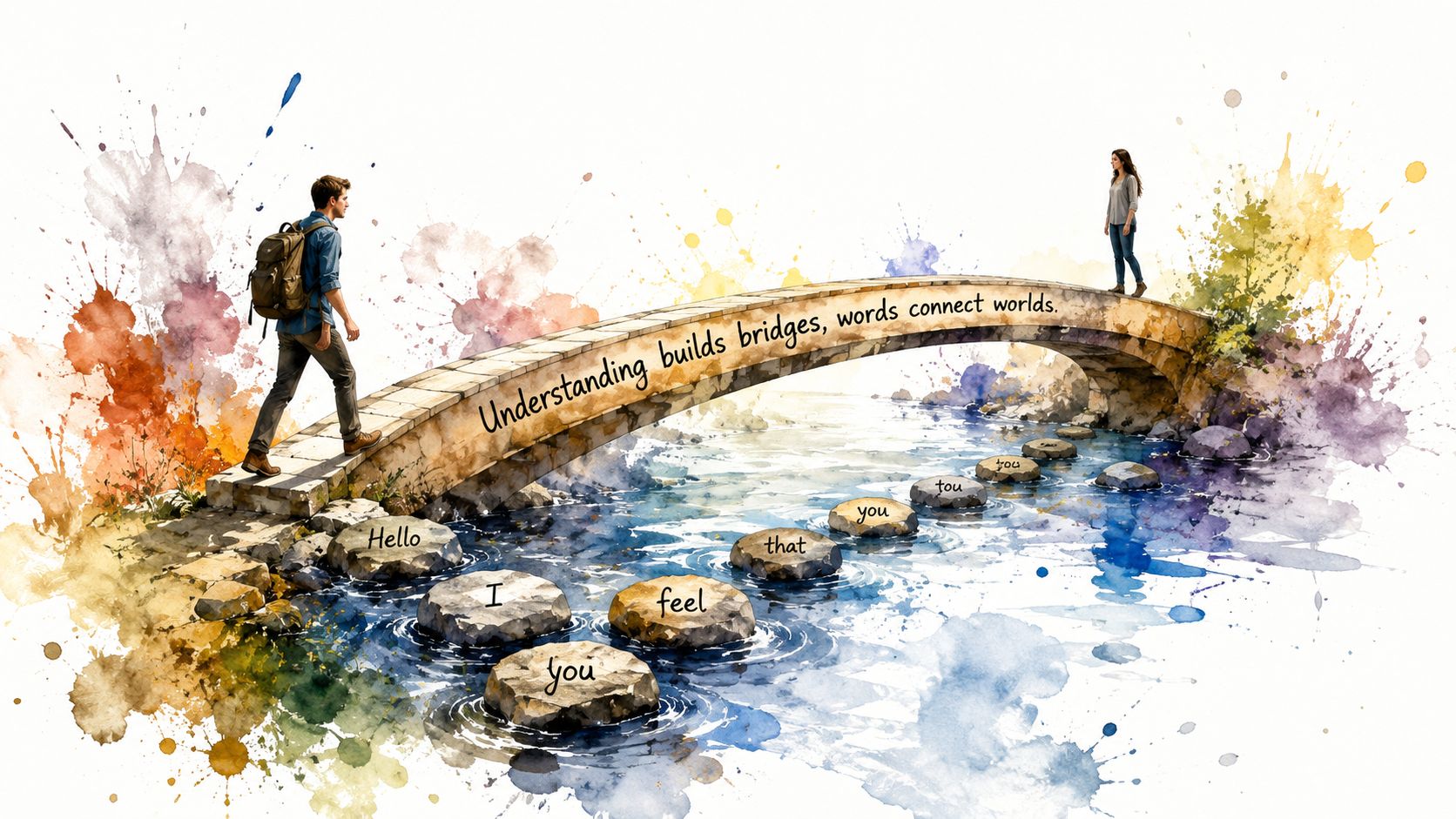
A sentence is a bridge, not a test
Think of single words as stones in water. Useful, but hard to walk on for long. A sentence is closer to a bridge plank. It gives enough support for the conversation to move forward.
Compare these:
- “Coffee. Morning. Tired.”
- “I need coffee this morning because I'm really tired.”
Both examples point to the same idea. But the second one gives shape to the thought. It helps the listener understand quickly.
That shape can do different jobs in conversation.
| Sentence type | What it does | Example |
|---|---|---|
| Statement | Shares information | “I started learning English for work.” |
| Question | Invites a reply | “How long have you lived here?” |
| Opinion | Adds personality | “I think this film is too long.” |
| Request | Gets help or action | “Could you explain that part again?” |
Why learners freeze
This skill sounds simple, but it often feels hard in real life. Research shows that 68% of ESL learners struggle with sentence-level fluency, meaning they find it hard to produce a complete, grammatically sound sentence without planning it in advance, according to this report on conversational English teaching.
That number matters because it shows this struggle is common. A learner who pauses too long before speaking isn't failing. They are dealing with a normal speaking problem.
A good conversational sentence doesn't need to be fancy. It needs to be clear enough to move the exchange forward.
A useful rule is this:
- Start with the main idea. “I missed the bus.”
- Add one reason or detail. “I missed the bus because I left home late.”
- Stop there if needed. The sentence is already doing its job.
Many learners try to build a perfect, advanced sentence from the beginning. That creates pressure. It is often better to build a shorter sentence first, then add more detail later.
What listeners actually need
Most listeners don't need perfect grammar in every line. They need a message they can follow. If a learner says, “I didn't sleep well, so I'm tired today,” the conversation can continue easily. That is successful speaking.
Spoken Sentences Are Different Than Written Ones
A big source of stress comes from one false idea. Some learners believe spoken English should sound like a book, an essay, or an exam answer. Real speech doesn't work that way.
When people talk, sentences are often shorter, softer, and less polished. They may restart. They may pause. They may use simple words instead of perfect ones. That isn't bad English. That's spoken English.
Written English and spoken English do different jobs
Writing usually gives a person more time. They can erase, improve, and reorganize. Speaking happens live. The listener is there now, and the speaker has to build meaning in real time.
The difference becomes easier to see side by side.
| Situation | Formal Written Sentence | Natural Spoken Sentence |
|---|---|---|
| Being late | “I apologize for my late arrival, as traffic conditions were unusually heavy this morning.” | “Sorry I'm late, traffic was really bad.” |
| Giving an opinion | “I do not believe that this proposal will be effective in the long term.” | “I don't think this plan will work long term.” |
| Asking for repetition | “Could you please repeat your previous statement for the sake of clarity?” | “Sorry, could you say that again?” |
| Sharing uncertainty | “I am not entirely certain whether that is the correct approach.” | “I'm not sure that's the right way.” |
A learner who wants more help with natural rhythm can read about connected speech in English, because spoken sentences often blend sounds together in ways that aren't obvious from written text.
Pauses and filler words are normal
Many learners feel embarrassed when they say um or uh. They think these sounds show weakness. But conversation research says something more useful. In conversation analysis, “thinking words” such as “um” and “uh,” along with overlaps and silences, are not treated as errors but as functional parts of conversation, according to this explanation of conversation analysis.
That means a pause can have a purpose. It can give the speaker time. It can show the speaker is not finished yet. It can help both people manage turns.
For example:
- “I think... um... the second option is better.”
- “Well, uh, I'm not free on Friday.”
- “So... should we start now?”
These are normal spoken patterns. They are not ideal in every sentence, but they are part of human speech.
Spoken English sounds human because it includes movement, pauses, and repair.
Natural speech is often less complete
Another relief for learners is this. People often speak in chunks, not beautiful full sentences.
A friend might say:
- “Not really.”
- “Maybe later.”
- “Sounds good.”
- “Depends on the price.”
These are short, but they still work because the conversation gives them meaning. A written test may ask for full forms. Real conversation often doesn't.
A better speaking goal
Instead of trying to sound like a textbook, a learner can aim for these three things:
- Clear meaning: The other person understands the point.
- Natural pace: The sentence comes out without too much strain.
- Flexible repair: If the speaker gets stuck, they continue anyway.
That last point matters a lot. A speaker can say, “I went to, um, the place near my office, the small cafe,” and still communicate very well. The sentence is alive. It adapts while the person is talking.
Examples of Conversing for Different Situations
The same speaker doesn't talk the same way in every situation. English changes depending on context. A job interview needs one type of sentence. A chat with a friend needs another.
That change is called register, which means the level of formality in language. The important point is simple. Good speaking is not always formal speaking. Good speaking matches the moment.

In a job interview
A more formal situation needs clearer structure and more careful word choice. The speaker doesn't need to sound stiff, but they should sound organized.
A question might be: “Can you tell me about yourself?”
Useful answers:
- “I've worked in customer support for three years, and I enjoy helping people solve problems.”
- “I'm finishing my degree this year, and I'm looking for a role where I can keep learning.”
- “One of my strengths is staying calm when work gets busy.”
These sentences work because they are direct. They give real information. They also sound professional without sounding unnatural.
A less effective answer might be:
- “Uh, yes, myself is hard-working and responsible person.”
The meaning is understandable, but the sentence shape is weak. A stronger version would be:
- “I'm a hard-working and responsible person, and I take deadlines seriously.”
In a casual conversation
Now compare that with a chat between friends. The language becomes lighter and more relaxed.
A friend asks, “What did you do this weekend?”
Natural replies:
- “I stayed home most of the time and watched a series.”
- “Nothing special, just met a friend for coffee.”
- “I wanted to rest, so I had a quiet weekend.”
These are simpler and warmer. They don't need business-style phrases.
Learners who want more examples of everyday natural phrasing can explore colloquial English expressions, because casual speech often uses looser wording than classroom English.
In travel or daily-life situations
Daily interactions often need short, practical sentences. The speaker's goal is quick understanding.
Examples:
- “Could you tell me which platform this train leaves from?”
- “I'd like a table for two, please.”
- “Is there a pharmacy near here?”
- “I think there's been a mistake with the bill.”
The best sentence for a situation is the one that sounds clear, appropriate, and easy to respond to.
A helpful habit is to prepare one sentence for each common situation in life. One for meetings. One for interviews. One for ordering food. One for asking for help. These become starting points, not scripts.
Common Mistakes and How to Build Confidence
For many learners, the hardest part isn't grammar. It's fear. The speaker starts building a sentence, hears a possible mistake in their head, and stops talking.
That experience is often called sentence anxiety. It is more common than many learners think. A recent survey found that 54% of intermediate English learners avoid speaking entirely if they fear making a grammatical error in a single sentence, according to this discussion of conversation strategies.

That fear makes sense. Speaking happens in public. A mistake feels visible. But waiting for a perfect sentence usually makes speech slower and harder.
Two common mistakes that stop people too much
Some errors matter less than learners think. For example:
- Verb tense confusion: “Yesterday I go to the store.”
- Missing articles: “I had meeting with manager.”
These are real mistakes, but they usually do not destroy communication. The listener still understands the message. That matters.
A corrected version is simple:
- “Yesterday I went to the store.”
- “I had a meeting with the manager.”
The speaker doesn't need shame. The speaker needs repetition and feedback.
A stronger mindset for speaking
Confidence grows when the learner changes the goal from perfection to progress. That shift can look like this:
- Say the sentence anyway. Even if it feels imperfect.
- Notice one thing to improve. Not five things.
- Try the sentence again out loud. The second version usually feels easier.
Practical rule: If the message is clear, the sentence has already done something useful.
Private speaking practice can help a lot here, especially for shy learners. A tool like Verse gives spoken practice out loud with instant feedback on grammar, vocabulary, and fluency, in a judgment-free space. It also lets learners choose a British, American, or Australian accent. Because the practice is spoken, not silent, learners can work on the practical experience of conversation instead of only studying rules. There is also a free, no-signup demo on the Verse homepage for learners who want to try a short practice session first. Verse is a paid subscription at $12/month.
What to say when a sentence breaks
A learner doesn't need to freeze when a sentence goes wrong. They can repair it live.
Useful repair lines:
- To restart: “Let me say that again.”
- To correct a word: “Sorry, not Tuesday, Wednesday.”
- To buy time: “What I mean is...”
- To simplify: “In simple words, I was very tired.”
These short rescue phrases keep the conversation moving. That is a real speaking skill.
Simple Ways to Practice Speaking Every Day
Daily practice doesn't need to be long. It needs to be spoken. A learner can build fluency by turning small daily moments into short speaking tasks.
One useful idea is to choose a one-minute topic and speak in complete sentences without stopping. A learner can describe a room, explain the plan for the day, retell a short story, or talk about what they ate for dinner. Another good habit is to respond out loud to simple questions like “What are you worried about this week?” or “What would you change about your routine?” For more ideas on bringing English into normal life, this guide on how to live the language gives practical inspiration.
A simple routine might look like this:
- Morning practice: Say three sentences about the day's plan.
- Midday practice: Describe one problem and one solution.
- Evening practice: Retell one conversation from the day.
The key is not to sound perfect. The key is to keep building the habit of turning thoughts into speech.
One sentence at a time, spoken out loud, is how confidence starts to grow. A learner doesn't need perfect English to begin. They just need the courage to say the next sentence.