Best English Pronunciation App of 2026: A Complete Guide
July 18, 2026 · 18 min read
Many English learners know this feeling. They can read articles, write emails, and answer grammar questions well. But when they speak, the other person says, “Sorry?” or asks them to repeat one simple word.
That moment is frustrating because it makes a learner feel less confident than they really are. Often, the problem isn't vocabulary or grammar. It's pronunciation, the way sounds come out in real speech. A good pronunciation app can help, but not every app helps in the same way.
Some apps train single sounds again and again. Others help learners speak in full conversations. The best English pronunciation app depends on the learner's goal. Some people need help with very specific sounds. Others need to feel calmer and clearer during real conversations. This guide helps learners choose the right method, not just the most famous app.
Table of Contents
- Why Your Pronunciation Matters More Than Your Grammar
- How to Choose the Right Pronunciation App for You
- The Best English Pronunciation Apps of 2026 Compared
- Sound Drills vs Conversation Practice Which Method Is Better
- How to Build a Daily Pronunciation Practice Habit
- Your Next Step Toward Confident Speaking
Why Your Pronunciation Matters More Than Your Grammar
A learner can know the difference between present perfect and past simple, and still struggle in a coffee shop, a class discussion, or a work meeting. That happens because spoken English moves fast. People don't have time to study a sentence like they do in writing. They react to what they hear in that moment.
A common example is this. A learner says, “I need a sheet,” but the vowel sound is unclear, so the listener hears “shit.” The grammar is correct. The word choice is correct. But one sound changes everything.
That's why pronunciation matters so much in daily life. Clear speech helps a learner be understood quickly. It also reduces stress. When learners trust their pronunciation more, they stop checking every word in their head before speaking.
Communication first, perfection second
Pronunciation isn't about sounding exactly like a movie actor. It's about making speech clear enough that other people understand it without effort. That small change in focus helps many learners relax.
Clear pronunciation supports connection. Perfect pronunciation isn't required for a good conversation.
Many learners confuse pronunciation with fluency. They are connected, but they aren't the same. Fluency is the ability to express ideas smoothly and naturally. Pronunciation is one part of that bigger skill. A helpful explanation appears in this guide on what English fluency really means.
Why this problem feels so personal
When someone asks a learner to repeat a word, it can feel like failure. But it usually means one sound, one stress pattern, or one rhythm pattern was unclear. That's fixable.
A pronunciation app can help because it gives private, repeatable speaking practice. The learner can say the same word, sentence, or idea many times without feeling judged. That matters. Speaking confidence often grows when practice happens out loud, not only in silent study.
How to Choose the Right Pronunciation App for You
You open an app, repeat a word five times, and get a green check every time. Then you use that same word in a real conversation and the other person still asks, “Sorry, what did you say?” That gap is the core question you need to solve before choosing an app.
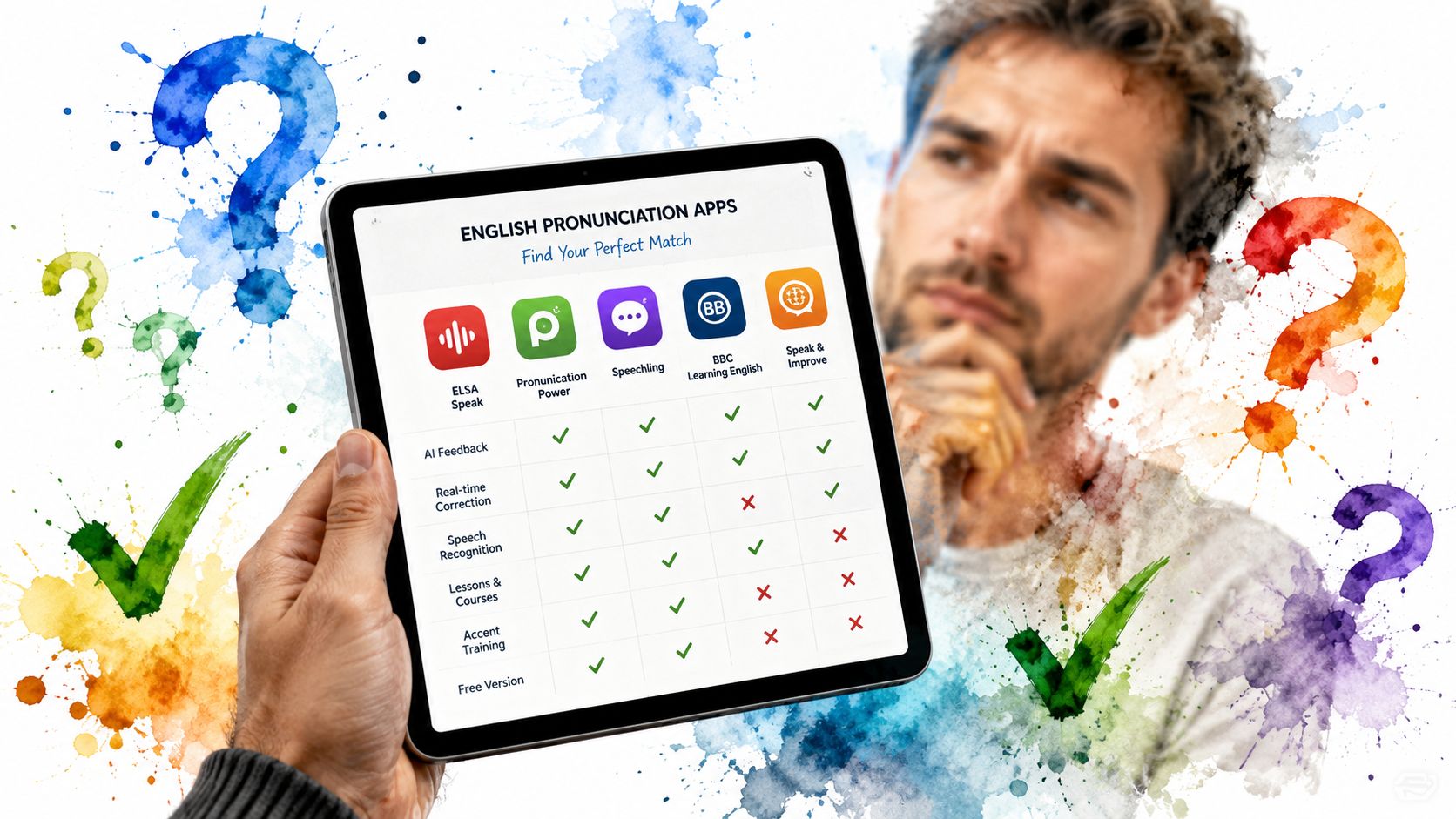
Some pronunciation apps train speech like a microscope. They focus on one sound at a time. Others train speech like a conversation rehearsal. They help you keep your pronunciation clear while you are also choosing words, building sentences, and responding in real time.
Both methods can help. The best choice depends on your goal.
Three features that matter most
Start with phoneme feedback. A phoneme is a single speech sound that can change meaning. For example, the difference between ship and sheep is small to the ear, but it matters a lot in conversation. A useful app should tell you which sound was unclear, not just whether the whole word was right or wrong.
Next, check for intonation practice. Intonation is the rise and fall of the voice across a sentence. It works like the rhythm section in music. The words may be correct, but if the stress falls in the wrong place, your meaning can still sound confusing, flat, or unnatural.
Then look at speech recognition quality. If the app misunderstands clear speech or accepts unclear speech too easily, practice turns into guesswork. Good feedback should feel specific and repeatable. You want to know what changed and whether the new attempt was better.
Check whether the app teaches correction, not just repetition
Many learners already know which words are hard. What they need is a tool that explains the problem and guides the fix.
Minimal pairs help with this. These are pairs like berry and very, where one sound changes the word. A good app should do three things: help you hear the difference, help you say the difference, and tell you whether your second attempt improved. If it only plays audio and asks you to repeat, progress can be slow because you may be practicing the same mistake again and again.
A simple test helps here. Say a difficult word, get feedback, adjust your mouth or stress pattern, then say it again. If the app cannot show what changed, it may be better for exposure than for correction.
Match the tool to the learner's goal
Many learners find themselves stuck. They search for the best English pronunciation app as if one app must fit everyone. A better question is, “Do I need sound training or speaking training first?”
Use this guide:
- Choose isolated pronunciation drills if one or two sounds keep causing problems, such as /r/ and /l/ or short and long vowel pairs.
- Choose integrated conversational practice if your pronunciation becomes less clear only when you speak under pressure.
- Choose accent-specific training if you want models from a particular variety of English, such as American or British.
- Choose immediate speaking practice if you understand pronunciation rules but still hesitate when speaking out loud.
Here is a helpful way to picture the difference. Sound-drill apps are like practicing one piano key until your finger lands correctly every time. Conversation-based apps are like playing the whole song without stopping. One builds precision. The other builds control during real use.
Some learners need one method more than the other. Many need both, just in a different order.
If you want practice that goes beyond repeating isolated words, this guide to an AI English speaking app for real spoken practice shows what conversational feedback can look like in daily learning.
The Best English Pronunciation Apps of 2026 Compared
You open an app, repeat a few words, and the score looks good. Later that day, you order coffee, answer a question at work, or join a class discussion, and your speech still feels unclear. That gap frustrates many learners because “pronunciation app” can mean two very different tools.
Some apps train sounds in isolation. Others train spoken English inside a real exchange. If you compare them as if they do the same job, it becomes much harder to choose well.
A quick way to compare app types
The table below compares the main categories learners usually choose between.
| App Type | Best For | Feedback Type | Platform | Price |
|---|---|---|---|---|
| Sound focused app | Fixing specific sounds | Phoneme and word level correction | Mobile or web, varies by app | Paid or mixed, varies by app |
| Conversation focused app | Building confidence in real speech | Feedback during or after spoken dialogue | Mobile or web, varies by app | Paid or mixed, varies by app |
| Accent focused app | Following a specific accent target | Sound and model based accent guidance | Mobile or web, varies by app | Paid or mixed, varies by app |
| Listen and repeat app | Repetition and imitation practice | Phrase level feedback | Mobile or web, varies by app | Paid or mixed, varies by app |
| Media based app | Improving listening and rhythm awareness | Little or no direct correction | Mobile or web, varies by app | Paid or mixed, varies by app |
| Verse | Spoken English practice with honest feedback | Instant feedback on grammar, vocabulary, fluency, and pronunciation after each turn | Web | $12/month |
Who benefits most from sound focused practice
A sound focused app helps most when the problem is narrow and easy to name. You may already know that one vowel keeps causing confusion. You may notice that final consonants disappear, or that two similar sounds still blur together.
That kind of app works like slow practice in music. You pause on one note, one movement, one mistake, and repeat it until your mouth learns a cleaner pattern. For learners who like structure, correction, and clear targets, this method can be very effective.
It also has a limit.
Clear pronunciation in a drill does not always stay clear in conversation. Real speech adds speed, sentence stress, linking, hesitation, and emotion. A learner can pronounce a word well alone and still lose control while speaking freely.
Who benefits most from conversation based practice
Conversation based practice is better for learners who sound clearer in short exercises than in real life. If your pronunciation drops when you need to answer quickly, tell a story, or react without planning, you probably need practice inside connected speech, not only at the sound level.
This method trains pronunciation where it has to work. Inside turns, responses, and longer thoughts. You hear yourself manage rhythm, word linking, and stress while also choosing vocabulary and keeping the conversation going.
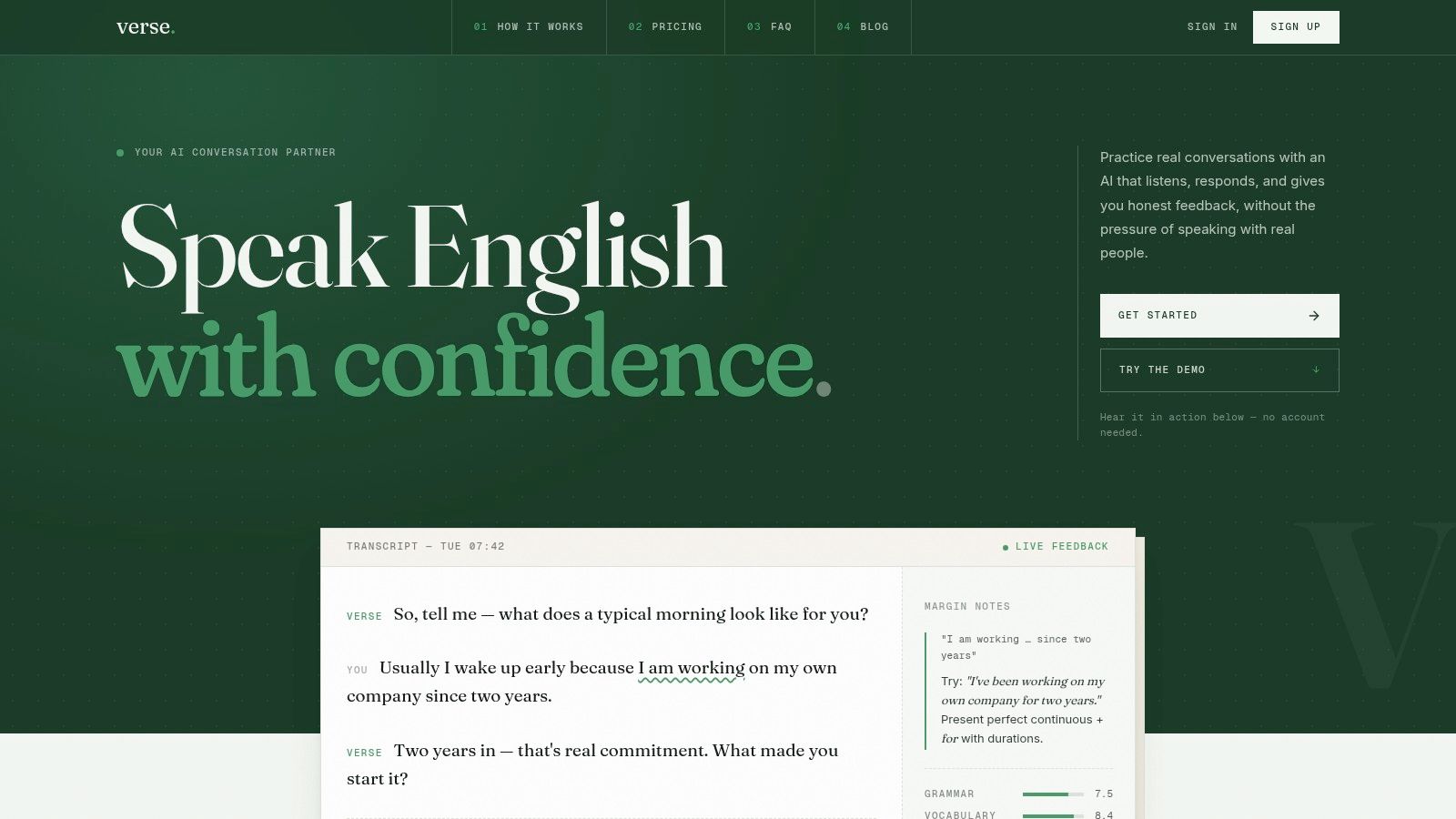
Verse is designed for that kind of practice. You speak out loud, get a natural reply, and then receive direct feedback on pronunciation along with grammar, vocabulary, and fluency. It also supports British, American, and Australian accents, which helps learners who want spoken practice with a clear accent target.
For many intermediate learners, this feels more useful than repeating isolated words. They do not need another study tool. They need a private place to speak more often and notice what happens to their pronunciation under pressure.
How to make the final choice
The best choice depends on the moment where your speech breaks down.
If the issue is one sound, one vowel pair, or one repeated pattern, a drill based app is usually the better starting point. If the issue appears only during longer answers or fast exchanges, conversation practice is often the better fit. If both problems are present, use both methods in sequence. First clean up the sound that keeps causing trouble, then practice keeping it clear while speaking naturally.
A simple question can make the decision easier. Do you need to train your mouth to make a sound, or train yourself to keep that sound clear while talking?
That is the key comparison. It is less about picking a winner and more about choosing the method that matches your goal right now.
Sound Drills vs Conversation Practice Which Method Is Better
You open an app, repeat a few words, and your score looks good. Then later, during a real conversation, those same sounds disappear. Many learners get frustrated at this point because they chose a tool for one job and expected it to solve a different one.
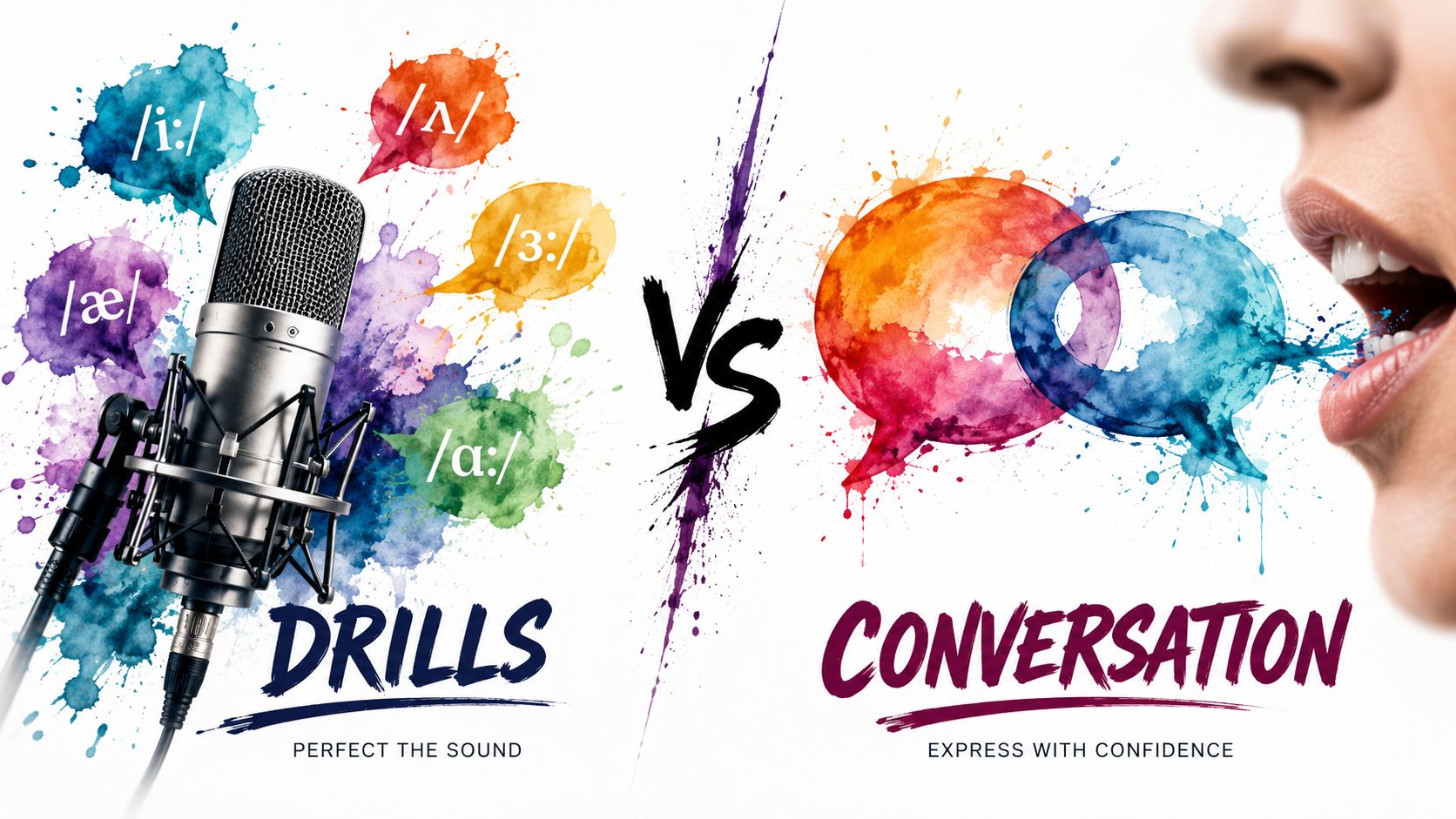
That is why this choice matters. You are not just picking an app. You are choosing a practice method.
What drills do well
Sound drills work like slow motion practice in sports. They isolate one movement so you can notice what your mouth, tongue, and jaw are doing.
This method helps most when the problem is small but stubborn. A learner may mix up short and long vowels, drop a final consonant, or stress the wrong syllable again and again. In that case, drills give clear repetition without the extra pressure of building full answers.
That focus is useful because pronunciation mistakes are often physical habits, not just knowledge gaps. You may already know the correct sound in theory, but your mouth still returns to the older pattern.
If that sounds familiar, drills are often the fastest way to fix the underlying problem. For more targeted exercises, this guide on how to practice pronunciation in English can help you train one sound at a time.
What conversation practice does better
Conversation practice trains a different skill. Instead of asking, "Can you make this sound correctly?" it asks, "Can you keep that sound clear while you are also thinking about meaning, grammar, and speed?"
That is a much harder task.
In real speech, pronunciation rarely breaks down because a learner has never studied the sound. It breaks down because attention is split. You are choosing words, following the other speaker, and trying to respond quickly. Under that pressure, old habits return.
Conversation based practice helps bridge that gap. It turns pronunciation from a classroom exercise into part of normal speaking. This matters for learners who do well in short repeats but lose clarity in meetings, interviews, class discussions, or casual chats.
A learner can say a word correctly alone and still lose it in a full sentence. Speech changes when speed, stress, and meaning enter the picture.
Which method should you choose first
A simple test can make the decision easier.
If your mistake shows up in one specific sound again and again, start with drills. If your pronunciation gets worse mainly during longer answers or fast exchanges, start with conversation practice.
Here is the difference in plain terms:
| Method | Best for | Main benefit | Main limitation |
|---|---|---|---|
| Sound drills | Fixing one repeated sound or stress pattern | High precision and repetition | Can feel disconnected from natural speaking |
| Conversation practice | Building speaking confidence in real situations | Helps you stay clear while thinking and responding | Gives less focus to one tiny sound |
Some learners need both, just not in the same order. A beginner or lower intermediate learner may need to clean up a sound first, then practice using it in speech. A more advanced learner may already know the sound and need practice keeping it stable during conversation.
Verse fits more naturally on the conversation practice side. It gives you a private space to speak out loud, respond in real time, and get feedback while your attention is divided the way it is in real life. That makes it especially useful for learners whose pronunciation weakens during actual speaking, not during drills alone.
How to Build a Daily Pronunciation Practice Habit
You finish a practice session feeling clear and confident. The next day, you get busy, skip it, and by the end of the week your mouth falls back into its old patterns. That cycle is frustrating, but it is common. Pronunciation improves the same way muscle memory improves. Short, repeated practice teaches your mouth what to do.
Start with a tiny routine
A good habit should feel easy to begin. If the routine is too big, learners postpone it. If it takes only 10 minutes, it is much easier to repeat on a normal day.
Use a simple four-step pattern:
- Warm up with one target sound that often causes trouble.
- Say two or three full sentences out loud so the sound appears in natural speech.
- Give one real answer about your day, work, studies, or plans.
- Repeat one sentence after feedback to lock in the better version.
This sequence works because it trains two different skills. The first part is for accuracy. The second part is for carryover, which means keeping that sound clear while you are also thinking about meaning. Many learners can pronounce a sound in isolation but lose it inside a sentence. This routine helps close that gap.
Match the habit to your goal
The best daily plan depends on the kind of improvement you need.
If your main problem is one repeated sound, build your routine around short drill work first. Give most of your practice time to careful repetition, then end with one or two sentences. That is like tuning a single guitar string before playing a song.
If your main problem appears during real speaking, start with conversation practice first. Use prompts that make you answer in full sentences, react quickly, and keep going even when you are slightly under pressure. That is closer to how speaking works in meetings, class discussions, and casual conversations.
A few examples make this easier to picture:
- Busy professional: Practice one daily speaking situation, such as giving an update or answering a common work question.
- Student: Choose one sound that affects class presentations, then use it in presentation phrases, not just single words.
- Shy learner: Begin with private voice responses and focus on being clear enough to be understood.
- Accent-focused learner: Stick with one accent model for a while so your ear and mouth build stable patterns.
One helpful option for conversation-based practice is the free no-signup demo on the Verse homepage. It lets learners speak out loud and get feedback without a long setup.
For a fuller routine you can copy and adjust, this guide on how to practice pronunciation in English gives useful examples.
How to stay consistent when motivation drops
Motivation comes and goes. A habit stays stronger when it is tied to something that already happens every day.
Try these small adjustments:
- Attach practice to an existing habit. Practice after coffee, after lunch, or before checking social media.
- Keep the target narrow. Work on one sound, one word stress pattern, or one speaking situation at a time.
- Track one visible win. Maybe you needed fewer repeats today, or one sentence felt smoother than yesterday.
- Practice out loud every time. Silent review can help memory, but pronunciation changes through speaking.
One more point matters. Do not switch methods every day just because you feel impatient. Give one approach enough time to work. If you are doing drill-based practice, stay with the same target sound for several days. If you are building speaking confidence, return to similar conversation tasks until they feel easier.
Small win to notice: clear pronunciation inside a full sentence matters more than saying one difficult word perfectly on its own.
Your Next Step Toward Confident Speaking
Pronunciation improvement isn't about becoming perfect. It's about becoming easier to understand and more comfortable speaking in real situations. That's what helps learners join conversations, share ideas, and stop holding back.
The best English pronunciation app is the one that matches the learner's real need. Some learners need focused sound correction. Others need conversation practice that helps them speak more naturally under pressure. Both paths are useful when they fit the problem.
What matters most is simple. Speak out loud often. Repeat difficult sounds. Practice full sentences. Use feedback, then try again. A few minutes of honest spoken practice each day can build more confidence than hours of silent study.
Speaking gets easier when the learner speaks.