Best App to Improve English Speaking: A 2026 Guide
A lot of English learners know this feeling. Reading is fine. Listening is mostly fine. Grammar exercises go well. Then a real conversation starts, and the mind goes blank.
That gap is why finding the right app to improve English speaking matters so much. Many apps help people study English. Fewer help people speak it out loud, make mistakes safely, and keep talking until speaking feels more natural.
The most useful way to choose isn't by looking at long feature lists. It helps more to ask a simpler question. Does the app train passive knowledge, or does it train active speaking?
Table of Contents
- Why Speaking English Is Harder Than Just Learning It
- What Makes a Great English Speaking App
- App Comparison The Gamified Generalist
- App Comparison The Pronunciation Specialist
- App Comparison The Structured Tutor
- Verse A Dedicated AI Conversation Partner
- How to Choose and Start Speaking Today
Why Speaking English Is Harder Than Just Learning It
A learner can study for months and still freeze when someone asks a simple question like, "How was your weekend?" That doesn't mean the learner is bad at English. It usually means the learner has built knowledge, but not enough speaking habit.
Many people spend most of their time with passive tasks. They read short texts, match words, fill gaps, and review grammar rules. Those activities help. But speaking asks for something different. A speaker has to think, choose words, build a sentence, pronounce it clearly, and respond quickly.

Why the words feel stuck
A common example makes this clear. A learner may understand the sentence "I would like to reschedule the meeting." But in a real call, that learner might suddenly say, "Meeting... change time... tomorrow maybe?" The problem isn't always grammar knowledge. The problem is pressure, speed, and lack of spoken practice.
Speaking also brings emotion into the process. Many learners worry about accent, mistakes, or sounding slow. That worry can block speech even when the learner knows what to say.
Speaking is a performance skill. It improves when the mouth practices, not only when the eyes study.
This is one reason speaking-focused apps have grown so quickly. The global English Learning App market is projected to reach $26.8 billion by 2034, with Speaking and Listening Apps as the fastest-growing product type, according to Dataintelo's English learning app market projection. That growth is tied to AI tools that simulate near-human dialogue and give learners a low-stakes place to practice.
Why active practice changes things
A learner who speaks out loud every day starts building a different kind of memory. Short answers come faster. Common phrases feel easier. Mistakes become less frightening because they happen during practice, not during a high-pressure moment at work or school.
That is the main shift. A study app often asks, "Do you know this word?" A speaking app asks, "Can you use it right now?"
A helpful app to improve English speaking creates chances to do these things:
- Respond in real time, even with simple sentences.
- Hear and notice errors soon after speaking.
- Repeat difficult phrases until they sound smoother.
- Practice common situations, such as meetings, travel, interviews, or small talk.
The real goal isn't perfect English
Most learners don't need perfect grammar in every sentence. They need to say what they mean, keep the conversation moving, and feel calmer while doing it.
That's why active speaking practice matters so much. It trains the part of English that many learners avoid, even though it's the part they need most.
What Makes a Great English Speaking App
Not every language app is built for speaking. Some are good for vocabulary review. Some are good for grammar order and structure. A great speaking app does something more demanding. It gets the learner to talk out loud, then helps that learner improve the next answer.
A strong research review found that 83.3% of studies on speaking skills reported positive effects, and for grammar and pronunciation, 100% of the studies in those categories showed improvement, according to this review of AI in language learning. That matters because it shows AI can support both conversation practice and core accuracy.
A quick comparison
| App type | Main activity | Best for | Main limit |
|---|---|---|---|
| Passive study app | Reading, tapping, choosing answers | Building basics | Little real speaking practice |
| Pronunciation app | Repeating sounds and phrases | Clearer speech | Can feel narrow or drill-heavy |
| Structured lesson app | Following planned dialogues | Learners who want order | Less spontaneous speaking |
| Speaking-first app | Talking out loud in open conversation | Fluency and confidence | Needs regular active effort |
Four signs that an app really helps speaking
1. It asks for spoken answers, not just taps
This sounds obvious, but many learners miss it. If most of the session involves no speaking, the app is mostly training recognition, not conversation.
A good speaking app should make the learner produce full answers. Even better, it should allow open answers, not only one correct sentence.
2. It gives feedback quickly
Fast feedback matters because the learner still remembers what they were trying to say. If the correction comes much later, the learning moment is weaker.
Look for feedback on things like:
- Grammar, such as missing articles or verb tense
- Vocabulary, such as a better word choice
- Fluency, meaning how smooth and natural the sentence sounds
- Pronunciation, especially problem sounds or stress patterns
Practical rule: If an app keeps a learner mostly silent, it may help with study, but it won't do enough for speaking confidence.
3. It allows unscripted conversation
Scripted dialogues are useful at first. They teach patterns. But real life isn't scripted. A coworker may ask an unexpected follow-up. A stranger may use simpler words than a textbook. A friend may change the topic suddenly.
An effective speaking app gives room for these messy, real moments. That is where learners build flexibility.
4. It feels safe enough to use often
Many learners stop speaking practice because they're embarrassed. A good app removes some of that fear. It should feel private, calm, and easy to return to every day.
One simple test before choosing
A learner can ask one question before paying for any app. "After ten minutes, have I mostly been studying English, or speaking English?"
That answer usually reveals the app's real method.
App Comparison The Gamified Generalist
Some apps are built to make daily study easy to start. That is a real strength. Short lessons, points, streaks, and simple challenges can help a learner return every day, even when motivation is low.
This kind of app often works best for beginners who need to build a base. It can help learners notice sentence patterns, common vocabulary, and very basic pronunciation. The design usually feels light and manageable, which matters for people who feel overwhelmed.
Where this method helps
A gamified generalist app is often useful for learners who say things like:
- "English feels too big." Small lessons reduce that fear.
- "I need habit first." A short daily task is easier to keep.
- "I don't know enough words yet." Basic practice can fill important gaps.
That broad appeal helps explain the scale of this category. One major app has over 100 million monthly active users, while specialized speaking tools are growing by focusing on features like pronunciation coaching and customizable conversation scenarios, according to Business of Apps data on the language learning app market.
Where this method falls short
The weakness appears when the learner wants spontaneous speech. A person may complete many lessons and still struggle with simple real-life moments such as introducing a project, explaining a delay, or answering an unexpected question.
That happens because this method often teaches language parts instead of the whole act of speaking. Learners may recognize correct sentences on a screen, but still find it hard to create their own sentence under pressure.
A typical session might ask the learner to choose one answer, translate one line, or repeat one phrase. Those tasks are useful. But they don't force the learner to organize ideas and speak freely.
A better way to use this type of app
A generalist study app works best when it becomes a support tool, not the only tool.
One practical routine looks like this:
- Study a small lesson and collect three useful phrases.
- Say each phrase out loud without reading.
- Use the phrase in a new sentence about real life.
- Answer one follow-up question aloud, even if the app doesn't ask for it.
For example, after learning "I usually start work at 9," the learner can add, "But today I started later because I had a dentist appointment."
A learner who turns passive prompts into spoken answers gets more value from a basic app.
This category can be excellent for building consistency. It is less effective when the main goal is confident conversation. Learners who already know a fair amount of English often notice that they don't need more tapping. They need more talking.
App Comparison The Pronunciation Specialist
Some learners don't struggle with ideas. They struggle with being understood quickly. Their grammar may be fine. Their vocabulary may be enough. But certain sounds, word stress, or sentence rhythm still create confusion.
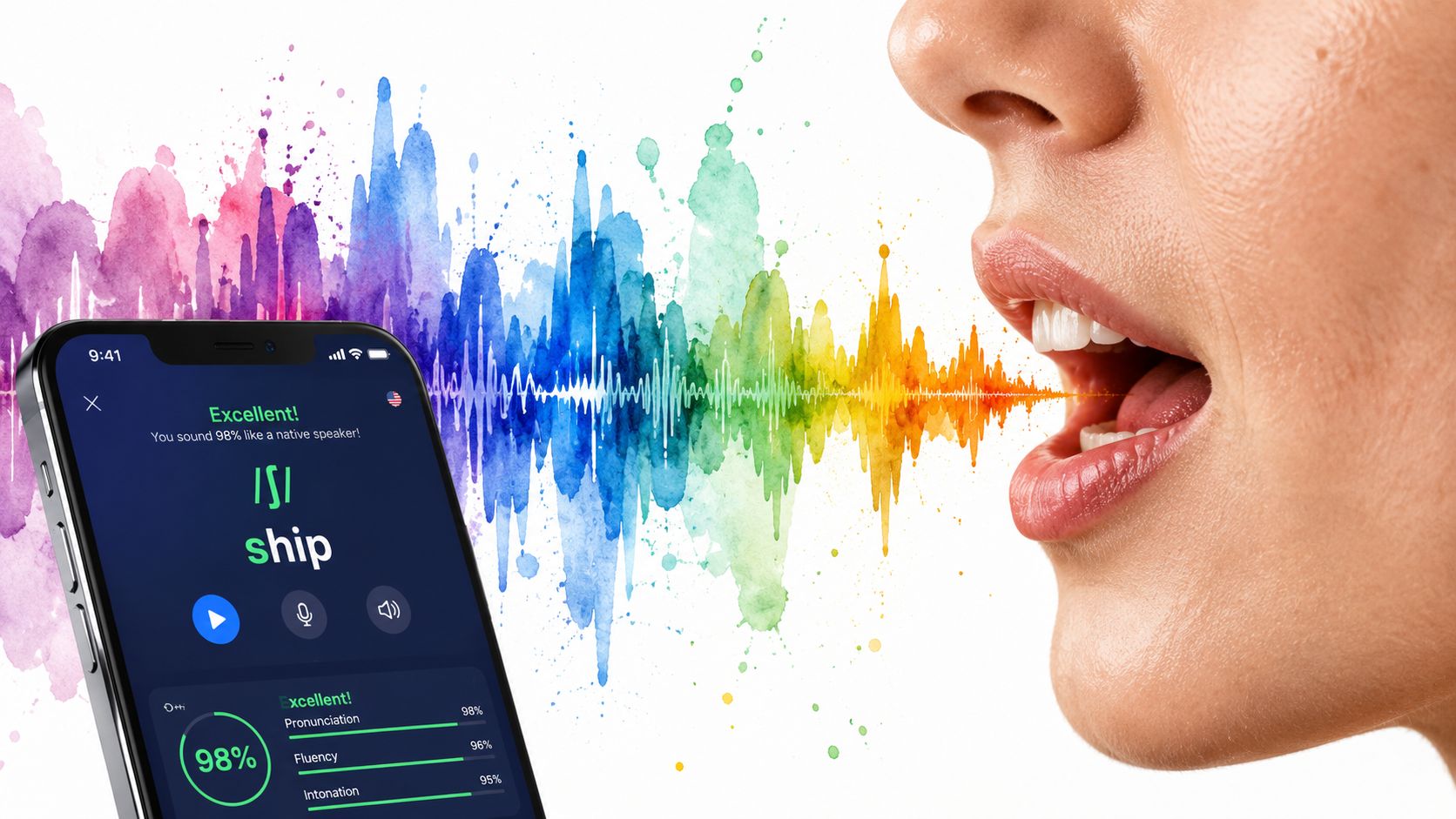
That is where a pronunciation-focused app can help. This kind of app listens closely to speech and points out sound-level issues that a general study app may ignore.
What this type of app does well
A pronunciation specialist usually breaks speech into small parts. It may focus on single sounds, word endings, stress, intonation, or the difference between similar sounds.
That can be very useful for learners who often hear, "Sorry?" or "Can you repeat that?" even when their sentence is correct.
This method suits learners who want to improve things like:
- Sound clarity, such as difficult consonants or vowels
- Word stress, which syllable sounds strongest
- Sentence rhythm, how English rises and falls
- Accent awareness, how speech is understood by listeners
For learners who want extra help with this area, these pronunciation practice ideas for English learners can make daily practice more focused.
What it doesn't always train
The main limitation is that clearer sounds don't automatically create smoother conversation. A learner may pronounce "comfortable" better and still freeze when asked, "What do you do for work?" That is because pronunciation and conversation are related, but not identical.
Drill-based pronunciation practice can also feel narrow after a while. Some learners enjoy that precision. Others start to feel they are practicing pieces of speech without practicing actual communication.
A useful way to make pronunciation practice more effective
Instead of chasing every sound problem at once, learners usually do better with a narrow focus.
A simple weekly plan helps:
- Choose one or two target sounds
- Practice them in words
- Practice them in short sentences
- Use those sentences in a real spoken answer
For example, a learner working on "th" can move from "think" to "I think the meeting went well" to a full answer about work.
Clear pronunciation matters most when it supports communication, not when it becomes a separate performance.
This type of app is a smart choice for learners who already speak fairly often but want cleaner, easier-to-understand speech. It is less complete for someone whose main goal is handling full conversations with confidence.
App Comparison The Structured Tutor
Some learners don't want a loose, open format. They want order. They want to know what comes first, what comes next, and how one lesson leads to the next. A structured tutor app serves that need well.
This type of app usually offers short lessons built around practical situations. A learner may study travel, work introductions, ordering food, or basic social exchanges in a planned sequence. That clear path can reduce stress, especially for people who don't know how to organize self-study.
Why structure helps many learners
A good curriculum gives learners a feeling of progress. Instead of guessing what to study, they can follow a path and build step by step.
That approach can support speaking too. One study found that nearly 60% of participants improved in oral proficiency using Babbel, according to Michigan State University's report on language learning app effectiveness. That is a useful reminder that structured app-based learning can help oral skills, not only vocabulary.
For learners who like guided support outside an app, this overview of online language tutor options can help clarify what kind of structure fits different goals.
The limit of scripted dialogue
A structured lesson often teaches conversation through prepared exchanges. For example:
- Person A asks about hotel check-in.
- Person B gives a model answer.
- The learner repeats or selects the correct reply.
That is helpful early on. It teaches common phrases and expected patterns. But real conversations don't stay inside those lines for long.
Someone may speak faster than expected. They may ask a question in a new way. They may jump to a related topic. A learner who has practiced only prepared dialogue can feel confident in the lesson and still feel lost in real interaction.
Who should choose this type
A structured tutor fits best when the learner wants:
- A clear learning path
- Short, manageable lessons
- Useful phrases for common situations
- More support than a purely open conversation format
It fits less well when the learner already knows the basics and needs to think on their feet.
A prepared script teaches what a conversation might look like. Open speaking practice teaches what to do when the conversation changes. Both matter, but they solve different problems.
Verse A Dedicated AI Conversation Partner
Some learners reach a stage where more lessons don't solve the underlying challenge. They know grammar rules. They understand a lot. They may even write well. But when they speak, they sound stiff, too careful, or too textbook-like.
That is the gap a dedicated conversation partner is built to address.
Built for speaking, not silent study
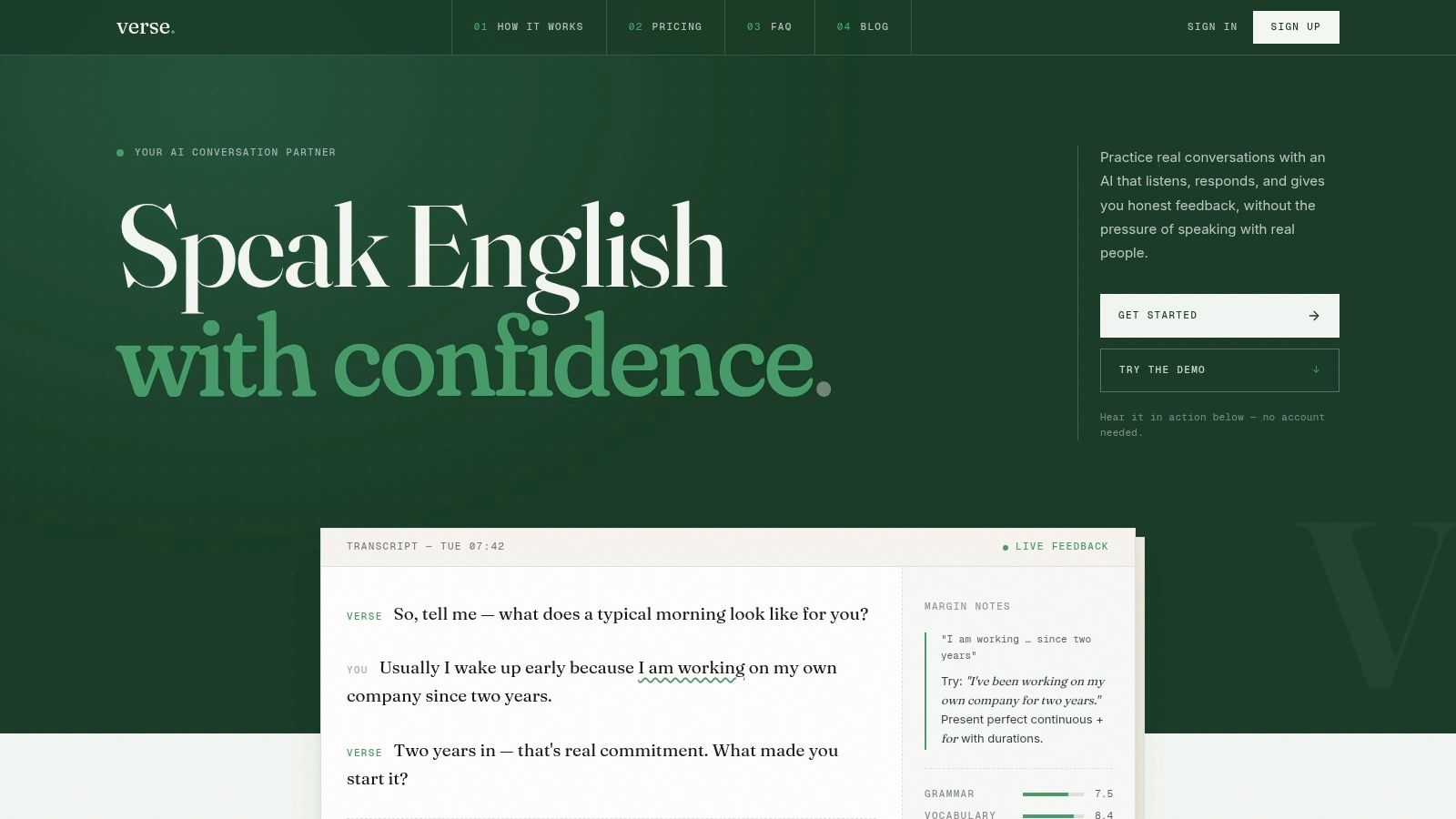
Verse is designed around one core activity. The learner speaks out loud, gets a natural reply, and receives honest feedback on grammar, vocabulary, and fluency right after each turn. It isn't a flashcard tool. It isn't mostly passive review. The method is active spoken practice.
That difference matters for learners who need a private place to try, pause, restart, and keep going without embarrassment. The feedback is direct, but the setting stays judgment-free.
It also lets learners choose a British, American, or Australian accent, which can help people who want their listening and speaking practice to match the English they use most often.
Why this helps intermediate and advanced learners
A major problem for stronger learners is that many apps still correct them like beginners. The feedback can be technically right but socially awkward. It may reward grammar that sounds formal and unnatural in daily life.
That gap has been pointed out clearly in this discussion of textbook English versus real-world usage. Many apps give rigid textbook feedback, which doesn't reflect how people naturally speak. That is especially frustrating for learners who already know the rules but want more natural phrasing.
Verse is more useful at this stage because it doesn't stop at "correct" versus "incorrect." It helps the learner notice better wording and more natural phrasing, which is often the practical next step.
What a session can look like
A learner might choose a situation like a job interview, travel problem, presentation practice, or casual small talk. Then the learner records a reply.
After each turn, the learner can see where the sentence was awkward, where vocabulary could be stronger, and how to say the same idea more smoothly. That quick feedback helps the learner fix mistakes while the moment is still fresh.
A simple example:
A learner says, "I am agree with this plan because it is more convenience."
Better feedback doesn't only mark errors. It can guide the learner toward something more natural, such as "I agree with this plan because it's more convenient."
That kind of correction helps the learner sound clearer and more natural at the same time.
Practical details that matter
Verse is a paid subscription at $12/month. There is also a free, no-signup demo on the homepage, which is useful for learners who want to hear how the conversation feels before committing.
This kind of tool fits learners who want:
- Real spoken practice, not mostly tapping and reading
- Immediate feedback after each response
- Private practice for anxiety or shyness
- Flexible conversation topics, including work, exams, and daily life
- More natural English, not only textbook correction
For many non-native professionals and upper-intermediate learners, that is the missing piece. They don't need another long unit on basic grammar. They need repeated practice saying real things out loud and improving each answer a little.
How to Choose and Start Speaking Today
The best app depends on the learner's real goal. Some people need habit and basics. Some need cleaner pronunciation. Some need a structured path. Others need a space for real conversation practice.
The key is simple. If the goal is speaking, the app should make the learner speak often.
A helpful way to choose is this:
- Choose a study app if the learner still needs core vocabulary and sentence basics.
- Choose a pronunciation app if people often struggle to understand the learner's speech.
- Choose a structured tutor if the learner wants step-by-step lessons.
- Choose a conversation partner if the learner needs spontaneous speaking practice and confidence.
For learners who want more ideas for daily routines, these English speaking practice methods can help turn short study sessions into real spoken work.
Speaking improves when learners stop waiting to feel ready and start using English out loud, a little every day. Even short practice counts. A few honest spoken minutes today can do more than another silent lesson.