Pronunciation of Favourite: A Clear Guide
Favourite is usually pronounced with two syllables, not three. In British English it sounds like fav-rit, in American English it changes to fav-rət, and in the US the spelling also changes to favorite.
That small word causes a lot of hesitation. A learner sees every letter, tries to say every letter, and suddenly the word feels heavier than it should. It often happens in simple sentences like “What's your favourite film?” or “Blue is my favourite colour,” where the speaker knows the meaning but isn't sure how the word should move in real speech.
The good news is that the pronunciation of favourite gets much easier once the speaker stops treating it like a spelling problem. It's really a rhythm and mouth-movement problem. When the mouth relaxes in the right places, the word starts to sound natural.
Table of Contents
- Why Is 'Favourite' So Tricky to Pronounce
- UK vs US Pronunciation The Core Differences
- Mastering the Syllables Two or Three
- Your Guide to Mouth and Tongue Position
- Common Mistakes and How to Correct Them
- Quick Drills to Practice Your Pronunciation
- Speak with Confidence One Word at a Time
Why Is 'Favourite' So Tricky to Pronounce
Many learners struggle with this word for one simple reason. The spelling looks longer and clearer than the spoken form.
The letters suggest something like “fa-vou-rite,” so it feels natural to give each part a full sound. Native speech usually doesn't work like that. English often reduces unstressed parts of words, and favourite is a strong example of that pattern.
Another reason is accent choice. A learner may hear one version in British English, another in American English, and a slightly different shape in Australian English. That can make the pronunciation of favourite feel inconsistent, even when the speaker is doing well.
Practical rule: The main goal of pronunciation isn't copying a perfect regional accent. It's being easy to understand.
That idea matters here. Speech Active's guidance on accent goals explains that the primary goal of any English accent is clarity for easy communication, not sounding exactly British, American, or Australian. That takes pressure off. A learner doesn't need perfection first. A learner needs a clear, steady version that feels comfortable in real speech.
UK vs US Pronunciation The Core Differences
The first difference is spelling. In the UK, Canada, and Australia, the standard spelling is favourite. In the US, the standard spelling is favorite.
The second difference is the last vowel sound. That final part is where most of the accent difference lives, and it changes the rhythm of the word.
According to Merriam-Webster's explanation of favorite and favourite, the UK form is pronounced /ˈfeɪ.vər.ɪt/ and the US form is pronounced /ˈfeɪ.vər.ət/. In simple language, British English ends with a clearer “rit” sound, while American English ends with a weaker, softer “rət” sound.
What the symbols mean in plain language
A learner doesn't need to love IPA to use it well. Only the last part really matters here.
- British English /ɪ/, this is a short vowel like the sound in ship
- American English /ə/, this is the schwa, the relaxed sound in the first syllable of about
That means these two versions feel different in the mouth:
| Accent | Simple guide | Final vowel feel |
|---|---|---|
| British English | fav-rit | clearer, slightly sharper |
| American English | fav-rət | weaker, shorter, more relaxed |
Why the American ending feels shorter
The schwa is the most relaxed vowel in English. The mouth doesn't work hard for it. The jaw stays looser, and the tongue stays more neutral. That's why the American ending sounds lighter.
A useful way to hear the difference is this. British English finishes the word with more shape. American English lets the ending shrink.
A learner who wants a British model should keep the last vowel a little clearer. A learner who wants an American model should reduce that final vowel and avoid making it too sharp.
Mastering the Syllables Two or Three
This is the part many guides skip. The biggest trap in the pronunciation of favourite is not only the accent. It's the syllable count.
Many learners say the word with three full beats, like FAY-vuh-rit. That can happen because the spelling invites the speaker to pronounce every written part. In slower careful speech, that version can appear. But in everyday native speech, the word is often reduced.
YouGlish examples for favourite in UK English support an important point here. British favourite often drops the middle vowel and becomes a 2-syllable word, and learner corpora show a 35% prevalence of 3-syllable versions among non-native speakers. That's why so many learners sound careful but less natural.
The natural rhythm
The stress stays on the first syllable. That first beat is strong.
Think of the word like this:
- Two syllables, FAYV-rit
- Three syllables, FAY-vuh-rit
The two-syllable version is usually smoother because the middle vowel gets reduced or disappears in connected speech. The lips and tongue move through the word without stopping on every letter.
Why learners add the extra syllable
Learners often do this for understandable reasons:
- The spelling pulls attention, the written form looks like it should have another clear vowel in the middle.
- Careful speaking habits, many learners were taught to pronounce words fully and clearly, which can lead to over-pronouncing.
- Exam pressure, when a speaker slows down too much, hidden vowels often become stronger.
A quick check can help. If the word feels heavy or bouncy, it may have grown into three syllables.
For extra checking, a learner can test the word with this syllable counter tool. The ultimate test comes after that, when the speaker says the word out loud and notices whether the middle vowel is pronounced.
Key listening clue: In more natural speech, favourite often sounds compact. The middle part doesn't get a full spotlight.
A simple way to reduce it
Try saying these slowly, then more smoothly:
- FAY
- FAYV
- FAYV-rit
That teaches the mouth to keep moving forward instead of stopping at FAY-vuh-rit. The change is small, but it often makes the whole word sound more natural.
Your Guide to Mouth and Tongue Position
The easiest way to improve the pronunciation of favourite is to stop thinking only about letters. Think about what the mouth is doing.
This word has a few moving parts, but each one is manageable. When a learner practises the sounds in order, the word becomes much less confusing.
Sound by sound movement
Start with F. The top teeth touch the bottom lip lightly, and air comes out. There is no voice yet. It's just breath.
Then comes AY. The mouth opens a bit wider, and the tongue moves slightly upward as the vowel glides. This part should feel clear and strong because the stress is here: FAY.
Next is V. The mouth shape is almost the same as F, but now the voice turns on. The lips and teeth stay in contact lightly, and the throat vibrates.
After that comes the r area. In rhotic accents like American English, the r is heard more clearly. In British and Australian English, the r is softer in many contexts, and sometimes it isn't strongly pronounced unless a following vowel pulls it forward. A learner doesn't need to force this part. Too much effort often makes the word sound stiff.
The final syllable in the mouth
This is the most useful contrast to practise.
For the British ending /ɪt/, the tongue is a little higher and tenser for the vowel. It's a short sound, but it has shape. The ending feels like rit.
For the American ending /ət/, the mouth relaxes more. The jaw loosens, the tongue stays neutral, and the vowel becomes a schwa. It feels like rət, not rit.
A learner who wants more help with vowel control can review this guide to English vowel pronunciation, then return to this word and notice how much the last vowel changes the accent.
A quick accent comparison
Australian English examples on YouGlish show that favourite in Australian English has two syllables, often described as FAYV-rit, with a clear FAYV sound followed by rit.
| Feature | British English (UK) | American English (US) | Australian English (AUS) |
|---|---|---|---|
| Standard spelling | favourite | favorite | favourite |
| Common syllable feel | usually 2 | usually 2 | 2 |
| Stress | first syllable | first syllable | first syllable |
| Final vowel | clearer /ɪ/ | reduced /ə/ | close to rit shape |
| Simple guide | fav-rit | fav-rət | FAYV-rit |
The mouth should work hardest on the first syllable and relax afterward. That's often the missing habit.
A useful body check
A learner can place a hand gently under the chin and say the word three times. If the jaw keeps dropping for a big middle vowel, the word may be turning into three syllables. If the movement is smaller and smoother, the rhythm is probably closer to natural speech.
Common Mistakes and How to Correct Them
Some pronunciation problems in favourite are very common. That's good news, because common problems usually have clear fixes.
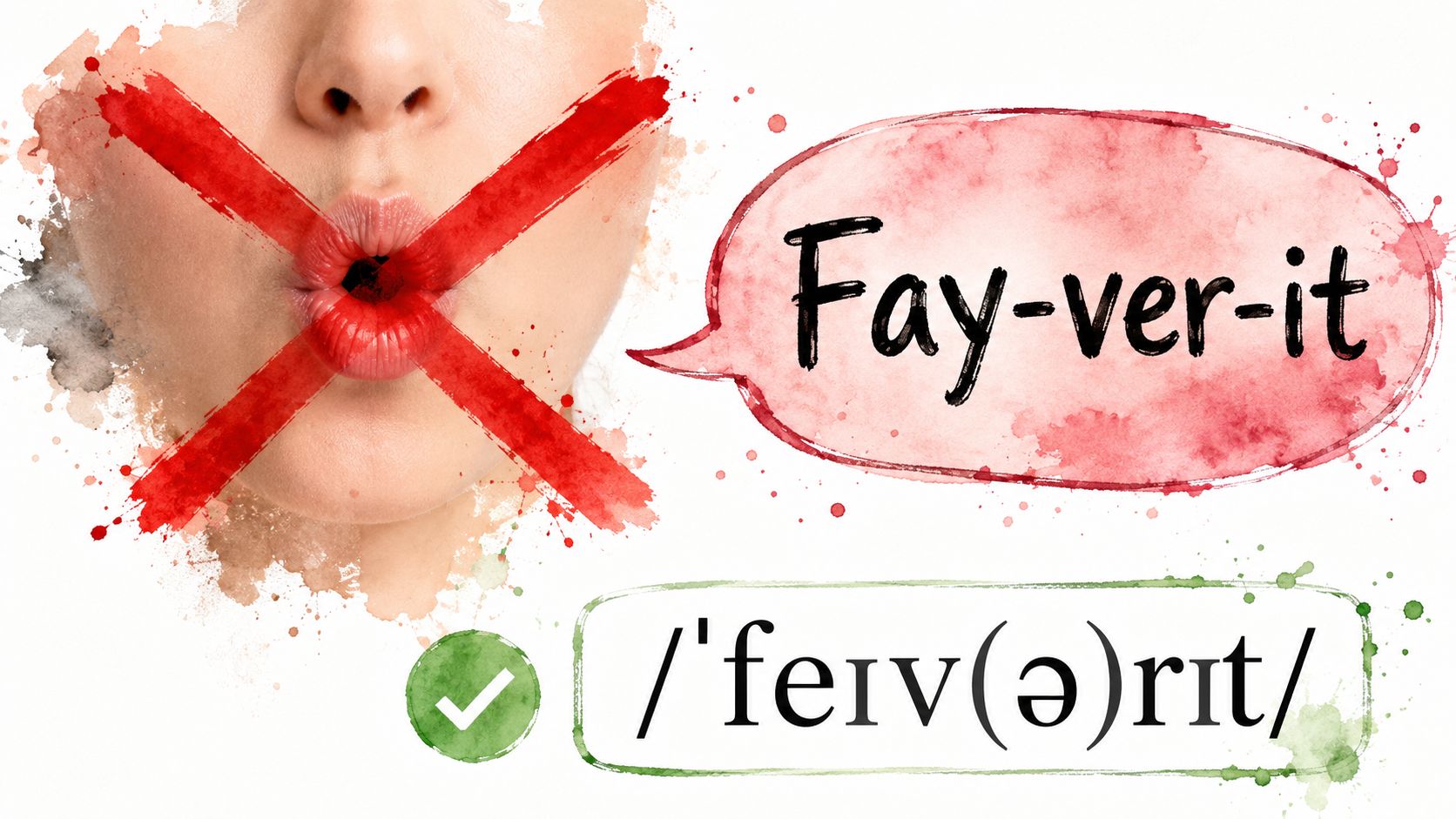
The image below shows the difference between a spelling-based guess and a more accurate sound pattern.
Mistake 1, saying every written vowel
A learner may say something close to fa-vou-rite or FAY-vuh-rit with three very clear parts. This happens because English spelling is not a perfect map of spoken rhythm.
The correction is to compress the middle. Say FAYV first, then add the ending. If needed, practise just these chunks:
- FAY
- FAYV
- FAYV-rit
Mistake 2, using the British ending in an American model
This is especially common when a learner wants an American accent but still says the final syllable like rit. Cambridge's US pronunciation entry for favourite notes that 78% of non-native speakers in major US markets retain the British /ɪ/ sound when attempting the American variant. The same source explains that correcting this means isolating the final syllable and dropping jaw tension to produce the neutral /ə/ sound.
A simple correction drill is to compare:
- rit
- rət
- fav-rit
- fav-rət
The goal isn't to make the American version lazy. The goal is to make it neutral.
Correction cue: If the ending sounds too crisp for American English, the jaw may be too tense.
Mistake 3, making the final T too strong
Many learners release the final t very clearly. That can sound extra careful. In natural speech, the last t is often softer, and the word may end with less force than the spelling suggests.
The fix is not to remove the t completely in all situations. Instead, the learner should stop punching it. Try ending the word gently, with a light stop instead of a strong burst of air.
Mistake 4, moving too slowly through the word
When a learner pauses inside the word, the whole thing sounds mechanical. Favourite works better as one smooth unit.
A helpful contrast is this:
- Less natural, FAY, vuh, rit
- More natural, FAYV-rit
That small rhythm change can make speech sound more connected and easier to follow.
Quick Drills to Practice Your Pronunciation
Practice works best when it moves from small to big. A learner doesn't need long sessions. Short spoken drills are enough if they're done clearly and out loud.
Drill 1, word only
Say each version five times.
- British: fav-rit
- American: fav-rət
- Australian: FAYV-rit
Focus on one accent at a time. Mixing them in one round can confuse the mouth.
Drill 2, short phrases
Now place the word inside everyday chunks.
- my favourite song
- her favourite teacher
- their favorite movie
- what's your favourite colour
These short phrases help the speaker keep the word connected to real speech, not isolated study.
Short phrases are where pronunciation starts to become usable. A word on its own is only the first step.
Drill 3, full sentences
Try full questions and answers:
- What's your favourite kind of music?
- This is my favourite part of the book.
- Her favorite subject is history.
- That café is their favourite place to meet.
A learner who wants more structured ideas can use this guide on how to practice pronunciation in English.
Drill 4, real spoken feedback
Solo practice helps, but real speaking helps more. Saying the word in a live answer shows whether the speaker can keep the rhythm naturally.
Verse can support that kind of practice. It works as an AI conversation partner for spoken English, with honest, judgment-free feedback on grammar, vocabulary, and fluency. Learners can choose a British, American, or Australian accent, speak out loud, and get instant feedback instead of doing silent study only. There's also a free, no-signup demo on the Verse homepage for trying a short speaking session.
Speak with Confidence One Word at a Time
The pronunciation of favourite becomes much easier when the speaker remembers three things. It's usually two syllables, the last vowel changes by accent, and the word sounds best when the mouth relaxes after the first stressed syllable.
Clear speech matters more than perfect copying. A learner can choose one accent, practise the mouth movements, and repeat the word in real phrases until it feels natural. Progress often starts with one small word said more smoothly than yesterday.
Keep practising it out loud. A calm, repeated spoken habit does more for confidence than silent study ever can.