How Do You Pronounce Been? a Simple Guide
You're probably here because you've heard the word been in two very different ways.
One speaker says, “I've been tired,” and it sounds like bin. Another says, “Where have you been?” and it sounds like bean. If you're learning English, that can feel messy fast. You start asking yourself, “So how do you pronounce been?”
The good news is that this word isn't random. There are patterns. Once you know the two main sounds, and once you notice when the word is stressed or unstressed, it gets much easier to hear and say.
Table of Contents
- Why Is Pronouncing 'Been' So Confusing
- The Two Main Sounds of Been Explained
- American vs British English Pronunciation
- The Most Important Rule Stressed vs Unstressed Words
- How to Make the Sounds Correctly With Your Mouth
- Practice Sentences to Build Your Confidence
- Keep Practicing and Sound More Natural
Why Is Pronouncing 'Been' So Confusing
A lot of learners meet this problem in real conversation, not in a textbook.
You listen to one sentence, “I've been busy,” and hear bin. Then later, “Where have you been?” sounds more like bean. Both speakers are correct, but your ear hears two different words. That's why this tiny word causes so much confusion.
One spelling, more than one sound
English often changes sounds in natural speech. Small words can become shorter, softer, and faster. Been is one of those words.
That means the spelling stays the same, but the pronunciation changes with accent and sentence rhythm. So if you've felt unsure, you're not doing anything wrong. You're noticing a real feature of spoken English.
Many learners think they “missed” a word when they hear bin. In fact, they often heard been perfectly, just in fast natural speech.
The confusion usually comes from two places
Here are the biggest reasons learners get stuck:
- Different accents: Some speakers say /bɪn/, like bin.
- Different sentence stress: The same speaker may say /bɪn/ in one sentence and /biːn/ in another.
- Listening habits: If you learned only one version in class, the other version can sound wrong at first.
Once you know that there are two main pronunciations, the word becomes much less mysterious. You don't need to guess anymore. You can listen for the pattern.
The Two Main Sounds of Been Explained
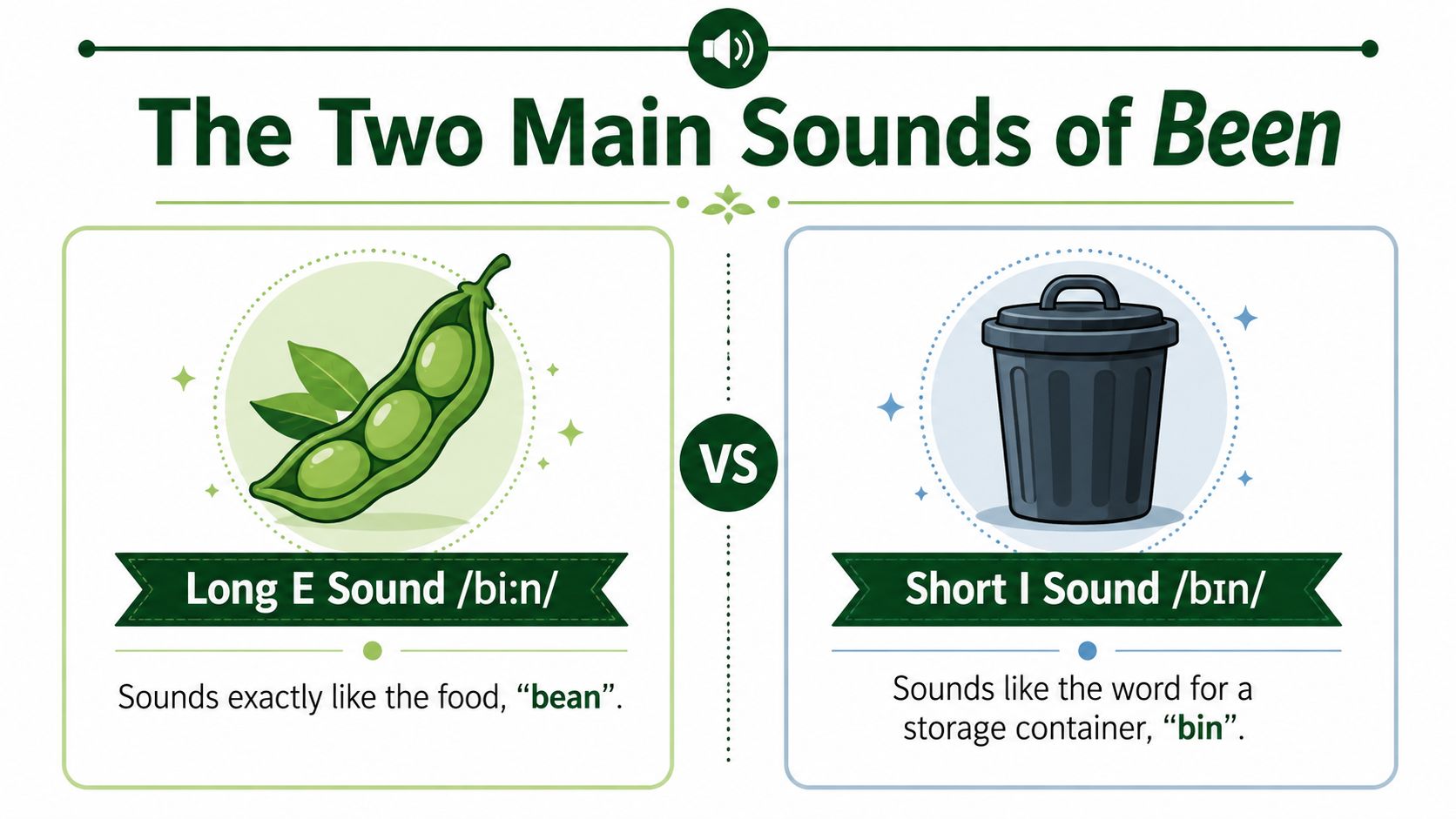
There are two main sounds you need to know.
The first is /biːn/. This sounds like bean.
The second is /bɪn/. This sounds like bin.
That's the simplest answer to “how do you pronounce been.”
Sound 1, /biːn/, like bean
This is the long E sound.
Your mouth feels a bit more stretched, almost like a small smile. The vowel is longer and clearer. If you say bean, then say been, the sound is the same.
Examples:
- “Where have you been?”
- “I have been waiting.”
- “I've been there before.”
Sound 2, /bɪn/, like bin
This is the short I sound.
Your mouth is more relaxed. The sound is shorter. If you say bin, then replace the meaning with been, you have the common everyday version many speakers use.
Examples:
- “I've been busy.”
- “She's been working.”
- “We've been ready for hours.”
Neither sound is automatically wrong
The important point is that one sound is not always “correct” and the other “incorrect.” They appear in different situations.
In Cambridge's pronunciation entry for been, British English is shown as having shifted over time. Most modern British speakers use the long /iː/ sound, like bean, especially when the word is stressed or emphasized, while /bɪn/ often appears in unstressed use.
If English vowels feel slippery, it helps to review them as a system. A simple guide to English vowel pronunciation can make these contrasts easier to hear.
American vs British English Pronunciation
Many learners want the quick textbook rule first.
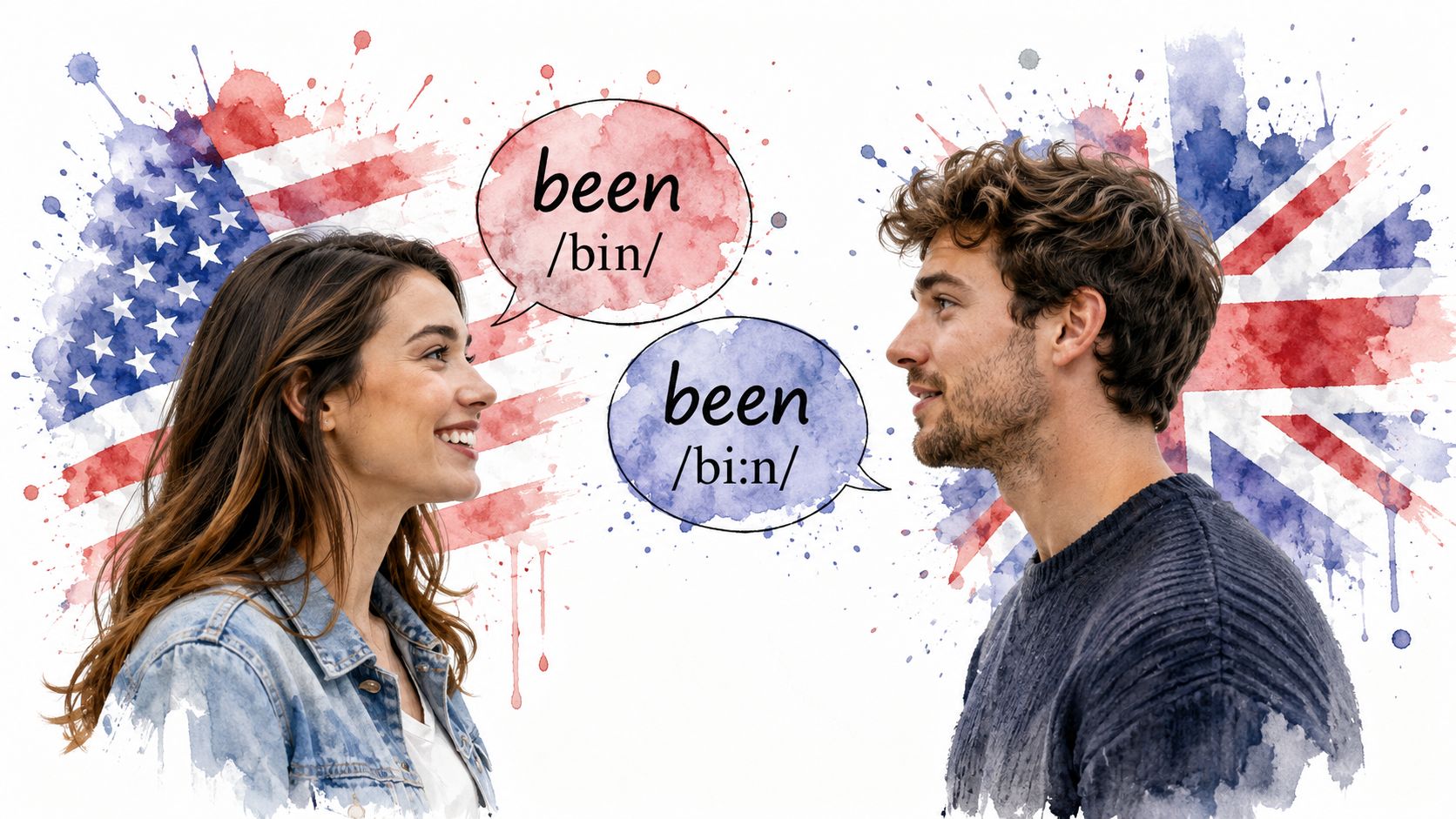
A useful starting point is this. In American English, people usually say /bɪn/, like bin. In British English, you'll often hear /biːn/, like bean, especially when the word stands out more in the sentence.
The general pattern
According to Verse's summary of American and British usage, about 95% of American speakers pronounce been as /bɪn/, like bin. The same source notes that while the traditional British form is /biːn/, like bean, about 70% of British speakers now use /bɪn/ in unstressed contexts.
So the simple memory rule is:
| Variety | Common sound |
|---|---|
| American English | /bɪn/, like bin |
| British English | often /biːn/, like bean, but /bɪn/ is common when unstressed |
Why this rule helps, and where it fails
This regional rule is helpful when you're just starting. If you speak American English, /bɪn/ is usually the safest choice. If you're learning British English, you should expect to hear both.
But accent alone doesn't explain everything. A British speaker might say bean in one sentence and bin in another. That's why learners sometimes get confused even after studying UK versus US pronunciation.
Useful shortcut: Learn the regional pattern, but don't stop there. Natural speech depends a lot on sentence stress.
If your goal is clear communication, don't worry about making every version perfect on day one. Pick one clear model, then learn how stress changes it in real speech.
The Most Important Rule Stressed vs Unstressed Words
This is the rule that helps most in conversation.
In fast everyday English, been is often an auxiliary verb. That means it helps another verb, as in “I've been working” or “She has been waiting.” When a word has this helper role, it often becomes weaker in speech.
What is a weak form
A weak form is a reduced pronunciation. The word is still there, but it's shorter and less strong.
In this pronunciation lesson on weak forms in fluent speech, been is described as changing to /bɪn/, rhyming with bin, when it is not stressed. The same explanation notes that this weak form is dominant across major English-speaking regions, including the UK and US, and that mastering it helps connected, natural speech.
So in normal speech, these often sound like this:
- “I've bin busy.”
- “She's bin waiting.”
- “We've bin there.”
When do you hear the stronger sound
You often hear /biːn/, like bean, when the word is stressed for emphasis.
Compare these:
Unstressed: “I've been tired.”
Stressed: “I have BEEN tired for days.”
Unstressed: “Where have you been?”
More emphasized: “Where have you BEEN?”
The second version feels stronger because the speaker wants to add emotion, contrast, or surprise.
If you want to sound more natural, don't only practice single words. Practice whole sentences and notice which word gets the energy.
This is one reason many learners sound careful but not yet natural. They pronounce every word with the same strength. English rhythm doesn't work that way.
A better question to ask
Instead of asking only, “Is this British or American?” ask:
- Is been stressed in this sentence?
- Is it a quick helper word here?
- Is the speaker emphasizing it?
If you want to train your ear for this rhythm, a guide to connected speech in English can help you hear why words shrink in real conversation.
How to Make the Sounds Correctly With Your Mouth
Knowing the rule is useful. Feeling the sound in your mouth is even better.
The two pronunciations of been are close, so many learners mix them. A small change in your lips and jaw can make the sound much clearer.
How to say /biːn/
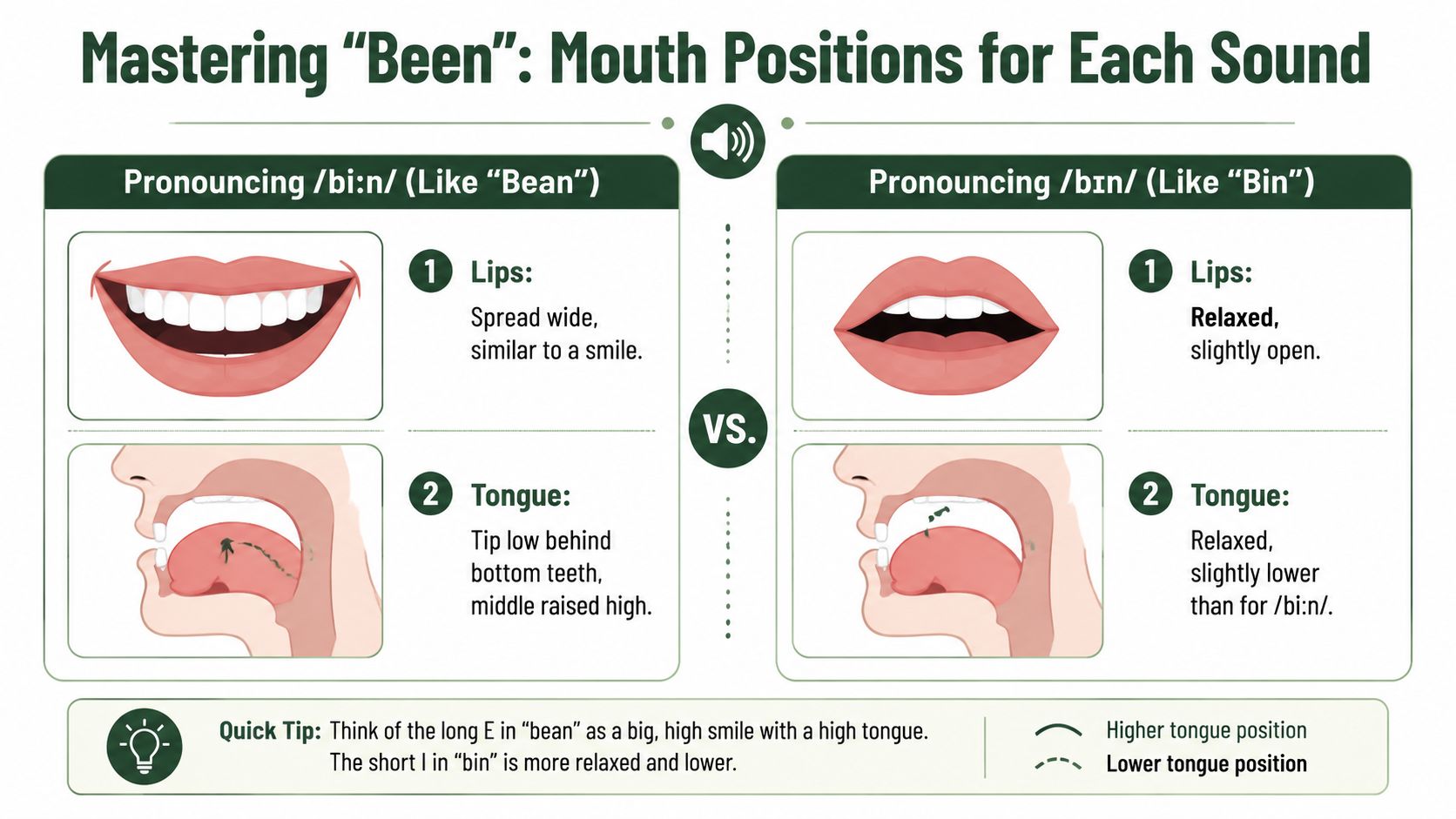
Start with the long vowel, /biːn/, like bean.
Try this:
- Stretch your lips slightly, like a soft smile.
- Raise your jaw a bit more than usual.
- Hold the vowel a little longer, eeeee.
- Add the final n sound, been.
Say these slowly: bee, bean, been.
How to say /bɪn/
Now try the short vowel, /bɪn/, like bin.
According to this articulation guide for been, bean, and being, the common American form /bɪn/ uses a relaxed jaw and lips. That contrasts with /biːn/, which needs spread lips and a higher jaw.
Try this version:
- Relax your lips
- Keep your jaw lower
- Make the vowel short
- Say bin, then replace the meaning with been
A quick mouth check:
| Sound | Lips | Jaw | Vowel feel |
|---|---|---|---|
| /biːn/ | spread | higher | long |
| /bɪn/ | relaxed | lower | short |
A simple practice trick
Say the pair out loud three times:
- bean, been
- bin, been
- bean, bin, been
If you want a quick way to check your own pronunciation, you can use this pronunciation tool and compare what you hear with what you say.
Practice Sentences to Build Your Confidence
Reading about pronunciation helps, but your mouth needs real practice.
Say these sentences out loud. Don't whisper them. Speak at a normal volume, and repeat each one two or three times. If possible, record yourself and listen back.
Sentences with the weak /bɪn/ sound
These are good for everyday fluent speech, where been is not stressed.
- “I've been busy all day.”
- “She's been studying since morning.”
- “We've been ready for a while.”
- “They've been talking for hours.”
- “He's been to that café before.”
For many learners, this is the most useful version to master first. According to the earlier linked usage summary, /bɪn/ is also the most widely recognized form globally, used by 85% of English learners in international exams like IELTS and TOEFL.
Sentences with the stronger /biːn/ sound
Use these when you want emphasis.
- “Where have you been?”
- “I have BEEN honest.”
- “She has BEEN trying.”
- “You've never been there?”
- “I told you, I've BEEN ready.”
Try saying each sentence twice. First say it in a flat way. Then stress been more clearly. Your ear will start to notice the difference.
A short speaking drill
Use this 3-step drill:
- First round: Read slowly and focus only on the target sound.
- Second round: Read at natural speed.
- Third round: Say the sentence without looking, like real conversation.
If you feel unsure, that's normal. Confidence often comes after repetition, not before.
Keep Practicing and Sound More Natural
The main idea is simple. Been can sound like bean or bin, but the most helpful rule is not only US versus UK. It's also stress versus weak form.
When been is unstressed, it often becomes /bɪn/ in natural speech. When it gets emphasis, you may hear the stronger /biːn/ form. Once you start listening for stress, English speech becomes much easier to follow.
Keep your practice small and regular
You don't need a long study session. A few minutes of spoken practice helps more than silent reading.
Try this routine:
- Pick 3 sentences: Use one with weak /bɪn/ and one with stressed /biːn/.
- Say them daily: Repeat until the mouth movement feels easier.
- Record yourself: Notice whether your stressed word is stronger and your unstressed word is lighter.
Clear pronunciation grows through speaking, listening, and repeating. It doesn't come from memorizing one rule and hoping it appears in conversation.
If you've been asking how do you pronounce been, you already have the answer now. The next step is simple. Start saying it out loud.
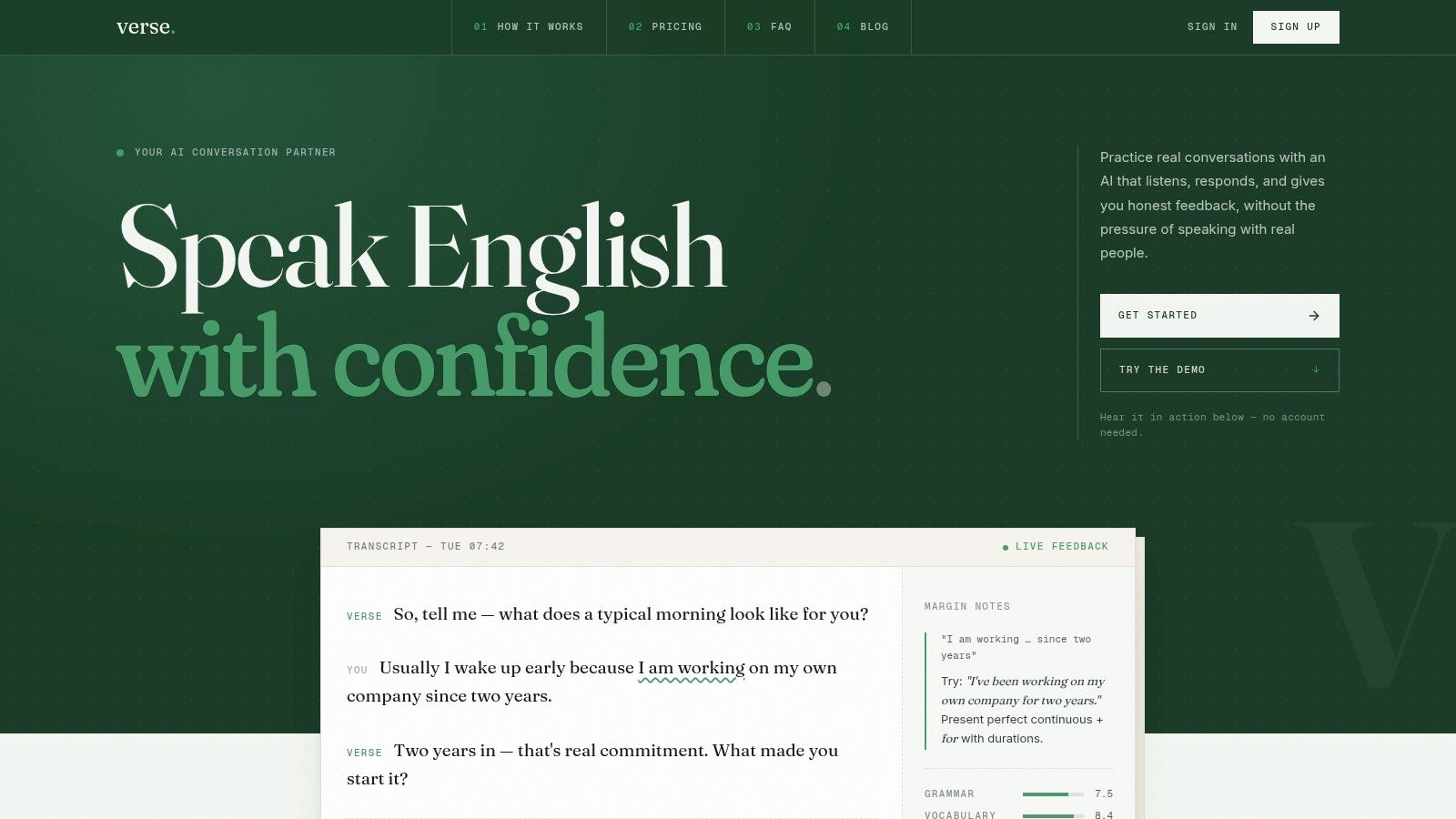
If you want a calm place to practice this in real conversation, Verse can help. You speak out loud, get honest feedback on pronunciation, grammar, vocabulary, and fluency, and practice without pressure. If you want to try a few lines first, there's a free no-signup demo on the Verse homepage.