English Syllable Stress: A Guide to Sounding Natural
A learner is speaking in a meeting. The sentence is simple: “We need to record that.” But the stress lands on the wrong part of the word, and people pause for a second. Did the speaker mean the verb “re-CORD,” or the noun “RE-cord”? The sounds were close, but the rhythm sent the wrong message.
That small moment happens all the time in English. Many learners study grammar, build strong vocabulary, and still feel that their speech sounds a little stiff or unclear. Often, the missing piece is English syllable stress. It is not just about saying the right letters. It is about putting energy in the right place.
When stress is clear, listeners follow more easily. Speech sounds smoother. Confidence grows, too, because the speaker doesn't need to repeat every second sentence.
Table of Contents
- Why Syllable Stress Matters for Clear Speaking
- Understanding the Music of English Words
- The Simple Rule for Two-Syllable Nouns and Verbs
- Finding the Stress in Words with Three or More Syllables
- How Stress Changes Meaning in Full Sentences
- Practical Activities to Improve Your Speaking Rhythm
Why Syllable Stress Matters for Clear Speaking
A common problem looks like this. A learner says, “I need this re-CORD,” when the meaning is a noun, so English listeners expect “RE-cord.” The word itself is familiar. The grammar is correct. But the stress pattern points to a different meaning.

That is why stress matters so much. English listeners don't only hear consonants and vowels. They also hear rhythm. They expect some parts of words to be stronger and other parts to be lighter. When that pattern changes, the word can sound strange, or even sound like a different word.
Stress helps listeners follow the message
English has a kind of beat. Some syllables are strong. Some are weak. That beat helps listeners predict what is coming next. It makes speech easier to process.
Practical rule: Good pronunciation is not only about sounds like /th/ or /r/. It is also about where the voice puts emphasis.
A speaker can pronounce every sound quite well and still sound unclear if the stress is off. That is why learners sometimes hear, “Sorry?” even when their grammar was perfect.
Stress supports confidence
Many learners feel nervous because they know the word, but they are not sure how to “push” it in speech. Once they start noticing stress, speaking often feels less random. Words begin to fit into patterns.
For learners who want more ways to build this skill in real speech, this guide on how to practice pronunciation in English can help turn passive study into spoken practice.
A helpful way to think about stress is this. Sounds are the letters of speech. Stress is the music. Both matter.
Understanding the Music of English Words
A syllable is one beat in a word. In the word “banana,” there are three beats: ba, na, na. One of those beats is stronger than the others. That stronger beat is the stressed syllable.

A simple image helps here. Think of a spotlight on a stage. The spotlight shines on one syllable. That syllable becomes easier to hear.
What makes a syllable sound stressed
According to this overview of stress in linguistics), primary stress is marked by increased duration, approximately 30 to 50% longer than unstressed vowels, higher loudness, and a significant pitch change. The same source explains that unstressed syllables often become shorter and reduce to a neutral sound like schwa (/ə/), which helps create the rhythm of English.
That sounds technical, but the feeling is simple:
- Longer: the stressed part lasts a little more time
- Louder: the voice has more energy there
- Higher or more noticeable pitch: the voice changes tone
In “ba-NA-na,” the middle syllable gets the spotlight.
What happens to unstressed syllables
Unstressed syllables are not said with full force. They are quicker and quieter. Very often, the vowel changes to schwa, written as /ə/. This is the soft sound heard in the first syllable of “about.”
That is where many learners get confused. They try to pronounce every syllable clearly and equally. English usually doesn't work that way. Equal syllables can make speech sound careful, but also flat.
Unstressed does not mean unimportant. It means lighter, faster, and less clear than the main syllable.
A useful way to hear it
Learners can clap once for each syllable and make one clap stronger.
Try these:
- TA ble
- gui TAR
- ba NA na
This kind of body practice helps because stress is physical. It lives in breath, timing, and voice movement, not only in spelling.
The Simple Rule for Two-Syllable Nouns and Verbs
One of the most useful patterns in English syllable stress appears in two-syllable words. Approximately 90% of nouns are stressed on the first syllable, while around 70% of verbs are stressed on the second syllable, according to Coffee Break Languages on English word stress.
That pattern gives learners a practical shortcut. It won't solve every word, but it helps a lot.
The pattern in plain language
When a two-syllable word is a noun, the first syllable is often stronger.
When the same or similar word is a verb, the second syllable is often stronger.
For example:
- RE cord, a noun
- re CORD, a verb
This is one reason English can feel tricky. The spelling may stay the same while the stress changes the job of the word.
Common noun-verb stress shifts
A quick check with a stress checker for English words can help when a learner is unsure, especially with new vocabulary.
| Word | As a Noun (Stress on 1st syllable) | As a Verb (Stress on 2nd syllable) |
|---|---|---|
| record | RE cord | re CORD |
| present | PRE sent | pre SENT |
| object | OB ject | ob JECT |
| project | PRO ject | pro JECT |
| permit | PER mit | per MIT |
| export | EX port | ex PORT |
| import | IM port | im PORT |
| increase | IN crease | in CREASE |
| conflict | CON flict | con FLICT |
| suspect | SUS pect | sus PECT |
Where learners often get stuck
The problem is not usually understanding the rule. The problem is remembering it while speaking fast. In conversation, the brain is busy with meaning, grammar, and nerves. Stress can disappear.
That is why this rule works best with short spoken drills, not only reading.
Try this kind of practice:
- Say both forms together: “a PRE-sent, to pre-SENT”
- Put each form in a short sentence: “That's a PRE-sent.” “They will pre-SENT tomorrow.”
- Notice the grammar first: ask, “Is this thing or action?”
The quickest way to use this rule is to link stress to grammar. If the word names a thing, first-syllable stress is often a safe guess. If it names an action, second-syllable stress is often more likely.
This pattern also helps listening. Once learners expect stress to signal noun or verb, many confusing word pairs become easier to understand.
Finding the Stress in Words with Three or More Syllables
Longer words can look frightening, but many follow clear patterns. One of the best clues is the ending, often called a suffix. The end of the word often pulls the stress to a certain place.
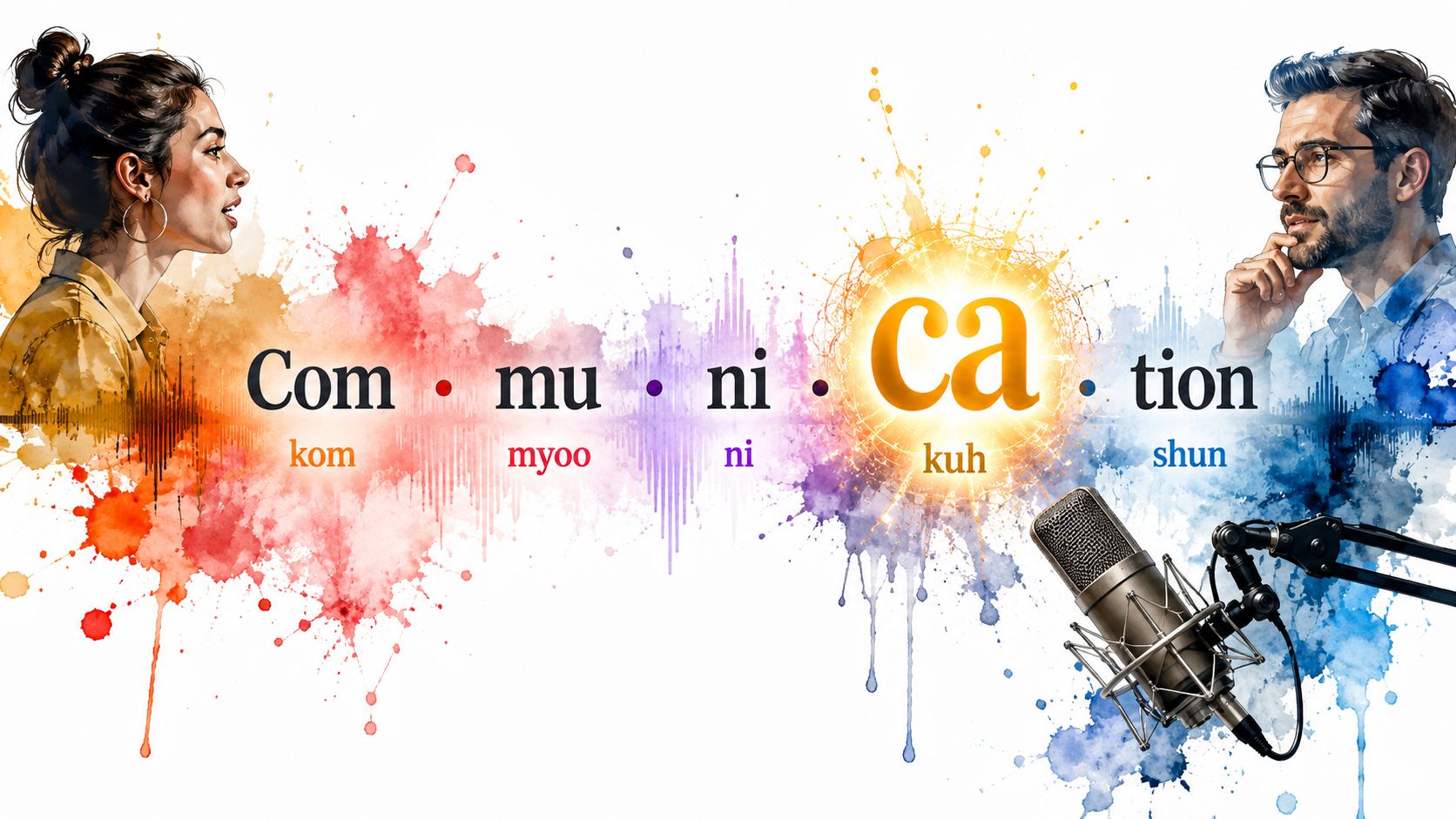
According to research on English stress placement and syllable structure, words with three or more syllables often take stress on the penultimate, or second-to-last, syllable when they end in -ic, -sion, or -tion. The same source says stress often moves to the antepenultimate, or third-to-last, syllable for endings such as -cy, -ty, -phy, or -gy.
Endings that usually pull stress near the end
These endings usually put stress on the syllable before the ending:
- geoGRAPHic
- inforMAtion
- exTENsion
A learner does not need to memorize every long word one by one. It helps to notice the family pattern. If a word ends in -tion, there is a strong chance the stress lands just before it.
Endings that pull stress one step left
Some endings move the stress farther back:
- deMOCracy
- geOGraphy
- aBILity
Here the stress goes to the third-from-last syllable.
A simple way to scan long words
Learners often panic when they see a long word. A calmer method works better.
- Look at the end first. Is it -tion, -sion, -ic, -cy, -ty, -phy, or -gy?
- Count backward. Find the second-to-last or third-to-last syllable.
- Say the word slowly. Stretch the stressed syllable a little.
- Repeat it in a short phrase. Not alone, but in real speech.
For example:
- communication
com mu ni CA tion - electricity
e lec TRI ci ty - biology
bi OL o gy
Long words become easier when the learner stops reading from left to right and starts checking the ending first.
Why this matters in daily speaking
These patterns show up in work, study, and everyday conversation. Words like “information,” “ability,” “technology,” and “graphic” are common. When the stress is clear, the word sounds more familiar to the listener.
It also saves mental energy. Instead of guessing every time, the speaker starts to hear repeatable patterns. That is a much better path than trying to memorize isolated words with no system.
How Stress Changes Meaning in Full Sentences
Word stress matters, but natural speech needs more than individual words. In full sentences, English gives more force to the words that carry the main meaning. These are often nouns, main verbs, adjectives, and adverbs. Smaller grammar words are often lighter.
That is where rhythm starts to feel real. A sentence is not a line of equal blocks. It rises and falls.
Content words carry the beat
Take this sentence:
“We bought a new computer yesterday.”
The strongest beats usually fall on bought, new, computer, and yesterday. The smaller words, such as “we” and “a,” are usually weaker.
This is one reason textbook pronunciation can sound different from real conversation. Learners often pronounce every word too carefully. Native-like rhythm usually gives more space to the important words and less space to the support words.
Stress can also change the message
English speakers also move stress to show contrast or focus. The sentence stays the same, but the meaning changes.
Consider this sentence:
“I love your new hat.”
Now look at what happens when the stress moves:
I love your new hat.
Someone else may not love it, but this speaker does.I love your new hat.
The speaker feels strongly, not just “like.”I love your new hat.
The new one is important, maybe not the old one.I love your new hat.
The hat is the focus, not the coat or shoes.
Sentence stress is meaning in action. The grammar may stay the same, but the speaker's intention becomes clearer when the voice highlights the right word.
Why learners sound robotic
A common issue appears here. A learner may know the right stress for individual words, but still speak every word with the same weight. Then the sentence loses shape.
That can happen in business English, too. A speaker says all the right words, but the message sounds flat, uncertain, or hard to follow. The problem is often rhythm, not vocabulary.
For a deeper look at how words join together in natural speech, this guide to connected speech in English gives useful examples.
A simple sentence drill
This drill helps learners feel sentence stress quickly:
- Choose a short sentence.
- Say it once in a neutral way.
- Say it again, stressing a different word each time.
- Listen for how the meaning changes.
This kind of practice teaches something important. Stress is not only a dictionary fact. It is also a speaking choice.
Practical Activities to Improve Your Speaking Rhythm
Knowing rules is helpful. Using them while speaking is the essential skill. Many learners can identify the correct stress in a single word, but they lose that control in conversation. As noted in this video on stress and connected speech, many non-native speakers can apply word-stress rules correctly on isolated words but struggle to use them in connected speech, which can create a “robotic” rhythm.
That gap matters because real speaking is fast. There is no pause button in a meeting, class discussion, or casual conversation. The mouth has to find the rhythm automatically.
Short drills work better than long study sessions
A learner does not need a huge pronunciation routine. Small, regular speaking practice is usually more useful.
- Shadow short audio: Listen to one sentence, then repeat it right away. Copy the rhythm, not only the sounds.
- Mark the strong syllable: Write a new word and make the stressed syllable bigger or in capital letters.
- Read aloud in chunks: Instead of reading word by word, read short phrases with a natural beat.
One minute of active speaking can teach more than many minutes of silent reading.
Record and listen without judging
Recording helps because speaking feels different from hearing. A learner may think the stress was clear, then notice on playback that every syllable sounded equal.
Useful questions while listening:
- Which syllable sounded strongest?
- Did the unstressed parts become lighter?
- Did the sentence have a clear beat?
- Did any important word disappear?
A calm recording habit helps learners notice patterns. The goal is not a perfect voice. The goal is clearer rhythm.
Build stress into daily vocabulary study
When learning a new word, learners often write meaning and translation. It helps to add stress too.
A better note looks like this:
- inforMAtion
- deVELop
- techNOLogy
That small habit trains the ear and the mouth together.
Practice with real spoken feedback
Speaking rhythm improves faster when learners practice out loud and get feedback right away. That is where a speaking partner can help, especially for shy learners who don't want the pressure of a live classroom.
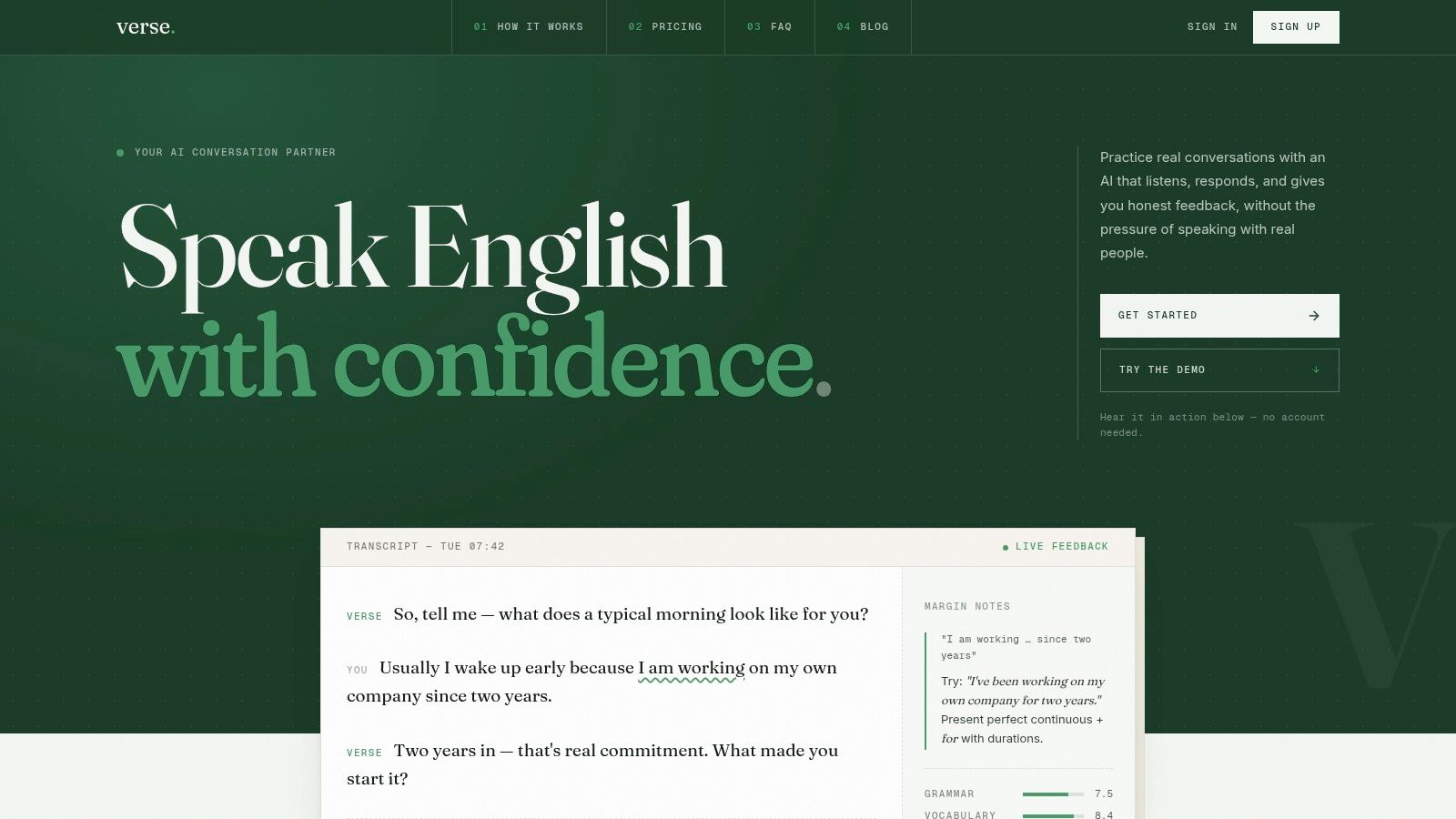
Verse is built for that kind of practice. It is an AI conversation partner for spoken English, with honest, judgment-free feedback on grammar, vocabulary, and fluency. Learners speak out loud, get instant feedback, and can choose a British, American, or Australian accent. It is not passive study with silent drills. It is real conversation practice. There is also a free, no-signup demo on the homepage for trying the speaking experience before deciding whether the paid subscription at $12/month feels right.
A learner does not need to master every stress rule before speaking. Speaking is how the patterns become natural.
English syllable stress can feel complicated at first, but it gets easier when learners stop chasing perfect rules and start practicing real rhythm out loud. A few clear patterns, a little daily listening, and regular speaking practice can make English sound much more natural. The most important step is simple. Keep speaking, keep listening, and let the rhythm become familiar.