Best English Conversation Practice Apps 2026
You know more English than you can say.
That's the frustrating part. You study grammar. You learn new words. You understand videos and emails. Then someone asks you a simple question in English, and your mind goes quiet for a few seconds. You know the answer, but it doesn't come out smoothly.
This is why many learners start looking for an English conversation practice app. Not because they want more rules, but because they need more real speaking time. The right app can help, but only if it matches your goal. Some apps train repetition. Some help you talk to real people. Some let you practise open conversations with feedback.
That difference matters more than most learners realise.
Table of Contents
- Feeling Stuck When You Try to Speak English
- Why Speaking Out Loud Is the Key to Confidence
- The Three Main Types of English Practice Apps
- A Closer Look at the Best Conversation Apps
- How to Choose the Right App for Your Goal
- Tips for Getting Great Results from Your Practice
- Start Your Speaking Journey with Confidence Today
Feeling Stuck When You Try to Speak English
A learner I often picture is someone sitting in an online meeting, listening well, taking notes, following everything. Then the manager says, “What do you think?” Suddenly the learner starts with, “Umm… I think… maybe…” The idea is there, but the sentence feels slow and shaky.
That moment is common. It doesn't mean your English is bad. It usually means you haven't had enough speaking practice under a little pressure. Reading, listening, and studying help a lot, but they don't fully train your mouth and mind to work together in real time.

Many learners think, “I need more vocabulary.” Sometimes that's true. But often the bigger problem is this: you know the words passively, yet you haven't used them enough in live speech. Speaking asks you to choose words fast, build sentences fast, and keep going even when you're unsure.
You don't become comfortable speaking English only by knowing English. You become comfortable by using it again and again.
This helps explain why speaking tools are getting so much attention. The speaking and listening category in English-learning apps is projected to be the fastest-growing segment, with an estimated 15.2% CAGR from 2026 to 2034, according to Dataintelo's English-learning app market report.
What this feels like in daily life
You might notice this problem in small moments:
- At work, you can write a message clearly, but speaking in a meeting feels harder.
- While travelling, you understand the question, but your reply comes too late.
- In social situations, you worry so much about mistakes that you say less than you want.
That gap is exactly where a good conversation app can help. Not by replacing study, but by giving you the missing part, regular chances to speak out loud.
Why Speaking Out Loud Is the Key to Confidence
Speaking is a skill you train with your body, not only with your memory. If you want to play guitar, reading about chords isn't enough. Your fingers need practice. English speaking works in a similar way. Your brain needs to find the words, and your mouth needs to say them smoothly.
Passive knowledge and active use
A lot of learners build passive knowledge first. That means you can recognise words and grammar when you read or listen. That's useful, but conversation needs active use. You have to pull language out of your memory at the right moment.
You may hear teachers use terms like active recall and muscle memory.
- Active recall means pulling information from your memory without looking at the answer.
- Muscle memory means your body gets used to a movement through repetition.
In speaking, that means your common phrases start coming out more naturally because you've said them many times before.
Why apps help shy learners
For many people, the problem isn't effort. It's fear.
You may worry about your accent. You may feel embarrassed when you make grammar mistakes. You may not know anyone who can practise with you regularly. These are real barriers, not excuses.
A conversation app can help because it gives you a place to practise privately and often. Mobile apps now account for about 80% of platform share in a language-learning market projected to reach roughly USD 16.2 billion by 2033, according to Market.us research on the language-learning app market. For learners, the practical meaning is simple. Speaking practice is easier to access than before.
Practical rule: if you want speaking confidence, your study plan must include actual speaking, not only reading, watching, or memorising.
What changes when you practise out loud
When learners start speaking regularly, they often notice three changes first:
They pause less
Common sentence patterns become easier to find.They recover faster after mistakes
Instead of freezing, they keep talking and correct themselves.They trust their own English more
Confidence doesn't come from perfection. It comes from repeated proof that you can continue a conversation.
That's why the best English conversation practice app for you isn't always the one with the most features. It's the one that gets you speaking often enough to make English feel usable, not just familiar.
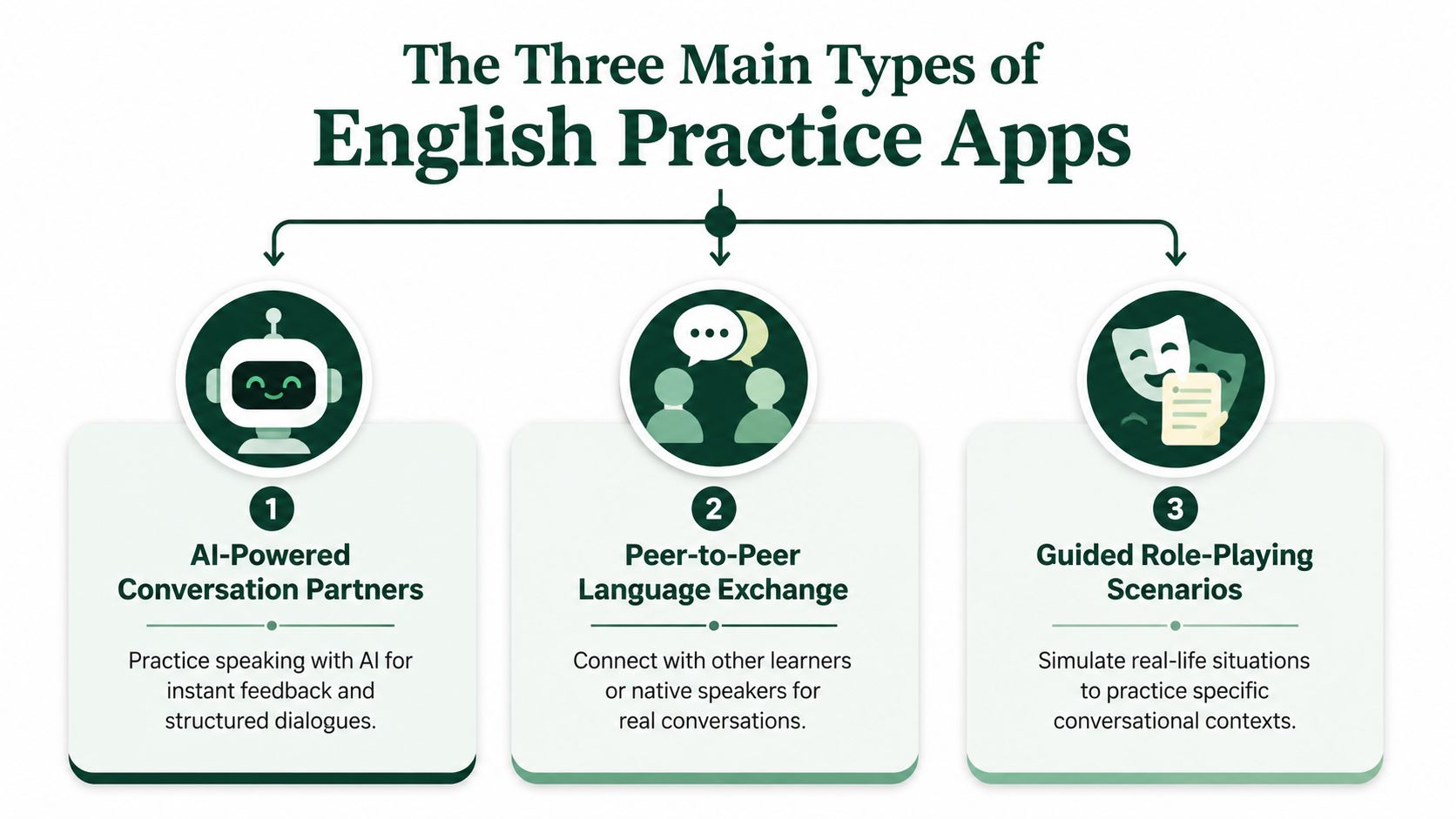
The Three Main Types of English Practice Apps
If you search for an English conversation practice app, many options look similar at first. They all promise speaking help. But the type of practice is often very different. This is the part that helps you choose wisely.
Early conversation apps often focused on large content libraries. Some listed 400 English conversation lessons with recording tools, while others claimed 1000+ conversations and large banks of phrases, according to this App Store listing reference for speaking practice apps. That history still shapes many apps today.
Scripted drill apps
These apps usually give you prepared dialogues, repeat-after-me tasks, listening exercises, and short speaking prompts.
They can be very helpful if you need structure. You don't have to decide what to say. The app gives you the topic, model answer, or fixed dialogue. That's good for beginners, busy learners, and anyone who feels lost without guidance.
But there is a limit. Scripted practice often teaches you how to answer the app, not how to handle a messy real conversation.
Best for:
- learners who want routine
- people building basic sentence patterns
- pronunciation repetition on common phrases
Less useful for:
- handling follow-up questions
- changing topic naturally
- speaking freely when there is no script
Live exchange apps
These apps connect you with other learners or native speakers. The big strength is obvious. You get real human interaction.
That can be exciting and useful. Real people bring surprises, personality, and natural communication. You also learn to manage turn-taking, interruptions, and different speaking styles.
Still, many learners struggle with this format at first. You may feel shy. Your partner may not match your level. Some conversations stay casual and friendly but don't give much correction. Others become text-heavy instead of spoken.
Best for:
- learners who want real human contact
- people comfortable with some unpredictability
- learners who enjoy cultural exchange as part of practice
Less useful for:
- very anxious speakers
- learners who want steady, detailed feedback every turn
- focused drilling on one weak area
Unscripted AI conversation apps
This type sits between drills and live exchange. You speak out loud, but you don't need to find a person or follow a fixed dialogue. The conversation can move in a natural direction, and the app can give feedback on what you said.
Many learners seek assistance with spontaneous speaking, moving beyond mere repetition. They want to answer unexpected questions, explain ideas, tell stories, or react in the moment.
One example in this category is Verse, which lets you record spoken answers, receive natural replies, and get feedback on grammar, vocabulary, fluency, and pronunciation in a private setting.
Scripted drills teach patterns. Live exchange tests real interaction. Unscripted AI practice helps you build the bridge between the two.
The simple way to remember it
Think of the three types like this:
| Practice Type | Feels Like | Main Strength | Main Limitation |
|---|---|---|---|
| Scripted drills | practising lines | structure and repetition | less spontaneous speaking |
| Live exchange | joining a real chat | human interaction | variable feedback and pressure |
| Unscripted AI conversation | private speaking with response | flexible practice plus feedback | less human warmth than a person |
If your goal is real-world fluency, this question matters more than “How many lessons does it have?” Ask instead, What kind of speaking will I be doing in this app?
A Closer Look at the Best Conversation Apps
The most useful comparison isn't app against app. It's practice style against your goal. Many learners choose based on design, price, or popularity, then quit because the practice doesn't fit what they need.
Quick Comparison of English Conversation Practice Apps
| App Type | Best For | Practice Style | Feedback Type | Example App |
|---|---|---|---|---|
| AI conversation partner | shy learners, daily fluency practice, repeat practice | open speaking with natural replies | instant in-app feedback | Verse |
| Language exchange platform | learners who want real people and cultural exchange | live or chat-based human interaction | mixed, depends on partner | language exchange app |
| Scripted lesson library | beginners, review, phrase-building | fixed lessons, prompts, repetition | limited and structured | lesson library app |
When each type works well
A scripted lesson library works well when you need a low-pressure starting point. If speaking still feels scary, fixed prompts can help you begin. You repeat useful sentence shapes, listen closely, and build a base. This kind of app is often good for warming up before harder practice.
A language exchange platform is better when you want real conversation with all the natural mess that comes with it. Some learners enjoy that energy. Others feel nervous because the quality changes from partner to partner. The conversation may be fun, but the learning can be uneven if your partner doesn't correct much.
A conversation-based app category has become a major global consumer space. One example often cited in this market reports 70M+ registered users across 200+ countries and support for 260+ languages, according to this overview of speaking app growth and category scale. The big lesson is not about one brand. It's that learners around the world clearly want conversation practice outside the classroom.
Why this choice affects your results
Some learners say, “I used a speaking app for months, but I still freeze in real conversation.”
Often the problem isn't effort. It's transfer. The app trained one kind of response, but real life asked for another.
For example:
- If you only repeat model sentences, you may sound fine in drills but struggle in free conversation.
- If you only chat casually with partners, you may get lots of exposure but not much correction.
- If you only practise in one topic area, your fluency may disappear when the subject changes.
That's why it helps to choose by outcome.
If your real goal is spontaneous speaking, your practice must include spontaneous speaking.
A balanced way to think about app quality
A good English conversation practice app should answer five simple questions:
- Will I speak out loud often?
- Can I practise the situations I care about?
- Will I get feedback I can understand?
- Can I repeat practice without shame or scheduling problems?
- Will this format help me talk outside the app too?
If the answer is “yes” to most of those questions, the app fits your speaking journey better than one with a long feature list.
How to Choose the Right App for Your Goal
Many learners ask the wrong first question. They ask, “Which app is best?” A better question is, “Which kind of app helps me do the speaking I need most?”
Recent learner-focused reporting points to a real problem in this market. Practice formats are fragmented across scripted drills, AI chat, live exchange, and tutor-led correction, and many learners still want to know whether practice will carry into real, unscripted conversation. That gap is discussed clearly in Preply's guide to English conversation practice.
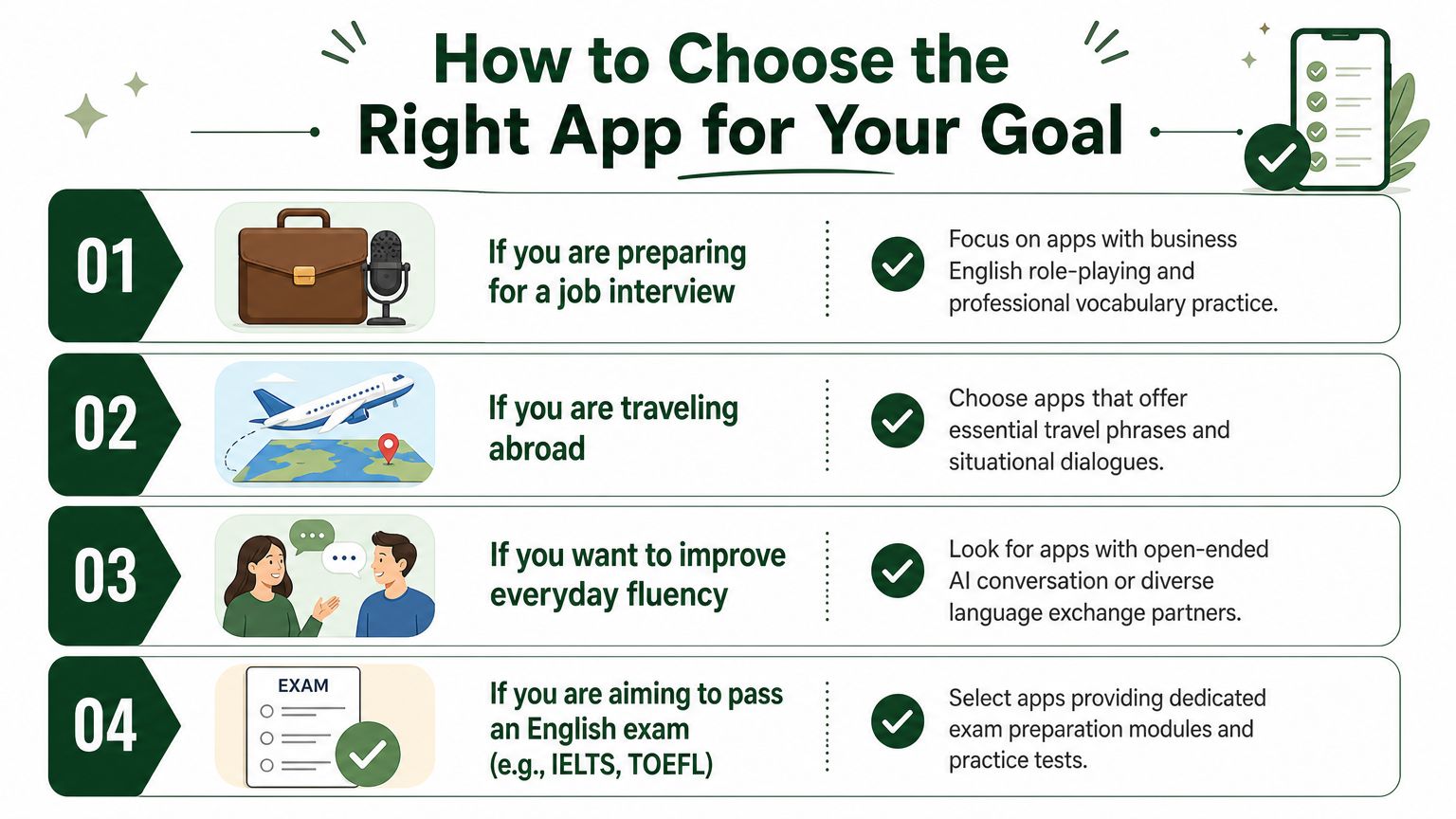
Match the app to the moment
If you are preparing for job interviews or work meetings, choose practice that lets you answer open questions out loud. You need more than phrase study. You need to explain opinions, give examples, and recover after a small mistake.
If you are very shy, start with private speaking. An unscripted AI format is often easier than talking to strangers immediately. You can repeat the same topic, notice patterns in your mistakes, and build comfort before moving to human conversation.
If you are travelling soon, scripted situational practice can help first. Airport questions, hotel check-in, asking for directions, and restaurant talk are easier to train with focused phrases. After that, open conversation practice helps you handle unexpected replies.
If your goal is broader self-study, this guide to free learning apps for adults can help you think about app habits and study styles around your speaking work.
Questions to ask before you choose
Write your answers to these before downloading anything:
What real situation scares me most?
A meeting, phone call, small talk, interview, or exam answer.Do I need privacy or human energy?
Be honest. Some learners need safety first.Do I want correction during practice, after practice, or only sometimes?
Too much correction can stop your flow. Too little can slow improvement.Can I practise at a fixed time, or do I need flexibility?
Your best app is one you can use often.
Choose the format that removes your biggest barrier to speaking. That's usually smarter than choosing the app with the most features.
Tips for Getting Great Results from Your Practice
The app matters. Your routine matters more.
A learner who practises a little every day usually gets more from an English conversation practice app than someone who does one long session and disappears for a week.
Build a habit that feels easy
Start small. Really small.
- Begin with five minutes if speaking feels heavy. A short session is easier to repeat.
- Use one topic for a few days instead of changing topics every time.
- Practise at the same moment each day, after breakfast, after work, or during a walk.
If you want more ideas for building a speaking routine, this article on how to practise English speaking online gives useful ways to make speaking part of normal life.
Make each session useful
Don't try to improve everything at once. Pick one focus.
One week, you can work on speaking in the past tense. Another week, you can focus on fewer filler words. Another week, you can practise giving longer answers.
Try this simple pattern:
- Speak for one minute
- Notice one repeated problem
- Say the answer again with that one fix
That second attempt is powerful. It turns feedback into action.
A mistake you notice and repair is more useful than a perfect sentence you copied.
If your app offers a quick demo conversation, use it. A low-pressure first try often helps you stop overthinking and just start speaking.
Start Your Speaking Journey with Confidence Today
Confidence in English usually grows in a quiet way. First, you answer faster. Then you pause less. Then one day you notice that a conversation felt normal.
That change doesn't come from collecting more tips. It comes from the right kind of speaking practice, repeated often enough to feel familiar.
Confidence grows from repetition
Some learners need drills first. Some need real people. Some need a private place to talk freely and get clear corrections. There isn't one perfect path for everyone.
What matters is choosing a practice type that helps you move toward real, unscripted speaking. If your current method isn't doing that, it's okay to change methods.
A calm first step
You can begin with one short conversation today. Not a full study plan. Not a big promise. Just one honest session where you speak, notice what happens, and keep going.
If you're interested in building a more natural relationship with English in daily life, Live the Language is a helpful mindset to keep with you.
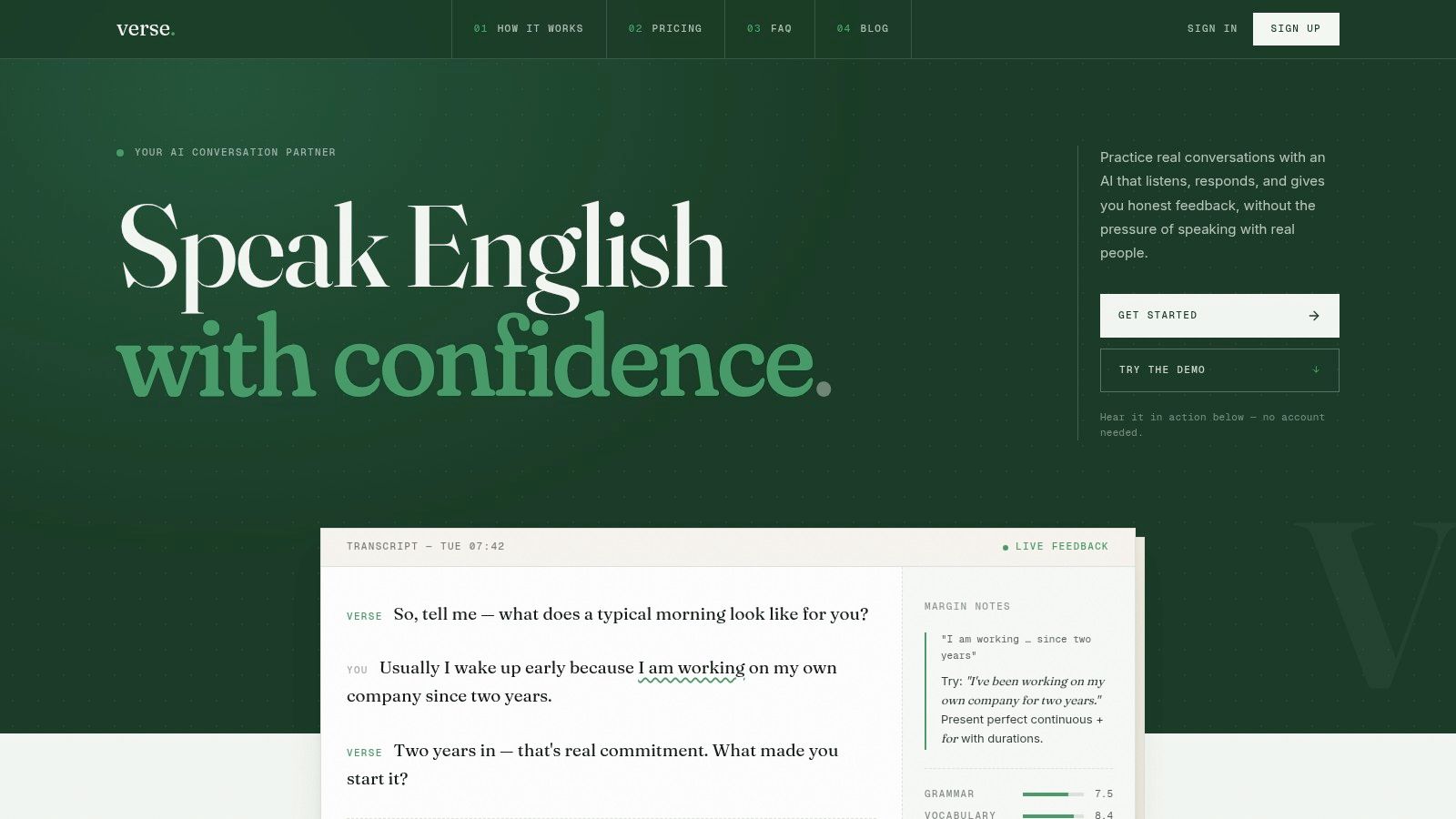
If you want a private place to practise spoken English and get honest feedback on grammar, vocabulary, fluency, and pronunciation, Verse is a simple place to start. You can try the no-signup demo, see how the conversation feels, and decide if that kind of practice fits your goals.