Parts of the Sentence: A Guide for English Speakers
You speak in English, then pause for a second and think, “Was that a real sentence?”
That moment is familiar for many learners. You may know a lot of words, but when you speak, the words don't always come out in a clear order. Maybe you stop halfway through a thought. Maybe you add too many words and lose the point. Maybe your sentence is grammatical, but it still doesn't sound natural.
The good news is that English sentences are not magic. They have parts, and those parts work together in patterns. When you understand the parts of the sentence, speaking feels less random. You can hear your own mistakes more clearly, fix them faster, and speak with more confidence. If speaking still makes you tense, this guide on building confidence when speaking English can help too.
Table of Contents
- Why Sentence Parts Matter for Confident Speaking
- The Two Core Parts of Any Sentence
- Expanding Your Sentences with Objects and Complements
- Adding Detail with Modifiers
- Understanding Clauses to Build Better Sentences
- Common Spoken Mistakes and How to Practice
- Your Next Step to Confident Speaking
Why Sentence Parts Matter for Confident Speaking
Speaking confidence often breaks down at the sentence level.
You may know the right vocabulary for work, travel, or daily life, but if the sentence itself feels shaky, you hesitate. You start again. You simplify too much. Sometimes you stop talking because you're not sure whether your idea is complete.
A basic English sentence is typically built from a subject and a predicate, and grammar instruction treats those as the two core elements of a complete sentence, as explained in Walden University's overview of sentence structure and language analysis. That sounds academic, but the practical meaning is simple. If you know who or what the sentence is about, and what is being said about it, you already have a strong base.
Why this helps in real speech
When learners feel lost, the problem is often not vocabulary. It's sentence assembly.
If you say, “Because I was tired,” your listener waits for the rest. If you say, “My friend,” your listener also waits. But if you say, “My friend was tired,” your idea lands. It feels complete.
Practical rule: When a sentence feels weak, check two things first. Who or what is it about, and what is happening?
This matters in conversation because spoken English moves quickly. You don't have much time to analyse every word. But if you can recognise the main parts of the sentence, you can repair your speech in real time.
A simple way to think about it
Think of a sentence like a bike.
The subject is the front wheel. The predicate is the back wheel. Without both, the bike doesn't move properly. After that, you can add more parts, such as detail, direction, and style.
Try this out loud:
- Too short: “After work.”
- Better: “I relaxed after work.”
- Too vague: “My brother.”
- Better: “My brother called me.”
That small shift can change how confident you feel. Instead of guessing, you're building.
The Two Core Parts of Any Sentence
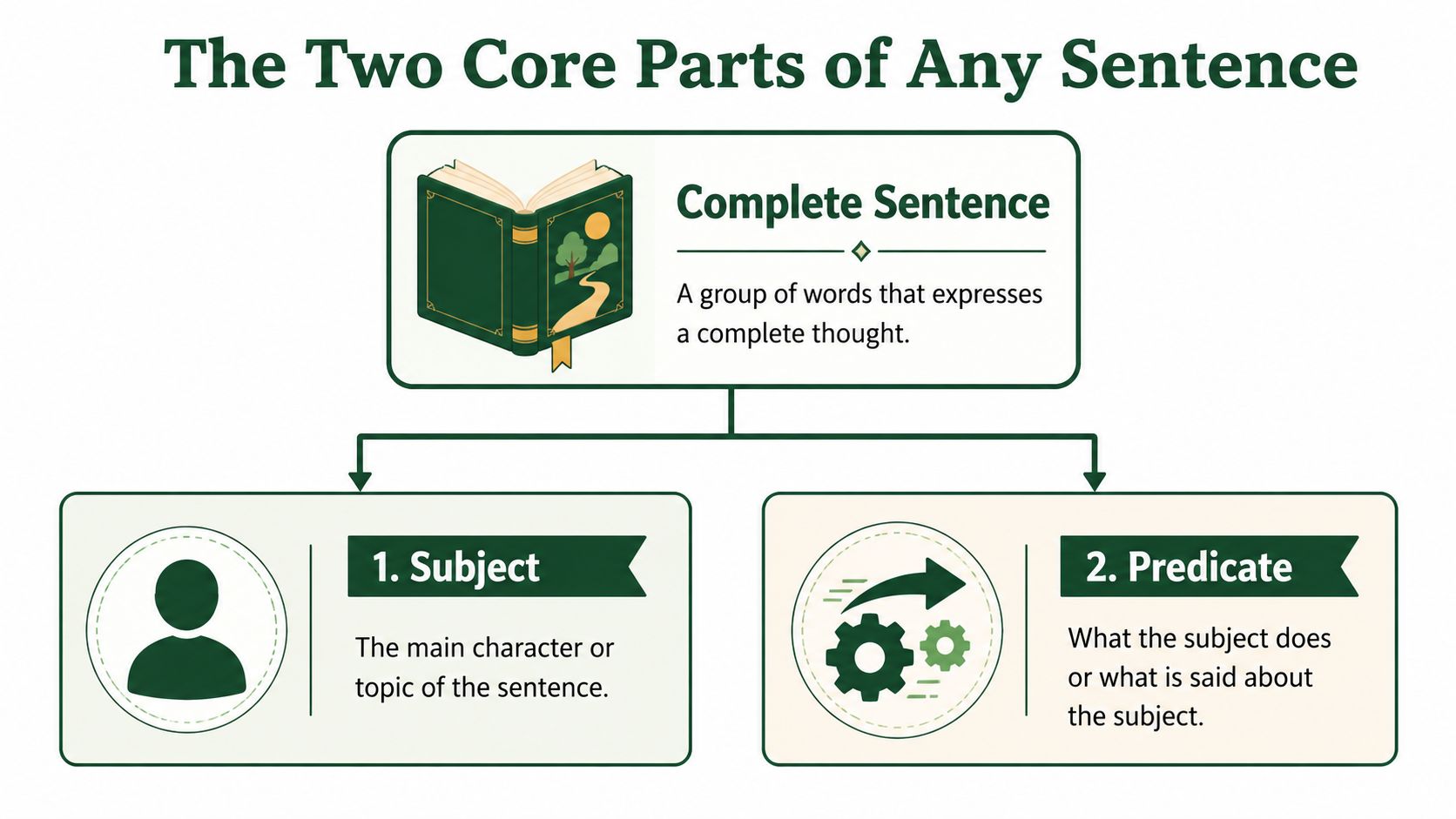
Every complete sentence needs two central parts, the subject and the predicate.
The subject tells us who or what the sentence is about. The predicate tells us what the subject does, feels, has, or is. If you can spot these two parts, you can quickly tell whether a sentence is complete.
How to find the subject
Ask, “Who or what is this sentence about?”
Examples:
- The teacher is speaking.
- My phone died.
- They arrived early.
The subject is not always one word. Sometimes it is a short group of words.
- The man in the blue jacket smiled.
- My best friend from university lives abroad.
The full subject can be long, but there is still a main word inside it. In “The man in the blue jacket smiled,” the main subject word is man.
How to find the predicate
Ask, “What is the subject doing, or what is true about the subject?”
Examples:
- The teacher is speaking.
- My phone died.
- They arrived early.
The predicate always includes the verb. It may also include other words that complete the meaning.
A complete sentence usually needs at least a subject and a verb. In practice, that gives you the basic frame you need before you add more detail.
Quick checks you can use while speaking
If you often stop and restart your sentences, use this fast mental test:
- Find the subject. Who or what am I talking about?
- Find the verb. What is happening?
- Say the short version first. Then add more detail.
For example, don't begin with:
- “The report from last week that my manager asked for...”
Begin with:
- “The report is ready.”
Then add:
- “The report is ready, and I sent it this morning.”
Practice aloud
Say these short complete sentences:
- I work.
- She laughed.
- The bus is late.
- My parents are cooking.
Now expand them:
- I work from home.
- She laughed at my joke.
- The bus is late again.
- My parents are cooking dinner.
That's the heart of sentence building. Start with the core, then grow the sentence.
Expanding Your Sentences with Objects and Complements
Once your sentence has a subject and a predicate, you can make it richer. Two helpful tools are objects and complements.
An object usually receives the action of the verb. A complement completes the meaning of the subject or object. These sound similar at first, so many learners mix them up.

Direct and indirect objects
A direct object answers what? or who? after the verb.
- She reads a book.
- I called my sister.
- We watched the film.
Ask the question:
- She reads what? A book.
- I called who? My sister.
An indirect object answers to whom? or for whom?
- He gave his sister a gift.
- I sent my friend a message.
- She cooked us dinner.
In “He gave his sister a gift”:
- a gift is the direct object
- his sister is the indirect object
A before and after view
Look at how objects make speech clearer.
- Basic: She wrote.
- Clearer: She wrote an email.
- More natural: She wrote her manager an email.
The first sentence is complete, but it leaves your listener with questions. The second and third versions sound fuller and more useful in real conversation.
What complements do
Complements do not receive the action. Instead, they rename or describe.
Examples:
- She is a doctor.
- The soup smells good.
- They elected him captain.
In “She is a doctor,” a doctor renames she. That is a subject complement.
In “They elected him captain,” captain gives more information about him. That is an object complement.
If the word receives the action, it's often an object. If it explains or renames, it's often a complement.
A common confusion
Learners often confuse these two patterns:
- She is a teacher.
- She teaches students.
In the first sentence, a teacher is not receiving an action. It completes the meaning of “She is...”
In the second sentence, students receive the action of teaching.
That difference helps you build better spoken sentences.
Try this speaking drill
Take one simple sentence and expand it in three steps.
Start with:
- “I made.”
Then build:
- “I made coffee.”
- “I made my friend coffee.”
- “The coffee was strong.”
You can do the same with daily speaking topics:
“I sent a message.”
“I sent my colleague a message.”
“The message was urgent.”
“He became nervous.”
“He became the team leader.”
“They chose him leader.”
This kind of short practice helps you feel how sentence parts work, not just what they are called.
Adding Detail with Modifiers
Modifiers are the detail words in a sentence. They help your listener see the picture more clearly.
Without modifiers, your English may be correct but flat. With them, your meaning becomes more specific. You sound more natural because you're not only naming actions, you're also showing how, where, when, or what kind.
Adjectives and adverbs
An adjective describes a noun.
- a small room
- an interesting idea
- my new job
An adverb often describes a verb.
- speak clearly
- drive carefully
- arrived late
Adverbs can also describe adjectives or other adverbs.
- really tired
- very slowly
Why placement matters
Modifiers help only when they are in the right place.
Compare these:
- I only spoke to my manager.
- I spoke only to my manager.
The meaning changes slightly because only moves. In speech, this matters. A small word in the wrong place can make your sentence confusing.
Here are some safe patterns for everyday speaking:
- Put adjectives before nouns.
“a difficult meeting” - Put many adverbs after the verb or at the end.
“She explained it clearly.” - Put time expressions where they sound natural.
“I saw him yesterday.”
More detail isn't always better. Add the detail that helps your listener understand you faster.
Phrases that act like modifiers
A modifier can be more than one word. A prepositional phrase often works as a modifier.
- the woman in the office
- the keys on the table
- we met after lunch
These phrases answer questions like where, when, or which one.
You may also see appositives, which rename a noun in a compact way. If you want a simple explanation, this guide on what an appositive phrase is is useful.
How to sound more natural with modifiers
Many learners know adjectives, but they don't use enough modifiers when speaking. That can make answers sound short or stiff.
Compare:
- “I bought a bag.”
- “I bought a black leather bag.”
- “I bought a black leather bag at the airport.”
Or:
- “He answered.”
- “He answered politely.”
- “He answered politely during the meeting.”
A simple speaking exercise
Choose one noun and one verb. Then add one modifier at a time.
Example:
- “I saw a dog.”
- “I saw a small dog.”
- “I saw a small dog outside.”
- “I saw a small dog outside this morning.”
Do this out loud with everyday topics:
- your room
- your job
- your family
- your weekend
This habit makes your spoken English more vivid without making it complicated.
Understanding Clauses to Build Better Sentences
Many learners think a long sentence is automatically a better sentence. It isn't.
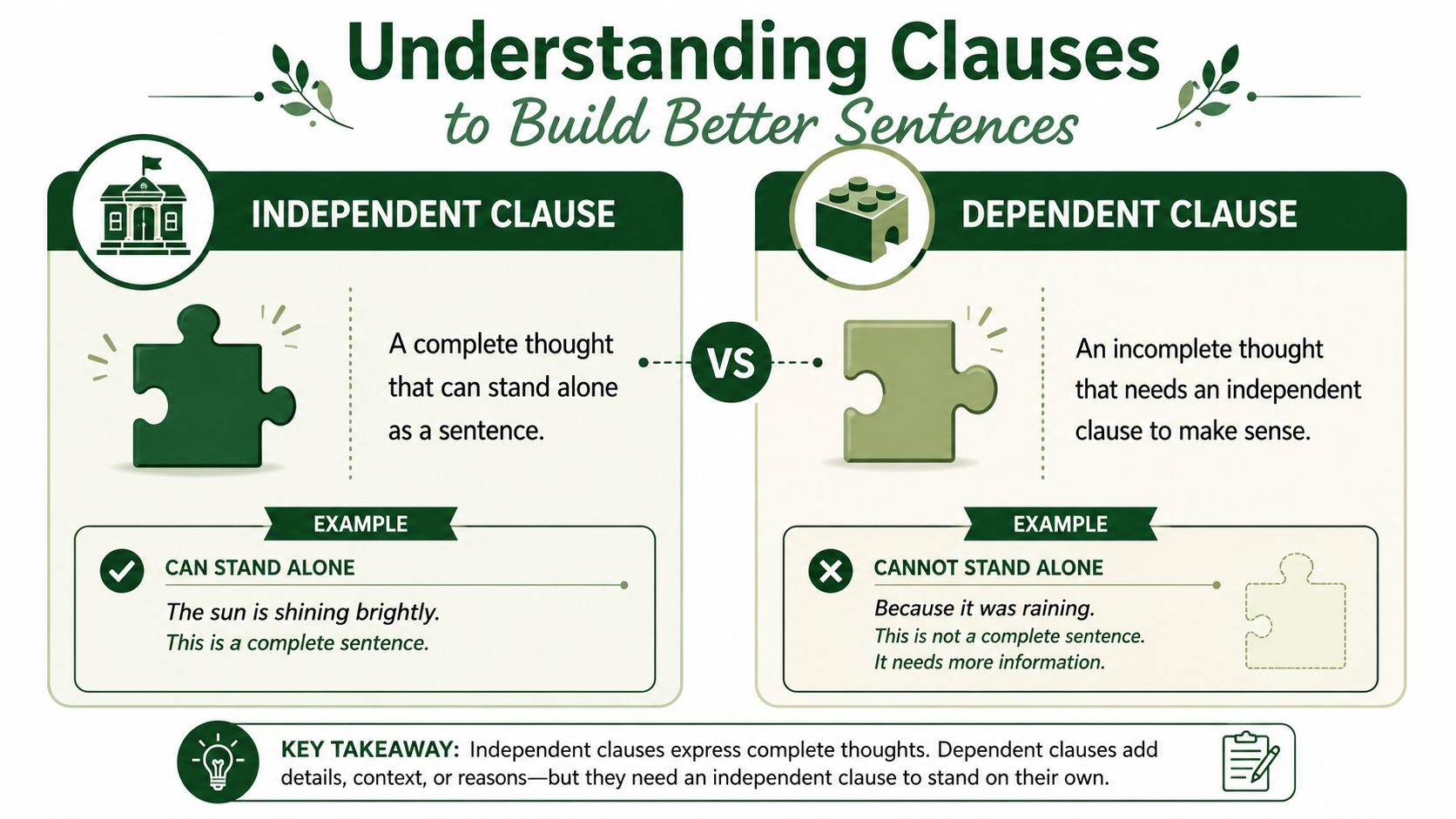
A better sentence is one that holds together. To do that, you need to understand clauses. A clause is a group of words with a subject and a verb. Some clauses can stand alone. Some can't.
Independent and dependent clauses
An independent clause can stand alone as a complete sentence.
- I missed the bus.
- She was tired.
- We stayed home.
A dependent clause cannot stand alone.
- because I missed the bus
- although she was tired
- when we stayed home
These clauses feel unfinished because they depend on another clause to complete the thought.
Why learners get stuck here
Many English learners struggle with how sentence parts work in real speech. A common issue is creating a sentence fragment, which is an incomplete sentence. According to NIU's explanation of sentence fragments, this often happens because a sentence is missing a core part like a subject or main verb, or because a dependent clause is left disconnected.
That's why sentences like these sound incomplete:
- Because I was late.
- When I got home.
- Although it was difficult.
Each one starts well, but each one leaves the listener waiting.
How to complete the thought
Add an independent clause.
- Because I was late, I took a taxi.
- When I got home, I made dinner.
- Although it was difficult, I finished the task.
You can also reverse the order:
- I took a taxi because I was late.
- I made dinner when I got home.
- I finished the task although it was difficult.
Both patterns are common in speech.
A dependent clause is like half a bridge. It needs another side before anyone can cross.
Conjunctions that connect ideas
Conjunctions help clauses work together. Common ones include:
- and for adding
- but for contrast
- because for reason
- while for two actions or a contrast
Examples:
- I wanted to go, but I was busy.
- She stayed home because she felt sick.
- He cooked while I cleaned.
A speaking pattern to practise
If long answers are hard for you, use this formula:
- Say one independent clause.
- Add one conjunction.
- Add one more clause.
For example:
- “I was tired, so I went to bed early.”
- “She called me when she arrived.”
- “We stayed inside because it was raining.”
This is one of the fastest ways to make your speaking sound smoother. You are not just saying separate short sentences. You are connecting ideas in a clear way.
Common Spoken Mistakes and How to Practice
Knowing sentence parts on paper is helpful. Using them while speaking is harder.
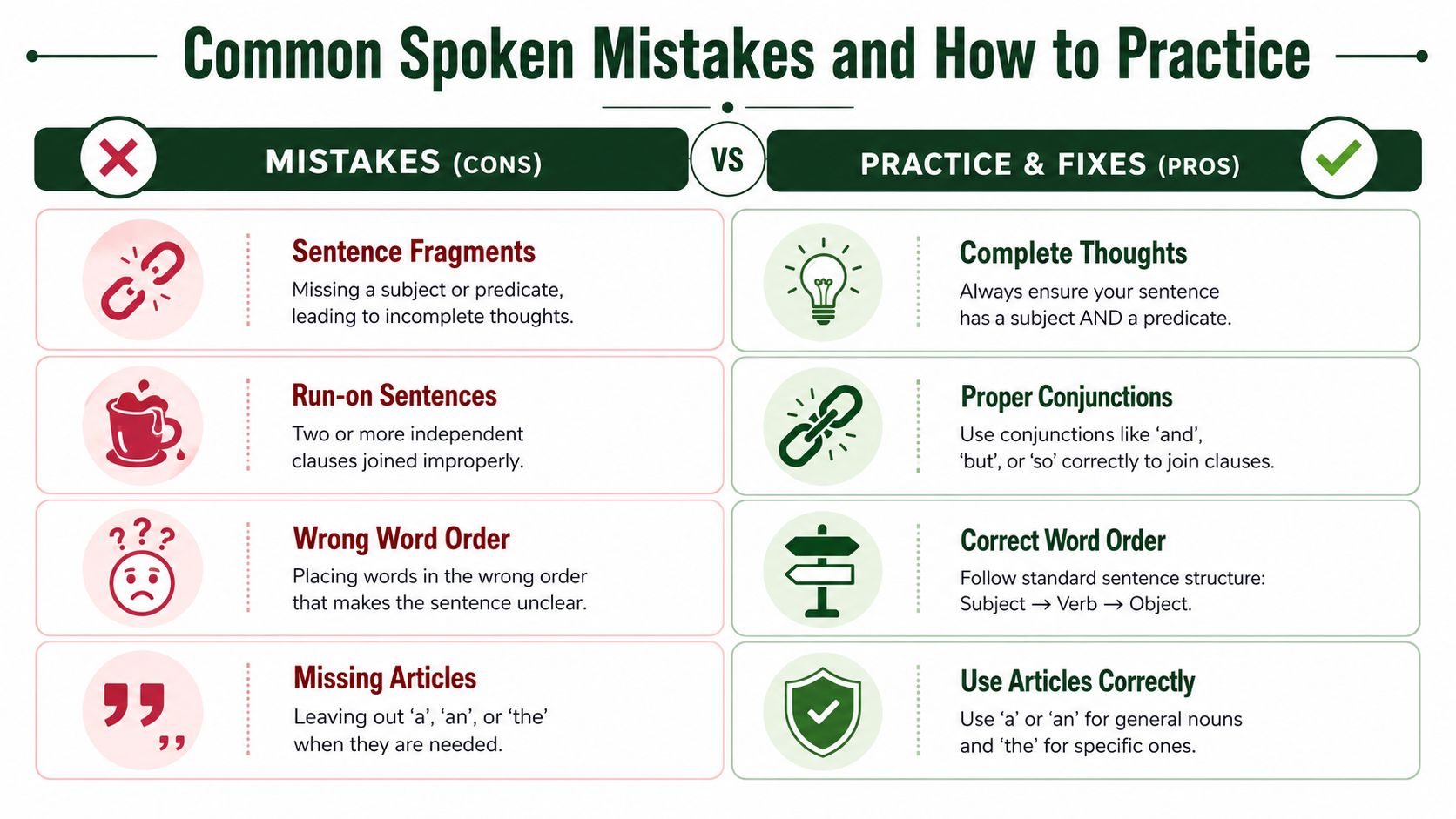
In real conversation, learners often make the same few sentence mistakes again and again. The good news is that these mistakes are very fixable when you know what to listen for.
Sentence fragments
A fragment is an incomplete sentence.
Spoken examples:
- Because I was busy.
- After the meeting.
- My friend from Spain.
These often happen when you begin with a good idea but stop before the full sentence arrives.
Fix them by adding the missing part:
- Because I was busy, I replied later.
- After the meeting, we went for coffee.
- My friend from Spain is visiting next week.
Run-on sentences
A run-on sentence joins ideas badly. In speech, this often sounds like one long chain with no clear connection.
Example:
- I went to the park I saw a dog it was cute.
Better versions:
- I went to the park, and I saw a dog. It was cute.
- I went to the park. I saw a dog there, and it was cute.
When you speak, pause between complete thoughts. If two ideas are separate, let them breathe.
Subject verb agreement problems
This happens when the subject and verb do not match.
Examples:
- The people is happy.
- My brother go to work early.
Fixes:
- The people are happy.
- My brother goes to work early.
This mistake often appears when the subject is far from the verb, or when the subject sounds singular but is plural.
Active and passive voice
Grammar isn't just about being correct. It's also about making choices. Australia's Style Manual on parts of sentences notes that active voice is usually clearer, while passive voice can be used intentionally for specific reasons, such as when the actor is not named.
Compare:
- Active: The manager approved the plan.
- Passive: The plan was approved.
The active version is usually clearer because the listener immediately knows who did the action. But the passive version can be useful when the action matters more than the person.
Quick Reference for Fixing Spoken Mistakes
| Common Mistake | What it Sounds Like | How to Fix It |
|---|---|---|
| Fragment | “Because I was tired.” | Add a complete main clause |
| Run-on sentence | “I called him he didn't answer” | Split the ideas, or join them with a conjunction |
| Subject verb agreement | “She go every day” | Match the verb to the subject |
| Unclear voice choice | “The file was sent” | Use active voice if the actor matters |
Practice drills you can do out loud
Use short speaking drills, not long grammar study sessions. If you want more ideas for daily speaking routines, this article on how to practice English speaking online gives you practical ways to keep going.
Try these drills:
Finish the fragment: Say the first half, then complete it.
“Because I missed the train...”
“Because I missed the train, I arrived late.”Cut the run-on: Record yourself saying a long idea. Then listen again and divide it into two or three clear sentences.
Match the verb: Make pairs aloud.
“He works.”
“They work.”
“My friend lives.”
“My friends live.”Change the voice: Say one sentence in active voice, then change it.
“The team solved the problem.”
“The problem was solved.”
Don't practise until the rule looks familiar. Practise until the sentence sounds familiar in your mouth.
A better way to notice your errors
When you listen to yourself, don't try to catch everything. Focus on one sentence problem at a time.
For one day, only check fragments.
For the next day, only check agreement.
Then spend another day checking clause connections with words like because, but, and while.
That narrow focus works better than trying to fix every grammar issue in one conversation.
A short self-correction routine
After you speak, ask yourself:
- Was my sentence complete?
- Did my subject and verb match?
- Did I connect my ideas clearly?
- Would active voice make this clearer?
Those four questions can improve your spoken English more than memorising long rule lists.
Your Next Step to Confident Speaking
The parts of the sentence are not just school grammar. They are tools for real speech.
When you know the core pattern, subject plus predicate, you can produce complete thoughts more easily. When you add objects, complements, and modifiers, your ideas become clearer and more natural. When you control clauses, you can connect ideas without getting lost halfway through.
You don't need perfect grammar to speak well. You need a sentence structure that you can trust.
A helpful habit is to notice sentence parts when you read, then say similar patterns out loud. Keep the practice small. One short sentence. Then one longer one. Then one connected idea. Over time, your speaking starts to feel more stable because you are building, not guessing.
If you want a calm place to practise out loud and get honest feedback on your grammar and fluency, Verse can help.
If you'd like a private, low-pressure way to practise speaking, try Verse. You can have real English conversations, get specific feedback on sentence structure, and build confidence through regular speaking practice. There's also a free no-signup demo if you want to see how it feels before committing.