Best Free Learning Apps for Adults in 2026
You download a learning app on Monday. You feel motivated. On Tuesday, you open it once, do two quick tasks, and think, “I'll do more tomorrow.”
By Friday, the app is still on your phone, but your week has become busy. Work, family, messages, tiredness. The little app icon is still there, waiting.
If that sounds familiar, you're not lazy, and you're not bad at learning. Most adults don't have a motivation problem. They have a real-life problem. They need learning that fits into a full day, and they need a simple way to turn study time into real speaking practice.
That's why this guide is different. It's not just a list of free learning apps for adults. It's a practical guide to choosing the right kind of app, using it in a small daily habit, and connecting what you learn to spoken English you can use.
A quick note before we begin. The education app space is huge. In 2023, the sector reached 709 million users, 939 million downloads, and $5.93 billion in revenue, and it was the second largest category on Google Play and third largest on the Apple App Store, according to Business of Apps' education app market data. With that much choice, it's easy to feel lost.
If you want a place to practise spoken English after your app study, you can also explore Verse, which is built for conversation practice and feedback.
Table of Contents
- Your Phone Is Full of Apps You Never Open
- The Challenge with Free Learning Apps
- Best Free Apps for English Vocabulary and Grammar
- Free Apps for Professional and Soft Skills
- Great Apps for Quick Daily Learning
- How to Turn App Lessons into Speaking Skills
- Start Speaking with More Confidence Today
Your Phone Is Full of Apps You Never Open
Many adult learners do the same thing. They install one app for grammar, another for vocabulary, one for listening, and maybe one more for “daily learning.” For a short time, it feels like progress.
Then life gets in the way.
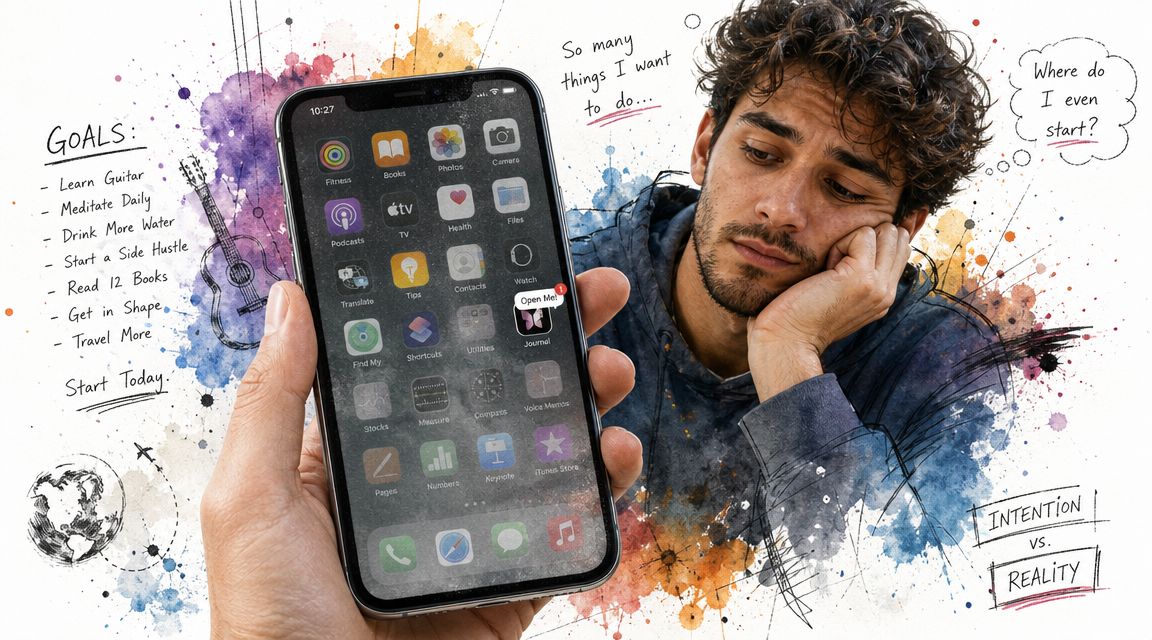
A teacher sees this all the time. A student says, “I have many resources, but I still don't speak.” That sentence is honest, and important. It shows the core problem. Having tools is not the same as using them well.
When your phone is full of learning apps, you can start to feel one strange kind of pressure. You have many choices, so you choose nothing. You open one app, forget your password, close it, then try another app with a different style and a different plan. Ten minutes later, you've done more deciding than learning.
Too much choice can feel like progress
The app stores make learning look simple. Download, tap, begin. But adults often need something more practical than that.
You may need:
- A clear goal, such as “I want to speak more confidently in meetings.”
- A small study plan, not a huge weekly promise.
- One main app, not six.
- A speaking step, so the lesson doesn't stay only in your head.
Free learning apps for adults can help a lot, but they work best when you give each lesson a job.
That “job” might be learning five useful work phrases, reviewing one grammar point, or collecting words for a short spoken answer. Once you know the job, the app becomes lighter and easier to use.
What helps more than motivation
Many learners think they need stronger discipline. Usually, they need a simpler routine.
Try this instead:
- Pick one purpose for the next two weeks.
- Choose one main app that matches that purpose.
- Limit study time to a short daily session.
- Say something out loud after every lesson.
This is how good intentions become real practice.
The Challenge with Free Learning Apps
A free app can feel like a good start on a busy Tuesday night. You download it with honest intentions, open it once, tap through a lesson, and then life gets loud again. By the next day, the app is still on your phone, but the learning has already slipped into the background.
That pattern is common for adults learning on their own. The problem is rarely laziness. It is usually a gap between a quick lesson on a screen and a clear action you can repeat in real life, especially if your real goal is to speak with more confidence.
Why free apps are easy to leave behind
Free apps remove the cost barrier. They do not remove the friction of adult life.
Many adult learners are studying in small, uneven pockets of time. Five minutes before work. Ten minutes on the train. A few tired minutes before sleep. In that kind of schedule, even a useful app can become one more thing to remember, one more login, one more decision.
An app also gives a feeling of motion very quickly. You tap, match, swipe, and collect points. That can feel encouraging at first. But language learning works more like cooking than like scrolling. Reading a recipe is helpful. You still need to use the ingredients yourself. In the same way, seeing a word or grammar rule is only the beginning. You need to say it, write it, and connect it to a real situation.
Where learners often get stuck
Adults usually stop using free learning apps for a few simple reasons:
- The lesson has no clear purpose. If you do not know what today's lesson is for, it is hard to care about finishing it.
- The app asks you to choose too much. Levels, paths, streaks, badges, review modes. Too many options can drain energy before the lesson even starts.
- The practice stays passive. Tapping the right answer is easier than building your own sentence.
- Nothing leads to speaking. You learn a word, but you never try it in your own voice.
- The tool feels harder than the lesson. If menus, settings, or account steps feel confusing, motivation drops fast.
One small test helps here. After a lesson, can you use one new phrase in a sentence about your life? If the answer is no, the lesson probably stayed too far from real communication.
For example, you might study a vocabulary set with words that look familiar but sound different in context. A quick follow-up with examples of sentences with homonyms can help you notice meaning more clearly before you try saying the words out loud.
Free access and real progress are different things
Some learners blame themselves when an app does not stick. That is usually the wrong conclusion.
Free access means you can begin. Real progress comes from repetition, clarity, and use. A good app can support that process, but it cannot create the habit for you. It also cannot turn quiet recognition into speaking skill unless you add that step yourself.
This is the part many lists miss. The goal is not to collect learning apps. The goal is to build a routine that turns short app lessons into language you can use in conversation, at work, or in everyday life.
If free apps have not worked for you before, do not read that as failure. Read it as feedback. You may need fewer choices, shorter sessions, and a simple speaking step after each lesson. That is often the difference between studying more and using what you study.
Best Free Apps for English Vocabulary and Grammar
You open your phone for a five-minute study break. One app promises quick lessons. Another offers flashcards. A third corrects your writing while you type. It sounds helpful, but after a week, many adult learners still ask the same question: “Why do I know more words, but still freeze when I need to speak?”
That usually happens because vocabulary and grammar apps solve different parts of the problem. One app type gives you structure. Another helps you remember. Another helps you notice mistakes. If you choose by purpose instead of popularity, your study time starts to work harder for you.
A quick comparison first
| App Type | Best For | Key Free Feature |
|---|---|---|
| Guided lesson apps | Building a steady vocabulary and grammar routine | Short step-by-step lessons |
| Custom flashcard apps | Reviewing words and phrases you personally forget | Self-made study sets and repeat review |
| Real-time writing assistants | Catching grammar, spelling, and word-choice errors while writing | Instant feedback as you type |
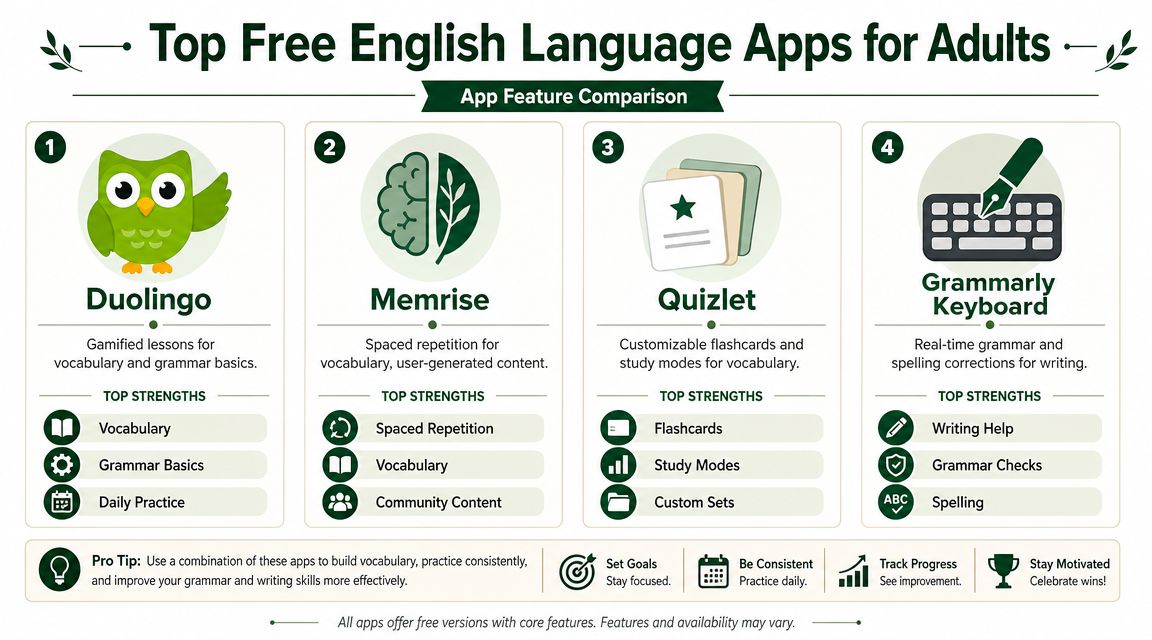
Which type of app helps with what
Guided lesson apps are useful when you want someone else to organize the route. They work like a marked walking path. You do not have to decide what to study next, which is helpful on tired evenings when too many choices can stop you before you begin.
Custom flashcard apps help more when your mistakes are specific. Maybe you keep forgetting workplace verbs, travel phrases, or adjective pairs that seem similar. In that case, your own study set often teaches better than a general word list because it reflects your real gaps, not someone else's.
Real-time writing assistants do a different job. They will not build speaking confidence by themselves, but they can show you patterns you miss. If you keep writing the same tense error or article mistake, that repeated correction can help you notice the pattern faster the next time you speak.
Some learners also struggle with words that sound the same but mean different things. If that keeps slowing you down, these examples of sentences with homonyms can make those differences easier to hear and remember.
A better way to use vocabulary and grammar apps
The better question is not which app is best. The better question is what job your app needs to do this week.
Try matching the app type to a real communication goal:
- For vocabulary growth: study five to ten useful words, then say one true sentence about your life with each one.
- For grammar review: practice one pattern, such as past tense or conditionals, then answer a few spoken questions out loud using that pattern.
- For better writing: save corrections you see more than once, and turn them into a short “watch list” before you write messages or emails.
- For work English: collect phrases you can reuse in meetings, updates, and polite requests, then rehearse them aloud until they sound natural.
This is the step many app lists miss.
An app lesson is like collecting ingredients. Speaking is cooking. If you only collect words and rules, you still have not made a meal. Adults make faster progress when each short lesson ends with one small speaking action, even if it is only thirty seconds out loud.
Keep the routine simple. Learn a little. Use it the same day. That is how vocabulary and grammar study starts turning into language you can say with confidence.
Free Apps for Professional and Soft Skills
Many adults don't study only for exams. They study because they want to do better at work. They want to explain ideas clearly, write better messages, speak with more confidence in meetings, or understand professional topics in English.
That's where work-focused learning apps can help.

A professional skills app usually teaches content such as communication, organisation, presentations, teamwork, or task planning. A soft skills app often focuses more on human interaction, such as listening, giving feedback, solving problems, or leading discussions.
What to look for in a work-focused app
You don't need a perfect app. You need one that fits your job and your energy.
A good choice usually has:
- Clear topic-based lessons, so you can study one workplace skill at a time.
- Short segments, so you can learn before work or during a break.
- Practical language, not only theory.
- Examples you can reuse, such as phrases for meetings, updates, and professional small talk.
If you work in English, try choosing content that matches your week. If you have a presentation coming up, study presentation structure. If you need to join more discussions, study useful opinion phrases and turn-taking language.
How to study job skills in English
This part is simple, but it changes everything. Don't only understand the idea. Say the idea.
Here's a useful routine:
- Watch or read a short lesson about one workplace skill.
- Write down two or three key phrases.
- Explain the lesson out loud in your own words.
- Add one real example from your job.
For instance, if the topic is giving feedback, don't stop at reading polite expressions. Practise saying them:
“I think we could make this clearer.”
“One thing we might change is…”
“I liked this part because…”
That last step matters because work confidence is often speaking confidence in disguise.
If you can explain a professional idea simply and calmly in English, people usually understand you better than when you try to sound advanced.
Learners sometimes avoid speaking because they think their English must sound formal or impressive. At work, clear language is often more useful than complicated language. A short, accurate sentence usually does more than a long one with many mistakes.
Great Apps for Quick Daily Learning
Busy adults often believe they need long study sessions to improve. Usually, they don't. They need short sessions they can repeat.
One source on adult learning notes that bite-sized lessons of around 10 minutes are designed for people with limited time, helping reduce effort and build habit. That point appears in the earlier source on free learning apps, and it matches what many teachers see every day.
Why short lessons work better for busy adults
A short lesson feels easier to start. That matters more than many learners realise.
When a task feels small, your brain is less likely to delay it. You don't need a perfect hour. You need a moment that already exists in your day. That might be while waiting for your coffee, sitting on a bus, or resting before sleep.
Quick learning also helps with consistency. Adults often remember better when study becomes part of a routine instead of a big event.
Some helpful daily moments are:
- Morning start: Review a few words before checking social media.
- Lunch break: Read one short lesson or do one quiz.
- Commute time: Listen, repeat, and shadow short phrases.
- Evening reset: Review what you learned and say two sentences aloud.
Simple daily learning ideas
If you get overwhelmed easily, keep your routine very small.
Try one of these:
- One word, three sentences: Learn one new word. Make three different spoken sentences with it.
- One rule, one minute: Review one grammar point, then speak for one minute using it.
- One topic, one opinion: Read something short, then give your opinion out loud.
- One review day: Use some days only for revision, not new content.
This is often called microlearning, which means learning in very small pieces. It works well for adults because it respects real life.
A short lesson can still be serious learning. The key is not lesson length. The key is whether you return tomorrow.
How to Turn App Lessons into Speaking Skills
This is the step many learners skip.
An app can teach you words. It can show grammar. It can test your memory. But if you never move that language into your mouth, it stays passive. You may recognise it when you read, but not when you need to speak.
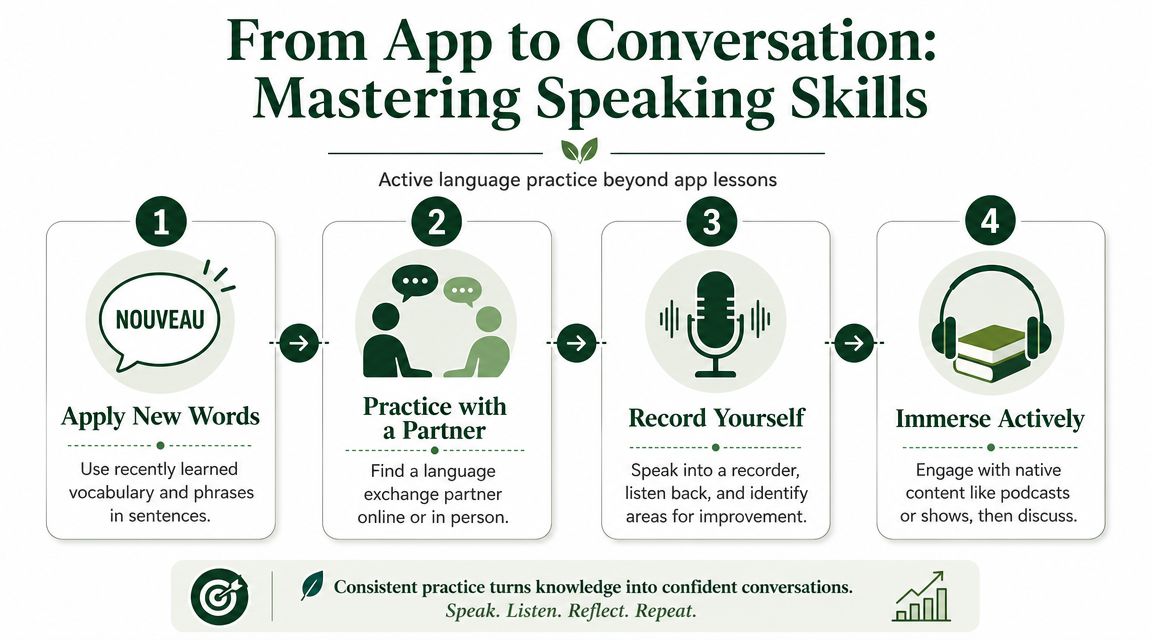
A simple speaking routine
Use this after any lesson, even a very short one.
Choose one thing from the lesson
Pick a word, phrase, grammar pattern, or question type.Make it personal
Don't repeat only the app's example. Change it to your life.
If the phrase is “I'm used to…”, say, “I'm used to working late on Mondays.”Say it out loud three times
First slowly. Then naturally. Then again without looking.Extend it by one sentence
Add a reason, an example, or a feeling.
“I'm used to working late on Mondays because that's when my team plans the week.”
This turns passive study into active language.
What many learners forget
Speaking confidence doesn't come only from knowing more. It comes from retrieving language under a little pressure. That means you need moments where you produce language, hear yourself, notice problems, and try again.
Here are a few ways to do that:
- Record yourself: Speak for one minute on today's topic, then listen back.
- Retell the lesson: Explain what you learned as if teaching a friend.
- Answer a real question: Use the new language in a spoken response.
- Repeat on another day: Reuse the same word or pattern later in the week.
If you want extra structure, practising common speaking prompts can help. This IELTS speaking practice test guide is useful even if you're not taking IELTS, because it trains you to organise spoken answers clearly.
Don't wait until you feel ready to speak. Speaking is how you become ready.
A lot of adults study privately because they feel shy, embarrassed, or worried about mistakes. That feeling is normal. The answer isn't to wait for perfect English. The answer is to build a safe routine where using your voice becomes normal.
Start Speaking with More Confidence Today
Free learning apps for adults can be a great starting point. They can help you build vocabulary, review grammar, learn job skills, and use small pockets of time well.
But the app is only the start.
True change begins when you take one small lesson and use it in speech. One sentence aloud. One short opinion. One recorded answer. That's often the difference between “I studied English” and “I can say something in English.”
If you're unsure where to begin, keep it very simple today:
- Choose one app you already have.
- Do one short lesson.
- Say three sentences out loud with what you learned.
That is enough for a good start.
You do not need a perfect plan. You need a repeatable one. If you keep connecting app study to real speaking, your confidence can grow step by step, in a way that feels calm and manageable.
If you want a simple way to practise speaking after your lessons, Verse gives you a private space to talk, get honest feedback, and build confidence without pressure. It's a good next step when you're ready to turn study time into real spoken English.