Master Formal and Informal English: Speak Confidently
A learner is in a meeting. The manager says, “Could everyone please share an update on their progress?” The learner answers carefully, in very formal English. A few minutes later, the meeting ends, people start chatting, and someone asks, “So, how was your weekend?” Suddenly, the same learner freezes.
That moment is common. Many English learners understand the difference between formal and informal language on paper, but live conversation moves fast. The hard part isn't only knowing the rules. The hard part is switching naturally, without sounding stiff, rude, or strange.
Formal and informal English are not two separate systems. They are two styles on a scale. A speaker moves up or down that scale depending on the situation, the relationship, and the goal. That's why this skill matters so much for speaking confidence. It helps a learner sound polite at work, relaxed with friends, and natural when a conversation changes direction.
Table of Contents
- Why Knowing Formal and Informal English Matters
- The Main Differences at a Glance
- Choosing Your Style in Different Situations
- How to Switch Between Formal and Informal Styles
- Common Mistakes to Avoid
- Practice Speaking Formal and Informal English
Why Knowing Formal and Informal English Matters
A learner might send a message to a manager that says, “Hey, just wanna check this thing.” The grammar may not be the main problem. The bigger issue is register, which means the level of formality in language. Register is the way speech changes depending on who is speaking, to whom, and why.
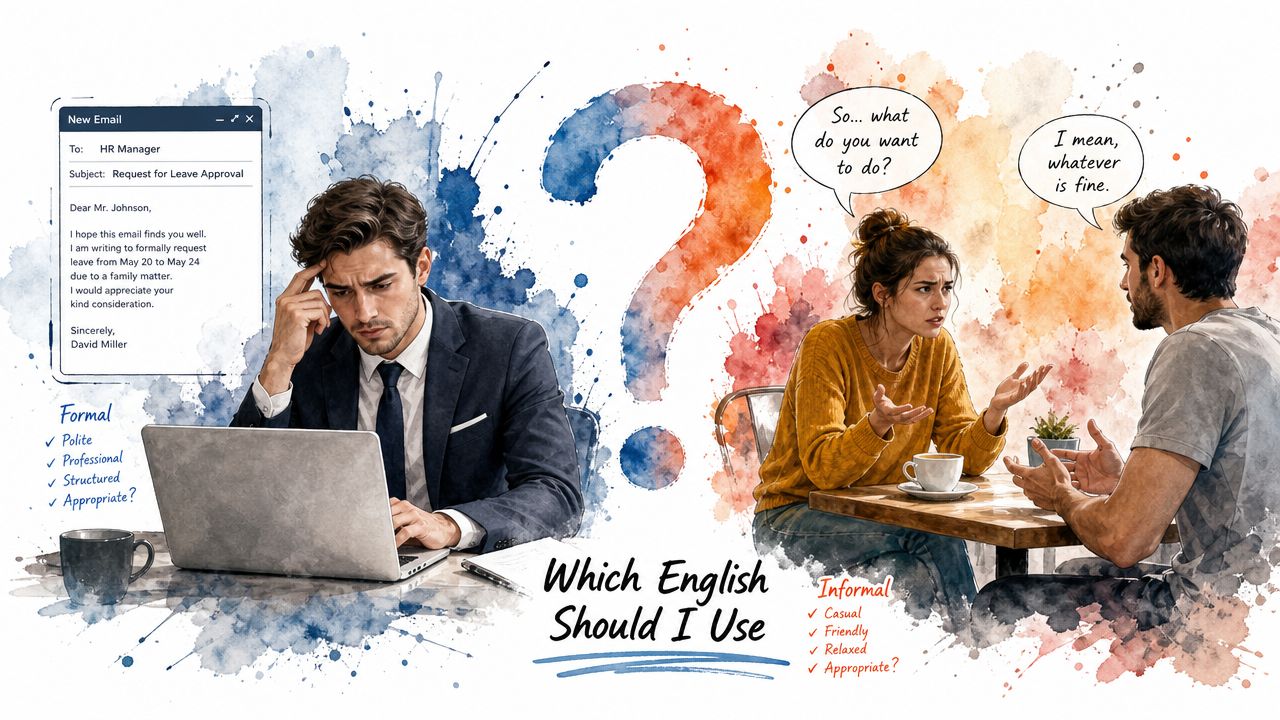
A strong speaker doesn't always use advanced words. A strong speaker chooses the right tone. In a job interview, polite and clear language matters. In a chat with a classmate, too much formality can sound cold or distant. That's why learning what formal language means in everyday English helps many learners make better choices faster.
Register affects meaning
The sentence “Could you assist me with this task?” and the sentence “Can you help me with this?” have the same basic meaning. But they create a different feeling. One sounds more careful and professional. The other sounds more relaxed and direct.
That difference affects how other people respond. Tone can shape trust, comfort, and respect.
Practical rule: If the relationship is new, unclear, or professional, starting slightly more formal is usually safer.
Confidence grows when choices feel clear
Many learners lose confidence because they try to memorize too many rules. A better approach is simpler:
- Think about the person: A teacher, customer, manager, friend, or stranger.
- Think about the setting: Email, meeting, exam, text message, or casual chat.
- Think about the goal: To request, explain, apologize, joke, or connect.
When those three points are clear, formal and informal English become easier to manage. The learner doesn't need perfect speech. The learner needs the right level of speech for the moment.
The Main Differences at a Glance
Formal and informal English often look very different, but the patterns are clear. In this explanation of formal vs. informal writing, formal English uses longer and more complex sentence structures, avoids contractions, and avoids slang. Informal English prefers shorter sentences, contractions, and everyday expressions that keep conversation flowing naturally.
| Feature | Formal English | Informal English |
|---|---|---|
| Vocabulary | More precise, sometimes more official | More common, everyday words |
| Verb choice | “assist,” “require,” “obtain” | “help,” “need,” “get” |
| Contractions | Usually avoided, like “cannot” | Common, like “can't” |
| Slang | Avoided | Often accepted |
| Sentence length | Longer, more structured | Shorter, simpler |
| Tone | Polite, careful, distant | Friendly, relaxed, direct |
| Grammar style | Closer to standard written rules | More flexible in speech |
| Common contexts | Work emails, reports, exams | Friends, chats, casual talk |
Vocabulary changes the feeling
Formal English often uses words that sound more official.
- Formal: “Please inform me if you require further assistance.”
- Informal: “Let me know if you need more help.”
Both are correct. The second version sounds warmer and more natural in daily speech.
A useful pattern is this: formal English often chooses one-word verbs, while informal English often uses common verbs and phrasal verbs.
- Formal: “I will investigate the issue.”
- Informal: “I'll look into it.”
Grammar becomes tighter or looser
Formal English usually follows standard grammar more closely. Informal English is more flexible, especially in speech.
Formal: “I cannot attend the meeting this afternoon.”
Informal: “I can't make the meeting this afternoon.”
Formal: “We do not have sufficient time.”
Informal: “We don't have enough time.”
In casual conversation, native speakers often shorten and soften language. That doesn't mean the speech is careless. It means the style matches the social setting.
A learner doesn't need to sound formal all the time. A learner needs to sound appropriate.
Sentence shape matters too
Formal sentences often carry more information in one line. Informal sentences break ideas into smaller pieces.
Compare these:
Formal: “I would appreciate it if you could send the revised document by Friday.”
Informal: “Could you send me the new version by Friday?”
Formal: “I am writing to request additional information regarding the schedule.”
Informal: “I'm writing to ask for more details about the schedule.”
The meaning stays almost the same. The level of distance changes.
A quick test for learners
When deciding between formal and informal, these questions help:
- Would this sound natural in a meeting?
- Would this sound natural in a text message to a friend?
- Am I using words because they are clear, or because they sound impressive?
If a sentence sounds heavy in a casual moment, it probably needs simpler words. If it sounds too loose in a serious setting, it probably needs cleaner structure.
Choosing Your Style in Different Situations
The right style depends on context. A speaker doesn't need one perfect version of English. A speaker needs range.

In workplace communication, informal exchanges can increase perceived benevolence and closeness, but informality in high-status roles can reduce perceived ability because it may seem to break role expectations, as shown in this workplace communication research on formality, closeness, and perceived ability. That means style is not just about grammar. It is a strategic choice.
At work
At work, a slightly formal style is often safest at first. It helps a speaker sound respectful and organized.
Better choice in a meeting
- “I'd like to add one point.”
- “Could you clarify that deadline?”
- “I haven't finished that task yet, but I'm working on it.”
Too casual for many workplaces
- “Yeah, I'm kinda doing it.”
- “Wait, what do you mean?”
- “I'll get to it later.”
A work conversation can still become warmer. After the main topic ends, the language may soften.
Meeting voice: “Thank you for the update. That's very helpful.”
Post-meeting chat: “Thanks, that really helped.”
That small change sounds natural. It doesn't sound fake.
In exams and interviews
Exams and interviews usually need clear, controlled English. This doesn't mean using difficult words in every sentence. It means avoiding slang, speaking in full thoughts, and sounding polite.
Stronger interview answer
- “I'm interested in this role because it matches my experience and goals.”
Weaker interview answer
- “Yeah, this job seems cool, so I thought I'd try.”
In spoken exams, many learners become too casual because they are nervous. A simple fix is to slow down and use clean sentence openings:
- “In my opinion...”
- “One reason is that...”
- “I would say that...”
These sound natural without sounding stiff.
While traveling
Travel often needs a mixed style. A speaker should be polite with strangers, but not too formal. If the language is too formal, it can sound unnatural in fast, everyday situations.
Natural travel English
- “Excuse me, could you tell me where the station is?”
- “Hi, is this seat free?”
- “Sorry, could you say that again?”
Too formal for a quick travel moment
- “I would be most grateful if you could provide directions to the railway station.”
That sentence is correct, but it sounds heavy for daily conversation. Short and polite usually works best.
With friends and new people
Friends usually expect informal English. New people often start in the middle, friendly but not too relaxed. That balance matters.
A learner who wants more natural casual English can study common colloquial English expressions used in everyday conversation, but context still matters. Casual language should fit the relationship.
Natural with a friend
- “Want to grab coffee?”
- “I'm running late.”
- “That sounds good.”
Too formal with a friend
- “Would you like to have coffee with me later today?”
- “I regret to inform you that I will arrive late.”
If the situation feels unclear, polite and simple is better than dramatic formality or forced slang.
How to Switch Between Formal and Informal Styles
Many learners understand formal and informal English separately, but live conversation doesn't stay in one mode. A meeting becomes small talk. A customer call becomes friendly. A class discussion becomes a joke. Many guides explain the features of each style, but they don't teach the skill of changing register in real-time by listening to tone, pace, and word choice, as noted in this discussion of switching language style in real time.
Notice the signals first
A smooth switch starts with listening. Before changing language, a speaker can watch for signals like these:
- Tone gets warmer: The other person sounds less careful and more relaxed.
- Pace gets faster: Sentences become shorter and more natural.
- Word choice becomes simpler: “assist” changes to “help,” “regarding” changes to “about.”
- The topic changes: Work details move to weekend plans, food, travel, or hobbies.
If the other person says, “Thanks for the update. By the way, did you do anything fun this weekend?” the conversation has moved. The speaker can move too.
Make small changes, not big jumps
Some learners switch too suddenly. That can sound awkward.
A smoother method is to change one layer at a time:
Shorten the sentence
“I would be happy to discuss that further” becomes “Happy to talk more about that.”Use a contraction
“I cannot” becomes “I can't.”Choose a simpler word
“purchase” becomes “buy.”Relax the rhythm
The voice becomes less rigid and more conversational.
That gradual shift sounds more natural than jumping from very formal English to heavy slang.
Use bridge phrases
Bridge phrases help a speaker move between styles without a strange break.
From formal to slightly informal
- “Sure, that makes sense.”
- “That's helpful, thanks.”
- “By the way...”
From informal back to formal
- “To return to the main point...”
- “Just to clarify...”
- “One thing to add is...”
These phrases act like stepping stones. They help the listener follow the change.
A good switch is usually small enough that the listener hardly notices it.
A simple micro-transition example
A manager says, “Could you send me the revised notes this afternoon?”
The employee answers, “Yes, of course. I'll send them by three.”
Then the manager smiles and says, “Thanks. Busy day?”
A natural shift would be, “Yeah, a bit. But it's going fine.”
That answer is not too formal and not too casual. It fits the new moment.
Common Mistakes to Avoid
Small mistakes in register can hurt confidence because they make a speaker feel out of sync with the room. The fix is usually simple once the pattern is clear.
Sounding too casual too soon
This often happens in professional settings, especially when a learner wants to sound friendly.
Don't do this
- “Hey boss, got your message.”
- “No worries, I'll do it later.”
Do this instead
- “Hello, I received your message.”
- “I'll take care of that this afternoon.”
Casual language is not always wrong. It becomes risky when the relationship is formal or the topic is serious.
Sounding formal when warmth is needed
Some learners use textbook English with friends or classmates. The result can sound distant.
Don't do this
- “I apologize for my delayed arrival.”
- “Would you care to join us?”
Do this instead
- “Sorry I'm late.”
- “Do you want to come with us?”
Shorter language often sounds more human in social situations.
Mixing styles in one sentence
This is a very common problem.
Awkward mix
- “I would appreciate it if you could kinda help me with this stuff.”
The sentence starts formal and ends very casual. That mixed signal sounds unstable.
Better options
- Formal: “I would appreciate it if you could help me with this.”
- Informal: “Could you help me with this?”
Using slang without control
Slang can be tempting because it sounds fluent. But forced slang often creates the opposite effect.
A safer goal is natural informal English, not trendy expressions copied from videos. If a learner is not sure how a phrase sounds, it is better to use simple casual language than slang.
- Safer: “That was great.”
- Riskier: A fashionable phrase the learner doesn't fully understand
Practice Speaking Formal and Informal English
Reading helps, but speaking builds control. Learners who do 15 minutes of daily spoken conversation practice show measurable improvement in fluency compared with passive study, because regular vocal output strengthens pronunciation muscle memory, according to this explanation of daily speaking practice and fluency improvement.
Three simple speaking drills
A learner can practice formal and informal English with the same topic twice.
- Job interview version: Introduce personal experience in a clear, professional way.
- Friend version: Introduce the same background in a relaxed, natural way.
- Email to speech version: Write a polite request, then read it aloud and make it sound spoken, not robotic.
A helpful routine is to record both versions. Then compare them. Did the formal version sound clear and polite? Did the informal version sound warm and simple?
Why speaking out loud helps
Silent study can teach rules, but live speaking trains timing. That matters when a conversation suddenly changes from formal to informal. The mouth, ears, and brain need practice together.
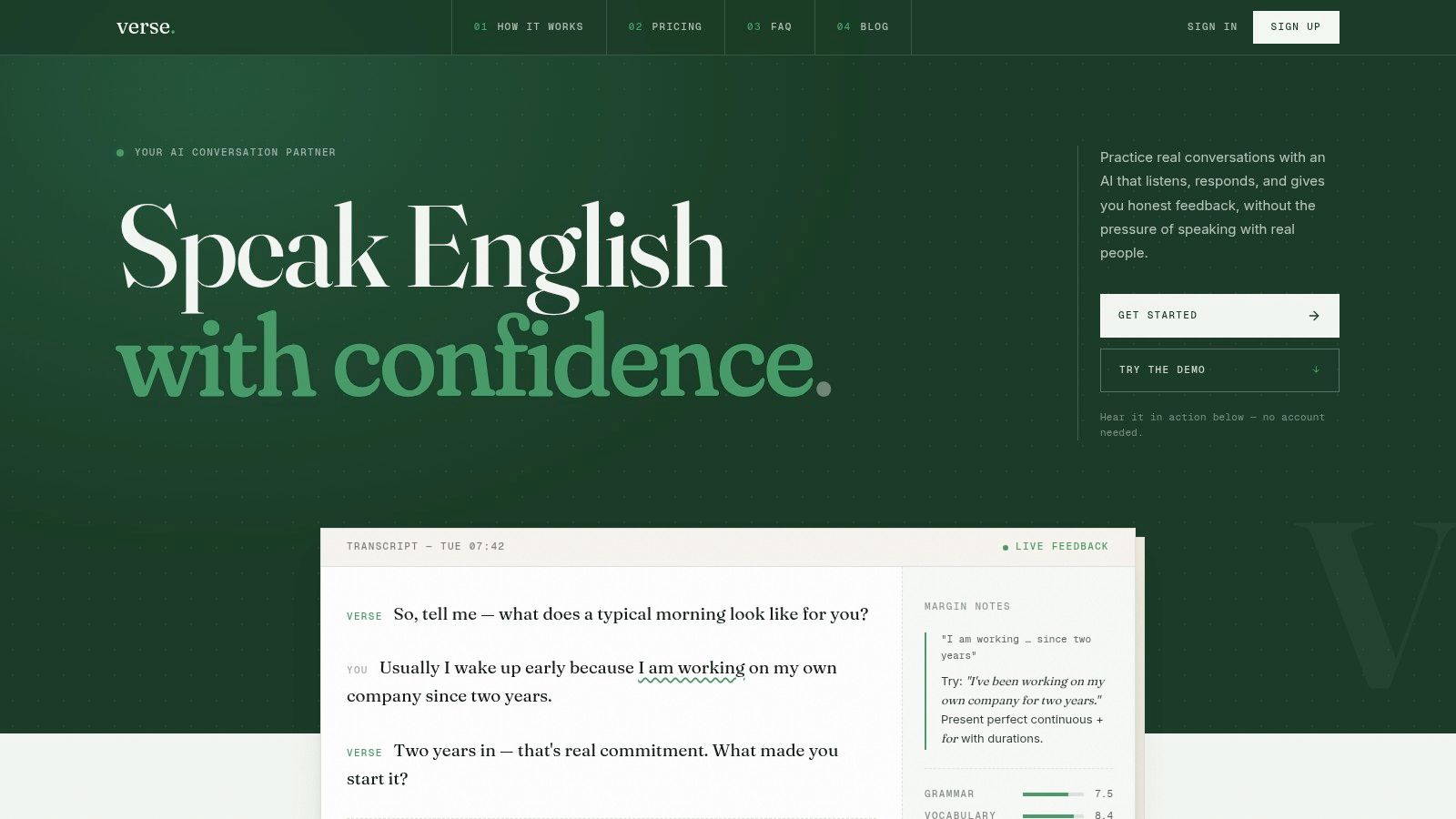
For learners who want more guided speaking work, English speaking practice for daily confidence can give useful structure. Some learners also like practicing with a conversation partner that gives instant feedback after each spoken turn. Verse does that through real spoken practice, with honest, judgment-free feedback on grammar, vocabulary, and fluency. Learners can choose a British, American, or Australian accent, and there's a free, no-signup demo on the homepage. The full service is a paid subscription at $12/month.
The goal isn't to sound perfect. The goal is to feel ready when the room changes. A little daily speaking practice helps formal and informal English feel less like rules, and more like choices.
Keep practicing out loud. A few careful minutes each day can make formal and informal English feel much more natural in real conversation.