Best English Speaking App for Adults: Master Fluency
You might be in this exact situation right now. You can read articles in English, write careful emails, and understand a lot in meetings. But when someone asks you a direct question, your mind goes blank. You know more English than you can say.
That gap is frustrating, especially for adults. You may already have years of study behind you. You may use English for work, travel, study, or daily life. Still, speaking can feel like the weakest part.
You're not alone in that. English is the most widely learned language through mobile apps, and it's used as a native or non-native language by roughly 1.5 billion people, or about 19% of the world's population as of 2023. More than 1.9 billion are non-native speakers, which shows how many adults are trying to build real speaking ability, not just grammar knowledge (English learning statistics).
The good news is simple. Speaking is a skill. It isn't just something you know. It's something you practice. A good English speaking app for adults can give you a private place to do that, especially if you feel nervous, busy, or out of practice. If confidence is your biggest problem, this guide on how to build confidence speaking English is also worth reading.
Table of Contents
- Do You Feel Stuck When It Is Time to Speak English
- Why Speaking Is Different From Studying
- What to Look for in a Great Speaking App
- Choosing an App Based on Your Personal Goals
- How to Build a Consistent Speaking Habit
- Start Your Speaking Practice Today
Do You Feel Stuck When It Is Time to Speak English
Let's start with a common adult learner story. Someone writes clear emails in English every day. Their messages are polite, correct, and professional. Then a live meeting starts, and they suddenly speak in very short sentences. They worry about grammar. They search for words. Their voice gets flat or quiet.
That doesn't mean they're bad at English. It means speaking asks for a different kind of skill.

Many adults carry this silent stress for a long time. They think, "I should be better by now." They compare themselves to coworkers, classmates, or people online. Then they speak less, which makes improvement slower.
Why this happens to adults
As an adult, you usually want to sound correct before you open your mouth. That's understandable. You don't want to sound careless in a meeting, an interview, or a conversation with a stranger.
But speaking doesn't wait for perfection. Real conversation moves fast. You need to choose words, build sentences, pronounce them, and listen at the same time. That can feel overwhelming, even if your reading and writing are strong.
You don't need more shame. You need more safe speaking time.
A speaking app can help because it gives you privacy. You can try again. You can pause. You can notice patterns in your mistakes without feeling watched. For many adults, that private space is the first place where spoken English starts to feel possible.
A better way to think about speaking
Think of speaking like learning a musical instrument. Reading music helps. Understanding rhythm helps. But at some point, your hands have to play.
English works the same way. Studying matters. Listening matters. But if you want your mouth and brain to work together in real time, you need regular practice out loud.
Why Speaking Is Different From Studying
You can read a driving manual and still not know how to drive. The manual teaches rules. Driving teaches action. Speaking English works in the same way.
Studying gives you knowledge. Speaking builds performance. Both matter, but they aren't the same.
A lot of adult learners confuse these two things. They think, "I studied for an hour today, so my speaking should improve." But if that hour was only reading, highlighting, or doing quiet exercises, your brain didn't practice fast spoken output.
Fluency is speed plus control
Fluency doesn't mean speaking like a movie actor. It means you can express your idea without stopping every few words. You may still make mistakes. That's normal.
Confidence doesn't mean feeling calm all the time, either. It means you're willing to speak even when the sentence isn't perfect.
A useful way to picture it is this:
| Part of learning | What it looks like |
|---|---|
| Passive knowledge | You understand words when you see or hear them |
| Active speaking | You produce your own sentence in real time |
| Confidence | You keep going even if the sentence isn't perfect |
A professional gap appears here. A British Council survey summary reported that 73% of adult learners in non-English-speaking countries believed clear pronunciation was necessary for professional success, yet only 30% felt confident in their spoken English at work.
That gap explains why so many adults feel "stuck." They know speaking matters. They just haven't had enough low-pressure practice.
Your mouth needs training too
When you study without speaking, your mouth isn't learning the movements of English. Your ears may recognize a phrase, but your tongue may still struggle to say it smoothly.
That's why adult learners often say, "I know this word, but I can't say it quickly." The problem isn't only vocabulary. It's the habit of turning thought into speech.
Practical rule: If your goal is to speak better, part of your study time must include speaking out loud.
What this means for app choice
An English speaking app for adults should help you produce language, not only recognize it. It should give you chances to respond, explain, describe, compare, and react.
If an app mostly gives fixed answers, short taps, or silent review, it may support your English. But it won't do enough for spontaneous speaking.
What to Look for in a Great Speaking App
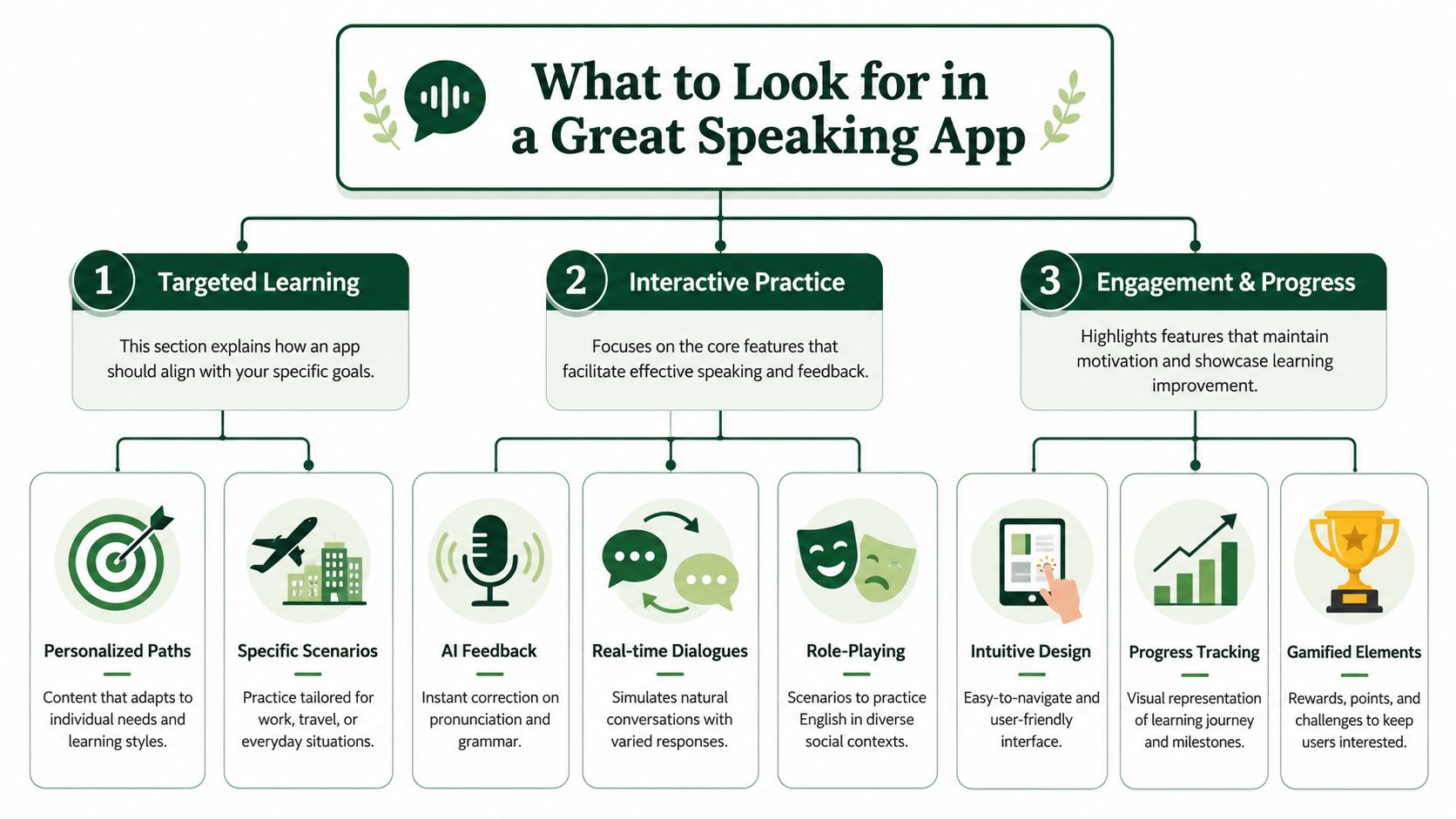
A lot of adults choose an app the wrong way. They look at popularity, design, or how many features appear on the home screen. A better question is this. What problem do you need the app to solve?
For one learner, the problem is fear. For another, it's lack of structure. For someone else, it's poor feedback. The best English speaking app for adults is the one that fits your real obstacle.
Start with emotional safety
Many adults don't need more pressure. They already pressure themselves.
A British Council survey summary found that fear of making mistakes was the biggest barrier to speaking English among adults, cited by over 60% of respondents, even though many already had intermediate reading and writing skills.
That matters when you choose an app. If the app makes you feel watched, rushed, or judged, you may stop using it. A calmer tool often works better because you do return to it.
Look for signs like these:
- Private speaking practice, so you can record and respond without social pressure
- Clear prompts, so you don't waste energy guessing what to say
- A calm feedback style, so corrections feel useful, not harsh
If you want a broader view of this topic, this guide to language learning apps for speaking can help you compare what matters.
Feedback should be specific
General comments aren't enough. "Good job" doesn't teach you much. "Improve grammar" is too vague to act on.
You want feedback that tells you what happened in your sentence. Did you use the wrong tense? Was a word unnatural in that context? Did your sentence sound incomplete?
Good speaking apps often help you notice patterns such as:
- Grammar patterns, like missing articles or verb tense errors
- Word choice issues, such as direct translation from your first language
- Fluency problems, like long pauses or repeated fillers
- Pronunciation notes, especially if a sound changes meaning
When feedback is specific, improvement stops feeling mysterious.
The topics should match your life
Adults stay motivated when practice feels useful. If your real goal is work, exam speaking, travel, or daily small talk, your app should reflect that.
A helpful app doesn't only ask random questions. It lets you practice tasks that sound like real life.
| If your goal is this | The app should give you practice like this |
|---|---|
| Work | Meetings, introductions, explaining decisions, giving updates |
| Travel or relocation | Asking for help, solving problems, everyday conversation |
| Exam preparation | Timed answers, opinion questions, describing experiences |
| Confidence building | Easy topics, short turns, repeat practice |
Ease of use matters more than people think
A complicated app can kill a good habit. If it takes too many steps to start speaking, busy adults often skip practice.
Notice whether the app lets you begin quickly, review old sessions easily, and see your progress without confusion. Small design choices matter because they affect whether practice becomes part of your day or stays on your to-do list.
Choosing an App Based on Your Personal Goals
The easiest way to choose well is to stop asking, "What is the best app?" Ask, "What is the best app for me right now?"
Your answer depends on your goal, your schedule, and your personality. The same tool can feel excellent for one learner and wrong for another.
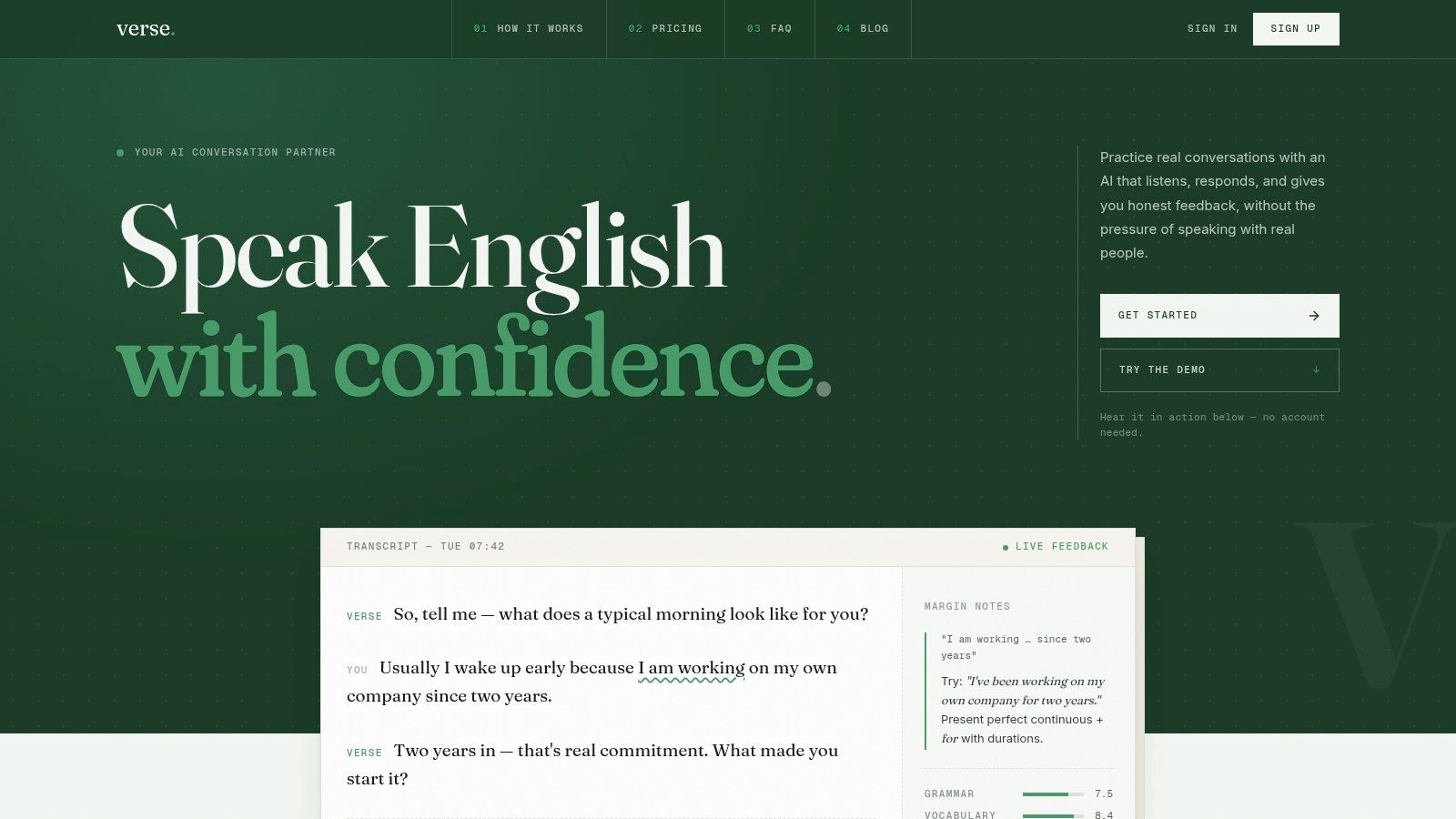
The busy professional
Ana works in finance. She reads English reports every day and writes polished messages. Her problem is live speaking. In meetings, she needs to explain ideas quickly and respond without long pauses.
Ana shouldn't choose an app mainly for entertainment. She needs one that gives business-like prompts, short practice sessions, and clear correction after each response.
Research summarized here notes that adult learners improve speaking fluency most when they receive specific, turn-by-turn feedback on grammar and word choice, rather than only general correction or scripted exercises. For a learner like Ana, that kind of feedback is more useful than broad scores alone.
Her checklist might look like this:
- Work topics first, not random conversation
- Fast feedback after each turn, so she can fix patterns quickly
- Session history, so she can review repeated mistakes before meetings
The exam-focused student
Ravi is preparing for an English speaking exam. He doesn't need endless casual chat. He needs timed answers, clear structure, and practice staying calm under pressure.
For him, a good app should help him answer common speaking tasks such as giving opinions, describing past experiences, or explaining a chart. He should also look for an app that lets him repeat similar tasks several times, because repetition builds control.
The right app isn't always the one with the most features. It's the one that matches the pressure you'll face outside the app.
The shy learner who avoids speaking
Mina understands a lot of English, but she hates speaking in front of people. She worries that her voice sounds awkward. She edits every sentence in her head before she says it.
Mina needs a low-pressure environment more than anything else. She may do better with private speaking practice first, then move slowly toward longer answers and more open-ended conversation.
A simple test can help before paying for anything. Try a short, no-signup demo if one is available. Notice your emotional reaction. Do you feel tense, judged, or confused? Or do you feel able to keep going? That first feeling tells you a lot.
How to Build a Consistent Speaking Habit
Choosing the right app matters. Using it regularly matters more.
Many adults wait for long free hours that never arrive. Then they feel guilty and do nothing. A better plan is smaller and more realistic.
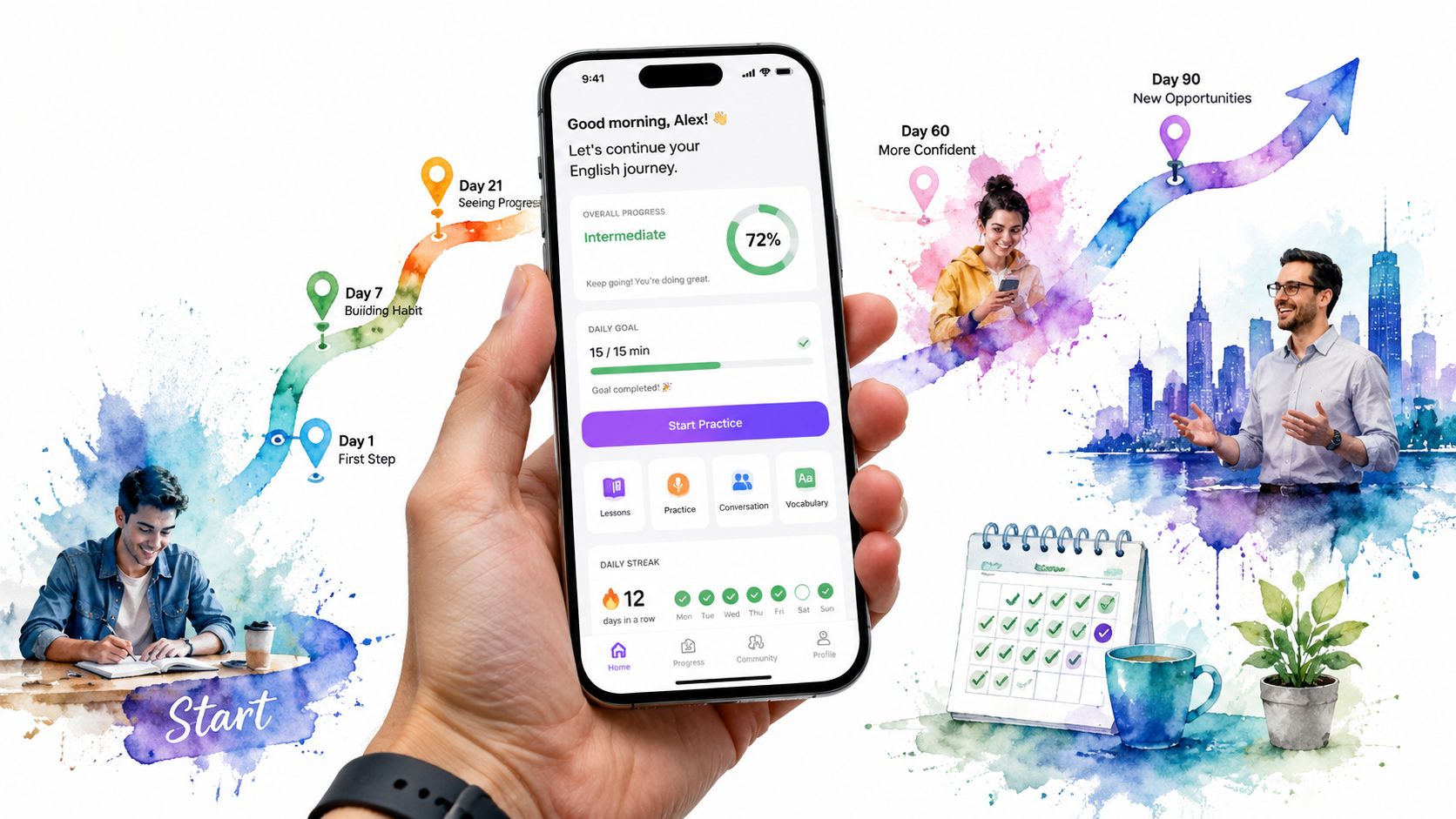
Research suggests adults from non-English-speaking countries often need 200 to 600 hours of guided practice to reach B2 to C1 levels, yet many articles still talk about either "a few minutes a day" or full immersion without giving a real plan. That's why habit building matters. Progress comes from steady practice that fits real life. This article on living the language every day can help you make English part of your routine.
A simple weekly pattern
You don't need a perfect routine. You need one you can repeat.
Try this structure:
Choose a small daily time
Start with 5 to 10 minutes. That's enough to build the habit. If you begin with a plan that feels heavy, you're less likely to continue.Use easy topics first
Talk about your day, your work, your plans, or something you watched. Easy topics remove the extra stress of inventing ideas.Focus on one correction at a time
If the app gives feedback on grammar, vocabulary, and fluency, don't try to fix everything at once. Pick one issue for the next session.Repeat useful scenarios
Repeating a topic isn't boring if your goal is speaking. It helps your brain build speed. Try the same type of answer again with small improvements.
Keep the habit light, but serious
Many adults fail because they treat practice in one of two extreme ways. Either they make it too casual, or they make it too intense.
A better middle ground looks like this:
- On busy days, do one short speaking turn instead of skipping completely
- On calmer days, do a longer session and review old mistakes
- At the end of the week, notice one thing that feels easier now
Small sessions count. Consistency teaches your brain that speaking English is a normal activity, not a special performance.
Make progress visible
Adults stay motivated when they can see proof of effort. Keep a small note after each session. Write down the topic, one mistake pattern, and one sentence you want to say better next time.
You can also set weekly goals such as:
| Weekly goal | Example |
|---|---|
| Minutes practiced | Speak out loud on most weekdays |
| Topic range | Practice work, daily life, and opinion questions |
| Feedback focus | Work on articles this week, then fluency next week |
| Review habit | Revisit one old session before starting a new one |
This kind of tracking doesn't need to be fancy. It just needs to remind you that you're building a skill over time.
Start Your Speaking Practice Today
If speaking still feels hard, that doesn't mean you're failing. It usually means you need more real speaking practice, in the right format, with feedback you can effectively use.
A good English speaking app for adults should fit your life, not fight it. It should lower pressure, give specific correction, and help you practice topics that matter to you. That's how speaking becomes more natural. Not overnight, but session by session.
Start small. Speak out loud today, even if it's only for a few minutes. One honest answer is better than one more silent study session.
If you'd like a calm place to practice spoken English, Verse offers private AI conversations with honest, judgment-free feedback on grammar, vocabulary, fluency, and British-accent coaching. You can try the free no-signup demo on the website and see whether it feels like a good fit for your daily speaking practice.