Business English Conversation: A Guide to Confident Speaking
You join a video call a few minutes early. Your notes are open. You know your topic. But when the first person says, “So, shall we get started?”, your mind goes blank.
If that feels familiar, you're not behind. You're dealing with a very normal part of learning Business English conversation. Real conversations move fast. People interrupt politely, change direction, pause, joke, and expect quick responses. That's hard, even when your grammar is quite good.
The good news is that this skill can be trained. You don't need perfect English. You need a clear process for starting, joining, and managing a conversation, one step at a time.
Table of Contents
- Why Business English Conversations Matter More Than Ever
- Plan Your Conversation for Success
- Useful Phrases to Start Any Business Conversation
- Sustain the Flow and Participate Actively
- Avoid Common Mistakes and Improve Your Fluency
- Create a Consistent Practice Routine That Works
Why Business English Conversations Matter More Than Ever
A lot of learners think, “I only need better vocabulary.” Usually, that isn't the full problem. In work situations, spoken English affects meetings, client calls, interviews, updates, and teamwork. You may know the right words, but still feel nervous when you have to say them out loud at the right moment.
That pressure makes sense. English is now central to international work. The global Business English Language Training Market is projected to grow from USD 23,105.17 million in 2026 to USD 54,074.32 million by 2035, which is over 134% growth in less than a decade, according to this business English training market projection. That kind of growth tells us something simple. More professionals need spoken English for real business situations.

For many readers, this isn't about sounding impressive. It's about sounding clear, calm, and professional. It's about being able to explain an idea, disagree politely, or ask a useful question without freezing.
If confidence is your main problem, this guide on how to build confidence when speaking English can help alongside your conversation practice.
What strong conversation skills really look like
Business English conversation is more than opening a meeting with a polite sentence. It includes skills like:
- Starting clearly, so people know why you're speaking.
- Following the discussion, even when the topic changes quickly.
- Joining at the right moment, without sounding rude.
- Handling silence well, instead of panicking.
- Closing smoothly, so next steps are clear.
You don't need to sound like a native speaker. You need to help the conversation move forward.
That's a learnable skill. When you treat conversation as a process, not a performance, it becomes much easier to practise.
Plan Your Conversation for Success
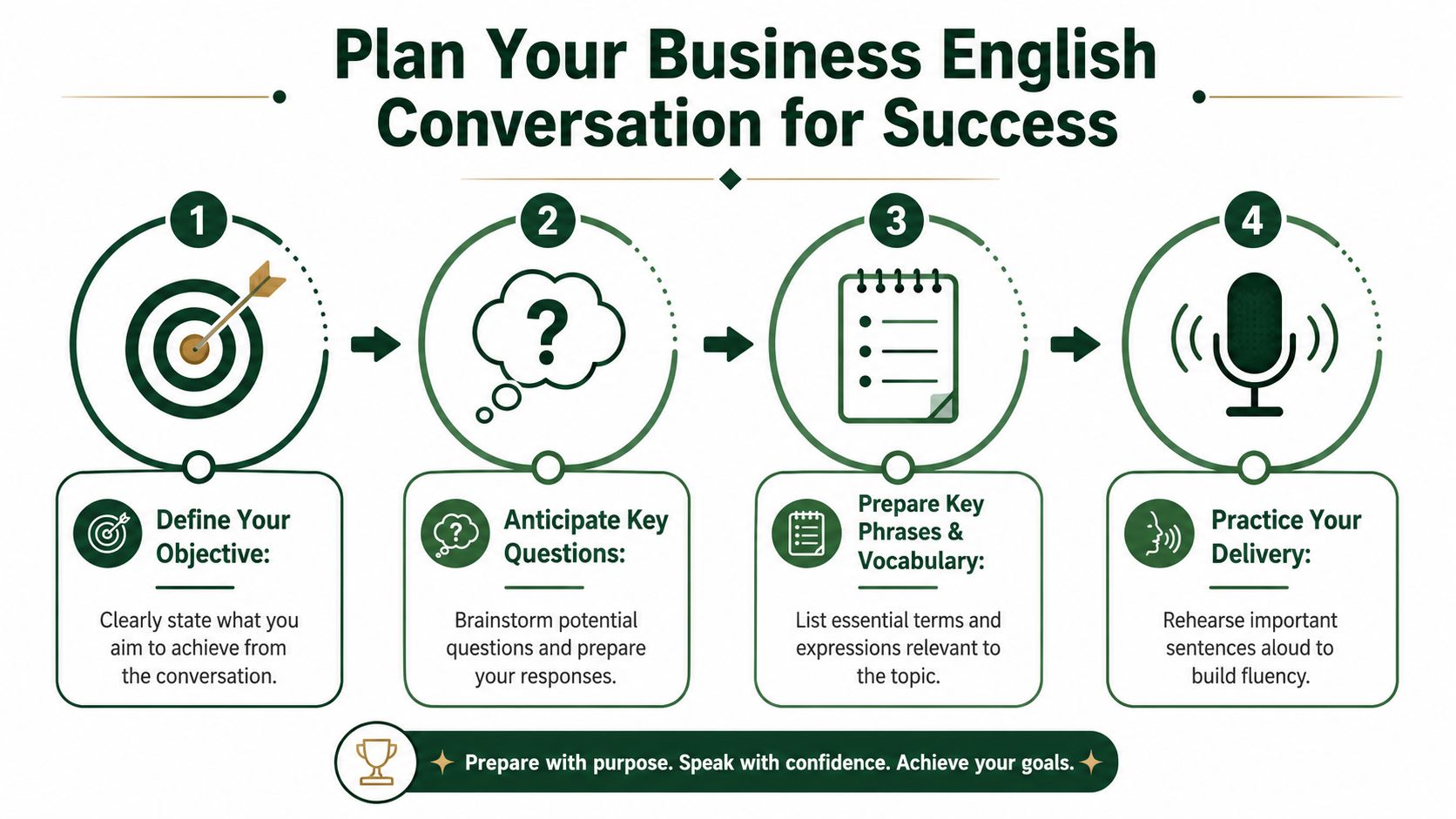
Many speaking problems start before the conversation begins. You feel nervous because you haven't decided what you want to say, what the other person may ask, or how formal you need to be.
A simple plan fixes a lot of that.
A structured needs analysis helps you identify your industry context, your communication challenge, and the level of formality you need. That matters because 67% of executives report that miscommunications caused by language barriers directly create workplace inefficiency, as explained in this article on English proficiency for employees.
Decide your real goal
Before a call or meeting, ask yourself one question.
What do I need from this conversation?
Your answer changes your language. Compare these goals:
- To inform. “I need to explain the project delay.”
- To ask. “I need to get approval for a budget change.”
- To build trust. “I need to make a good first impression with a new client.”
- To solve a problem. “I need us to agree on the next step.”
If your goal is vague, your speaking often becomes vague too.
Think about the people in the conversation
The same English sentence can sound too direct in one situation and too weak in another. That's why audience matters.
Ask yourself:
- Who are they? A manager, customer, colleague, or partner?
- How well do I know them? First meeting or regular contact?
- How formal is the setting? Team chat, interview, negotiation, or presentation?
For example, “I need that today” may be fine in a close team under pressure. In a more formal setting, “Would it be possible to have that by the end of today?” is safer.
Practical rule: Match your language to the relationship, not just the topic.
Prepare vocabulary that fits the situation
Don't try to memorise a huge list of business words. That usually creates stress. Instead, prepare a small set of useful language for one conversation.
Write down:
- Key terms you'll probably need, such as deadline, budget, shipment, feedback, approval, or revision.
- Useful verbs like confirm, clarify, recommend, suggest, postpone, or prioritise.
- Support phrases that help you manage the conversation, such as “Let me rephrase that” or “Could I clarify one point?”
Then say them aloud. Speaking preparation is different from silent study. Your mouth needs practice too.
If you want more support with that part, these ways to improve English speaking skills are useful because they focus on active speaking, not only reading.
Make a short pre-meeting note
You don't need a full script. A script can make you sound stiff. Use a short note with four lines:
| Line | What to write |
|---|---|
| 1 | Your main goal |
| 2 | Two likely questions |
| 3 | Five useful words or phrases |
| 4 | Your first sentence |
That last line is important. If you already know how you'll begin, your stress drops quickly. Very often, the hardest part is only the first ten seconds.
Useful Phrases to Start Any Business Conversation
Starting is often the most uncomfortable moment. You haven't found the rhythm yet. You're choosing your tone. You're trying to sound natural and professional at the same time.
The easiest way to improve this part is to keep a small set of opening phrases ready for common situations. Don't memorise too many. Choose a few that feel natural in your mouth, then practise them aloud until they sound easy.
Business conversation openers
| Situation | Formal Phrase Example | Informal Phrase Example |
|---|---|---|
| Scheduled meeting | “Thank you for joining today. Shall we begin?” | “Hi everyone, shall we get started?” |
| First introduction | “It's a pleasure to meet you. I'm responsible for the marketing team.” | “Nice to meet you, I'm on the marketing team.” |
| Follow-up call | “I'm calling to discuss the next steps from our previous conversation.” | “I wanted to follow up on what we discussed last time.” |
| Networking event | “What kind of work are you focused on at the moment?” | “What are you working on these days?” |
| Small talk before business | “How has your week been so far?” | “How's your week going?” |
| Joining a conversation | “May I add something here?” | “Can I jump in for a second?” |
How to choose the right opener
A good opener does one of three jobs:
- It begins the task, such as starting a meeting.
- It opens the relationship, such as small talk or an introduction.
- It creates space for your voice, such as joining a group discussion.
If you're not sure which style to use, start slightly more formal. It's easier to become warmer later than to fix an opening that sounded too casual.
Here's a simple example.
A formal opening:
“I'm glad we could meet today. I'd like to review the timeline and discuss the next steps.”
A more relaxed opening:
“Thanks for making time today. I thought we could go over the timeline and see what needs attention next.”
Both are correct. The difference is tone.
Practise the first line, not just the phrase
Many learners read a phrase and think, “Yes, I know that.” But recognition isn't the same as speaking. You need to hear your own voice say it.
Try this:
- Read the line once
- Say it from memory
- Change one word
- Say it again with a calm tone
That small change helps you sound less robotic.
If introductions are hard for you, this page on different ways to say nice to meet you gives you more natural options for first meetings.
A strong opening doesn't need to be clever. It needs to be clear.
Sustain the Flow and Participate Actively
This is the part many learners struggle with most. Starting is manageable. Preparing is manageable. But once the conversation becomes fast, messy, or unpredictable, confidence can disappear.
That's especially true in group meetings. A 2025 Harvard Business Review study found that 59% of non-native professionals avoid contributing in meetings because they fear “disrupting flow,” while only 12% of Business English platforms teach “soft entry” techniques for multicultural contexts, as noted in this discussion of business English conversations and soft entry.
Use soft entry instead of hard interruption
A lot of learners think they have only two choices. Stay silent, or interrupt strongly. There's a middle option.
Soft entry means joining the conversation with language that sounds respectful and cooperative. You're not stopping the flow. You're entering it carefully.
Try phrases like these:
- To connect to the last speaker: “That's a good point, and I'd like to add something.”
- To suggest gently: “I wonder if we could look at it another way.”
- To enter with care: “Could I come in on that point?”
- To build, not oppose: “I agree with part of that, and I think we should also consider the timeline.”
These phrases work well because they show listening first. Then they create space for your idea.
Treat silence as thinking time
Silence often feels dangerous to non-native speakers. You may think, “I must say something now or I will look unprepared.” Usually, that isn't true.
A short pause can help everyone think. In many business situations, a calm pause sounds thoughtful.
If you need a moment, use a holding phrase:
- “Let me think for a second.”
- “That's a good question.”
- “I'd like a moment to consider that.”
- “Let me put that clearly.”
These phrases do an important job. They protect your thinking time without making the silence awkward.
Silence isn't always a problem. Sometimes it's where the better answer begins.
Keep the conversation moving with follow-up language
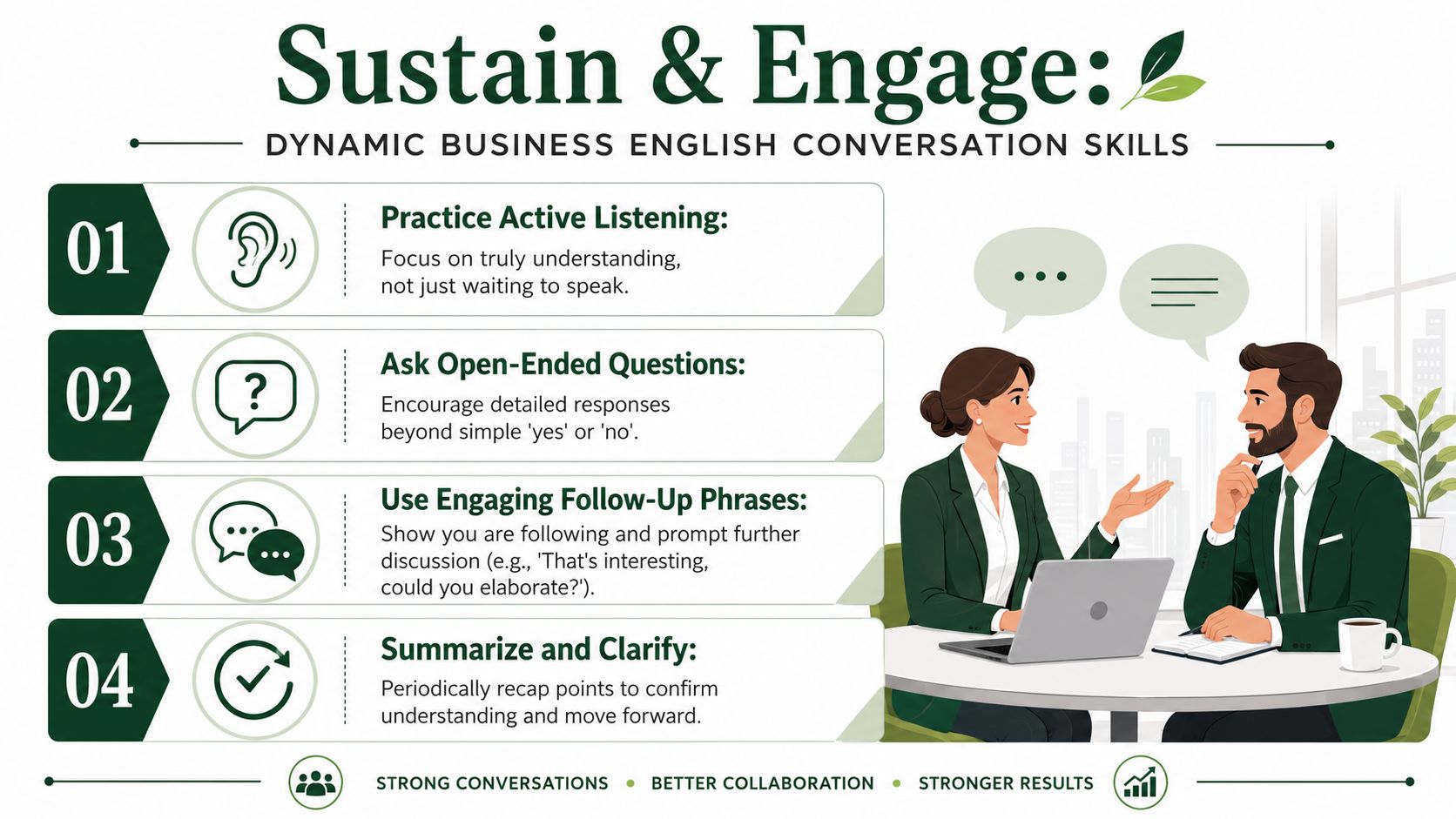
When you don't know what to say next, ask a useful follow-up question or reflect the last idea back.
Here are three easy ways to do that.
Ask for more detail
This helps when someone says something general.
- “Could you expand on that a little?”
- “What would that look like in practice?”
- “Could you give an example?”
Check understanding
This is useful when the discussion is moving quickly.
- “So, if I understand correctly, the priority is the client deadline.”
- “Just to make sure I'm following, are we discussing the first option or the second?”
- “Can I check one detail before we continue?”
Summarise and move forward
This is one of the best skills in business English conversation. It shows leadership, even if your English is not perfect.
- “So far, we agree on the goal, but not the schedule.”
- “It sounds like we have two main concerns.”
- “To summarise, we need to confirm the budget and assign responsibilities.”
Show active listening in a visible way
In real business conversations, listening is not silent. People need signals that you understand them.
Use short responses like:
- “Right.”
- “I see.”
- “That makes sense.”
- “Understood.”
- “Exactly.”
Then add one sentence that proves you were listening. For example:
“That makes sense. The timing seems to be the main issue.”
That second sentence matters more than the first one.
A simple rescue plan for fast discussions
If a meeting gets too fast, use this order:
Enter softly
“Could I add something here?”Anchor to the topic
“I think the delivery schedule is the key issue.”Say one clear point
“If we change the timeline now, the client needs to know today.”Invite response
“Does that sound reasonable?”
This structure is simple, but it works. It helps you contribute without trying to say everything at once.
Avoid Common Mistakes and Improve Your Fluency
Many learners feel stuck at the same level for a long time. They can communicate, but not as easily as they want. Their ideas are better than their spoken English.
That plateau is common. Some learners remain at B1 level because their English is too dependent on familiar situations, and this can limit them to 80 words per minute or less, with frequent errors. Reaching a higher level requires more spontaneous and precise expression, according to this explanation of B2 and C1 business proficiency.
The important point is not “I'm failing.” The point is “I need to move from memorised English to flexible English.”
Try this, not that
Below are a few common business speaking problems and better alternatives.
| Instead of this | Try this |
|---|---|
| “I am agree.” | “I agree.” |
| “We discussed about the issue.” | “We discussed the issue.” |
| “I have a doubt.” | “I have a question” or “I'm not sure about that point.” |
| “We should to review it.” | “We should review it.” |
| “I will explain you the process.” | “I will explain the process to you.” |
| “I didn't understood.” | “I didn't understand.” |
These errors are normal. Many come from direct translation from your first language.
Fluency is not the same as speed
Some learners try to sound fluent by speaking faster. That usually creates more mistakes and more stress.
Fluency in business English conversation means:
- Your ideas connect clearly
- Your pauses happen in natural places
- Your listener can follow you easily
- Your tone fits the situation
A slower, clear speaker often sounds more professional than a fast, unclear one.
Work on chunks, not single words
A useful way to improve fluency is to learn word chunks, which are short groups of words often used together.
For example:
- “From our point of view”
- “The main issue is”
- “What I'd suggest is”
- “Could we take a step back”
- “Just to clarify”
When you learn chunks, you don't need to build every sentence from zero. That reduces pressure in live conversation.
If you always search for one perfect word, your speaking slows down. If you learn phrases in groups, your speaking becomes smoother.
Improve pronunciation with sentence stress
You don't need a perfect accent. You do need clear stress. Sentence stress means giving more energy to the important words.
Compare these two versions:
- flat: “we need to review the report before friday”
- clear: “We need to review the report before Friday.”
Stress helps listeners catch your meaning quickly. It also makes you sound more natural.
A simple practice method:
- Choose one short business sentence.
- Underline the two important words.
- Say it three times.
- Record yourself.
- Listen for clarity, not perfection.
Honest, specific feedback can help a lot here, especially on grammar, vocabulary, and fluency patterns you may not notice by yourself.
Create a Consistent Practice Routine That Works
The biggest improvement usually comes from regular speaking, not occasional study. Long study sessions can feel productive, but they're hard to maintain. Short practice is easier to repeat, and repetition matters.
One useful benchmark is this: practising for 15 minutes a day for two weeks on one high-stakes scenario can create a noticeable difference in workplace performance, helping professionals become confident across six to eight key situations over one quarter, based on this article on business English conversation practice.
Build your routine around real situations
Don't practise random topics every day. Choose situations that matter in your work.
For example:
- Monday, giving a project update
- Tuesday, joining a group discussion
- Wednesday, asking for clarification
- Thursday, giving polite feedback
- Friday, handling a difficult question
That gives your practice structure. It also makes progress easier to notice.
Use a simple weekly pattern
A routine doesn't need to be complicated. Try this:
Pick one scenario
Example: negotiating a deadline.Write five useful phrases
Keep them short and realistic.Speak for 15 minutes a day
Answer questions aloud. Repeat key lines. Try different versions.Review your weak points
Notice where you hesitate, translate in your head, or lose grammar control.Repeat the same scenario for two weeks
Familiarity builds confidence.
This kind of repetition is not boring when the topic matters to your real life. It helps your speaking become automatic.
Focus on out-loud practice
Reading helps. Listening helps. But business English conversation improves when you speak.
If live practice feels stressful, private speaking practice can be a good place to start. Many learners speak more openly when they don't feel judged. That makes it easier to notice habits, correct errors, and try again.
If you want a calm place to practise spoken English for work, Verse is built for that. You can speak out loud, get honest feedback on grammar, vocabulary, fluency, and pronunciation, and practise difficult business situations privately. If you want to test the experience first, you can also try Verse's free no-signup demo.